


Evaluation of hydrocarbon source rocks and oil-source correlation of the Chang 7 and Chang 6 Members of the Yanchang Formation in the Jingbian area, Ordos Basin
-
摘要: 鄂尔多斯盆地靖边地区延长组7段(长7段)与延长组6段(长6段)是该区重要的烃源岩层系。然而,目前关于这2套烃源岩的生烃潜力及其对油气成藏贡献的系统研究仍较为薄弱,制约了该区勘探工作的进一步深化。此次研究运用地球化学分析手段,系统刻画了靖边地区长7段与长6段烃源岩的展布特征与地球化学性质,并分析了靖边油田延安组9段(延9段)和延长组2段(长2段)原油的地球化学特征。通过对比该区域长7段、长6段烃源岩与湖盆中心张家滩页岩的地球化学指标,明确了延9段和长2段油藏原油的潜在来源。研究结果表明:长7段烃源岩属中等–优质烃源岩,分布广、厚度大,有机质类型以Ⅰ–Ⅱ2型为主,处于成熟阶段。生物标志物特征显示其母质为混合生源输入,沉积环境偏还原、水体盐度较低。较低的Pr/Ph比值与较高的C27/C29规则甾烷比值(C27/C29R)指示长7段烃源岩有机质以水生藻类等低等生物为主,形成于还原性的淡水–微咸水环境。长6段烃源岩为中等–好烃源岩,有机质类型以Ⅱ2–Ⅲ型为主,整体处于低熟–成熟阶段;中等的Pr/Ph比值与较低的C27/C29R则反映其有机质以陆源高等植物输入为主,沉积环境为弱还原环境。油–源对比结果表明,延9段与长2段原油为同源油,主要来源于靖边地区长7段烃源岩,但长6段烃源岩亦存在一定贡献。湖盆中心张家滩页岩的地球化学特征与延9段、长2段原油差异显著,进一步支持原油主要为本地烃源岩所供烃。此次研究为鄂尔多斯盆地靖边地区油气勘探方向优选与资源潜力评价提供了关键地球化学依据。Abstract:
Objective The Chang 7 and Chang 6 Members of the Yanchang Formation in the Jingbian area of the Ordos Basin are important source rock intervals. However, systematic studies on their hydrocarbon generation potential and contributions to hydrocarbon accumulation remain limited, which has hindered further exploration efforts in this region. Therefore, this study applies geochemical analytical methods to systematically characterize the distribution and the geochemical properties of the Chang 7 and Chang 6 source rocks in the Jingbian area. In addition, the geochemical signatures of the crude oils from the Yan 9 and Chang 2 reservoirs in the Jingbian Oilfield were investigated. Methods By comparing the geochemical parameters of the Chang 7 and Chang 6 source rocks in the study area with those of the Zhangjiatan Shale in the basin center, the potential sources of the Yan 9 and Chang 2 reservoir oils were identified through oil–source correlation. Results The Chang 7 source rocks are moderate to excellent-quality source rocks, characterized by wide distribution, large thickness, Type Ⅰ–Ⅱ2 kerogen, and a mature thermal evolution stage. Biomarker characteristics indicate mixed organic matter inputs and deposition under reducing conditions with relatively low salinity. Low Pr/Ph ratios and high C27/C29 regular sterane ratios suggest that the organic matter was predominantly derived from aquatic algae and other lower organisms and accumulated in a reducing freshwater to brackish-water depositional environment. In contrast, the Chang 6 source rocks are moderate to good-quality source rocks, dominated by Type Ⅱ2–Ⅲ kerogen, and generally at the low-maturity to mature stage. Moderate Pr/Ph ratios and relatively low C27/C29 regular sterane ratios indicate a predomint innput of terrigenous higher plantsand deposition under weakly reducing conditions. Oil-source correlation results reveals that the Yan 9 and Chang 2 crude oils have the same originand were primarily sourced from the Chang 7 source rocks, with a minor contribution from the Chang 6 source rocks. The distinct geochemical characteristics of the Zhangjiatan Shale compared with the Yan 9 and Chang 2 crude oils further suggest that the Zhangjiatan Shale was not the major hydrocarbon source for these oils. Conclusions (1) The Chang 7 Member is the primary and high-quality source rock in the Jingbian area, exhibiting advantages over the Chang 6 Member in terms of thickness, lateral distribution, organic matter abundance, and hydrocarbon generation potential. (2) Distinct biomarker signatures differentiate the Chang 7 (aquatic/algal-derived organic matter under reducing conditions), Chang 6 (terrigenous organic matter under weakly reducing conditions), and Zhangjiatan Shale (highly aquatic organic matter under strongly reducing conditions) source rocks. (3) The Yan 9 and Chang 2 crude oils share a common origin and were primarily sourced from local Chang 7 source rocks, with possible minor contributions from the Chang 6 source rocks. These oils show no direct genetic relationship with the Zhangjiatan Shale in the basin center, supporting a predominantly local hydrocarbon charging model in the Jingbian area. [ Significance ] This study provides critical geochemical evidence for understanding the local hydrocarbon system, resolving uncertainties regarding oil sources, and evaluating exploration potential in the Jingbian area of the Ordos Basin. -
Key words:
- Ordos Basin /
- Jingbian area /
- source rock evaluation /
- biomarkers /
- oil-source correlation
-
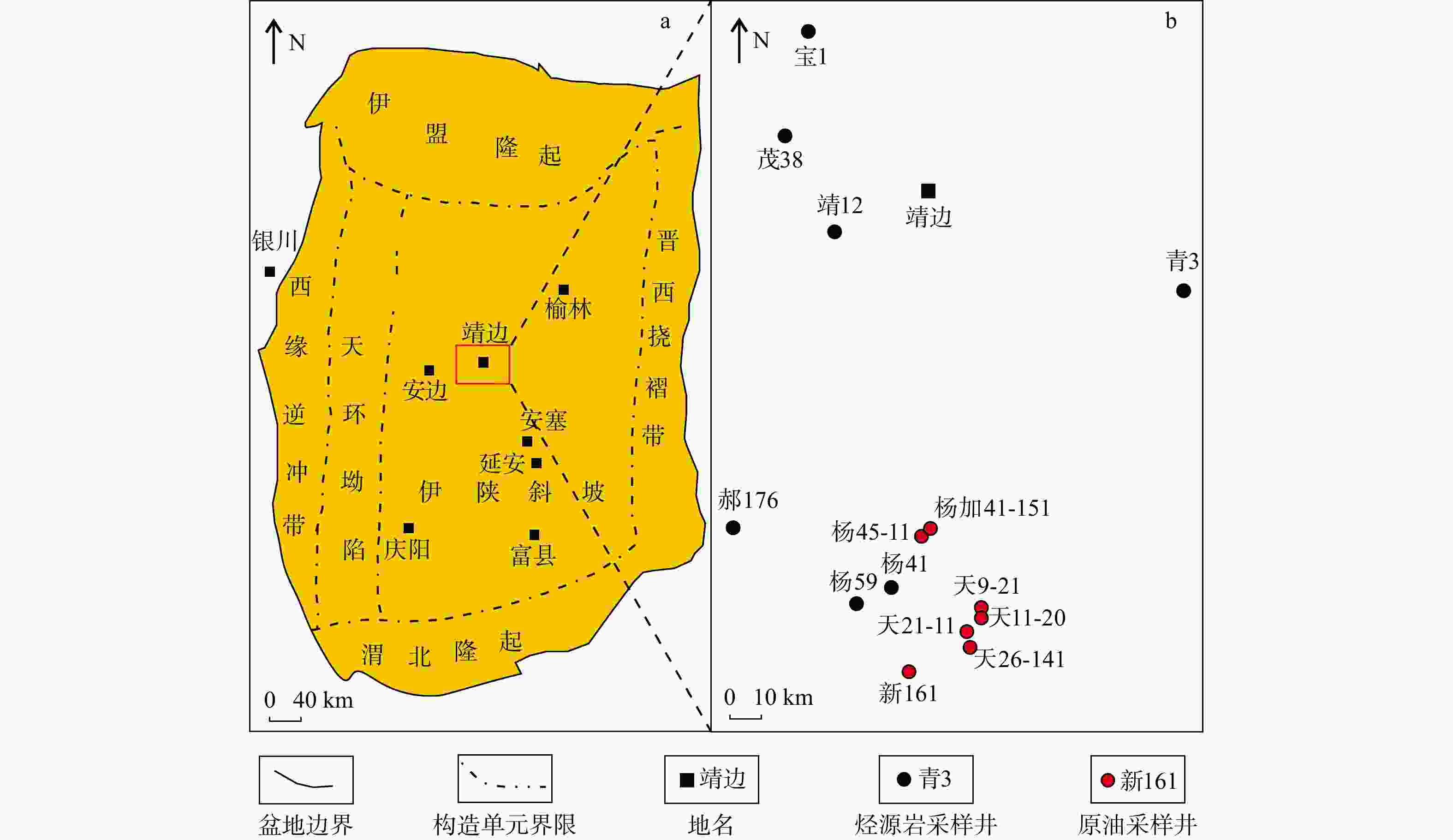
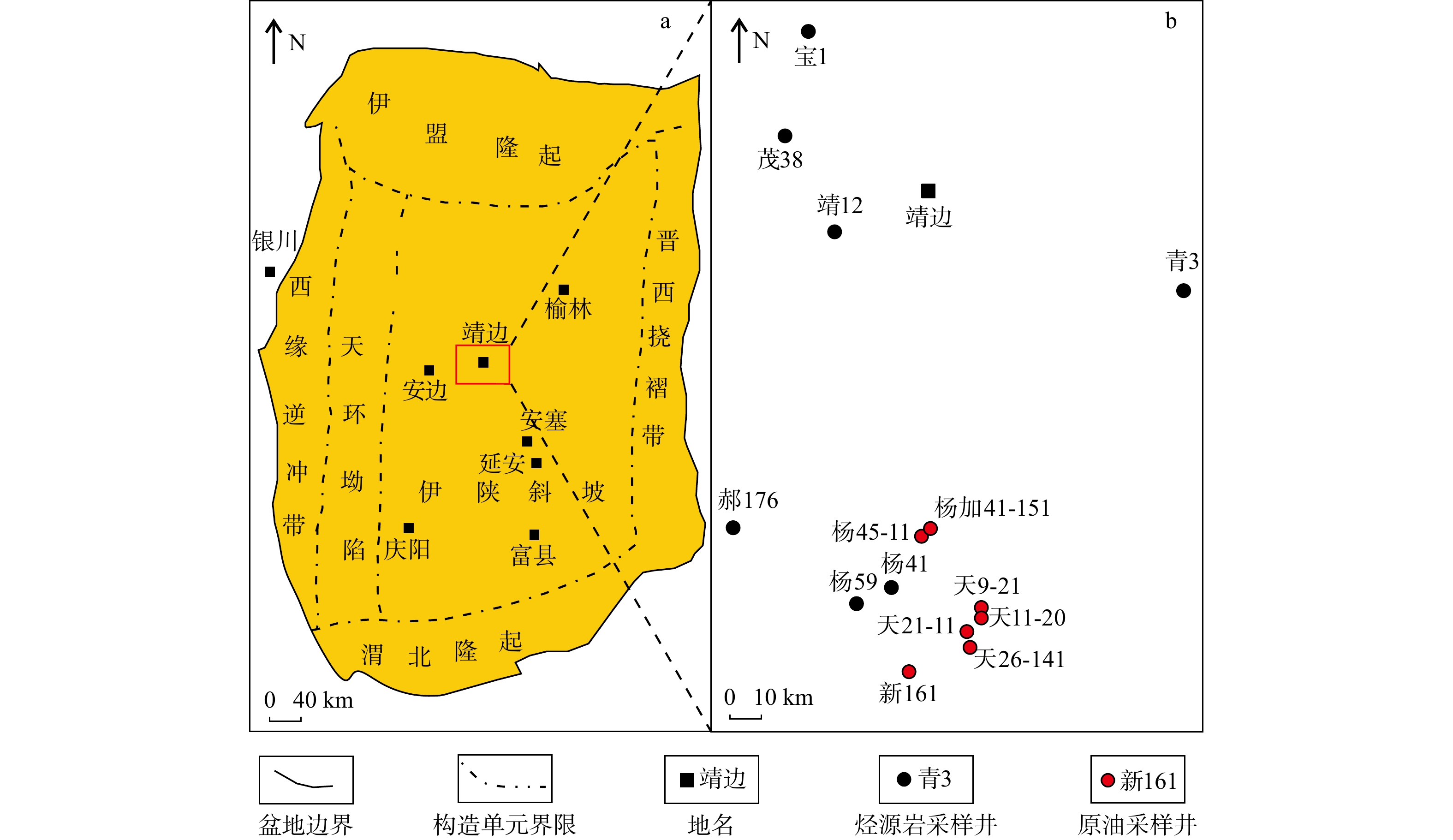
图 1 研究区地理位置图和样品分布图
a—研究区地理位置图;b—研究区样品分布图
Figure 1. Geographical location and sample distribution of the study area
(a) Geographical location map of the study area; (b) Sample distribution map of the study area
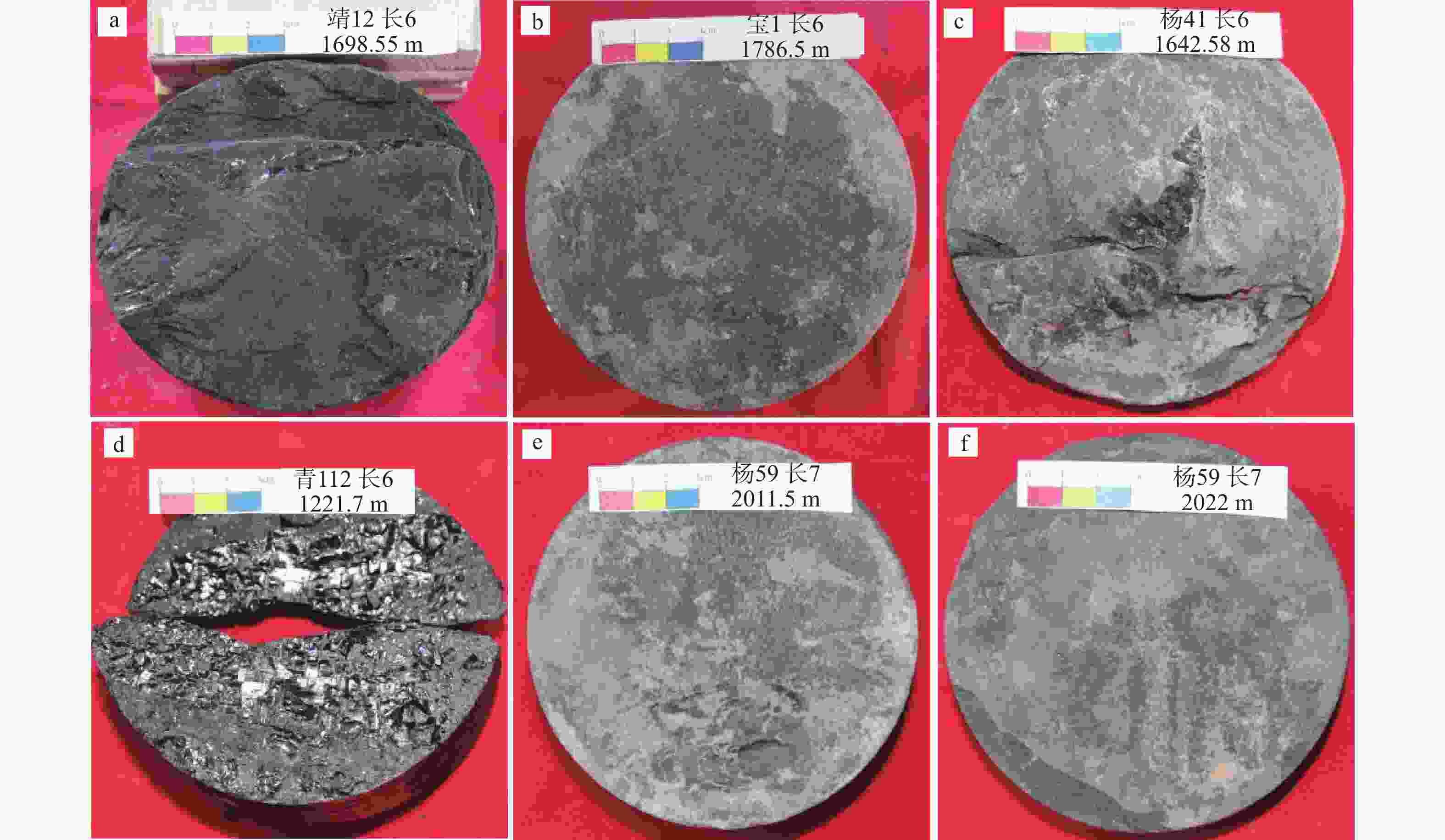
图 2 研究区烃源岩岩性特征
a—黑色泥岩;b—含砂泥岩;c—灰黑色泥岩;d—黑色煤屑;e—灰黑色泥岩;f—深灰色泥岩
Figure 2. Lithological characteristics of hydrocarbon source rocks in the study area
(a) Black mudstone, Well Jing 12, Chang 6 Member, 1698.55 m; (b) Sandy mudstone, Well Bao 1, Chang 6 Member, 1786.5 m; (c) Grayish-black mudstone, Well Yang 41, Chang 6 Member, 1642.58 m; (d) Black coal shale, Well Qing 112, Chang 6 Member, 1221.7 m; (e) Grayish-black mudstone, Well Yang 59, Chang 7 Member, 2011.5 m; (f) Dark gray mudstone, Well Yang 59, Chang 7 Member, 2022 m
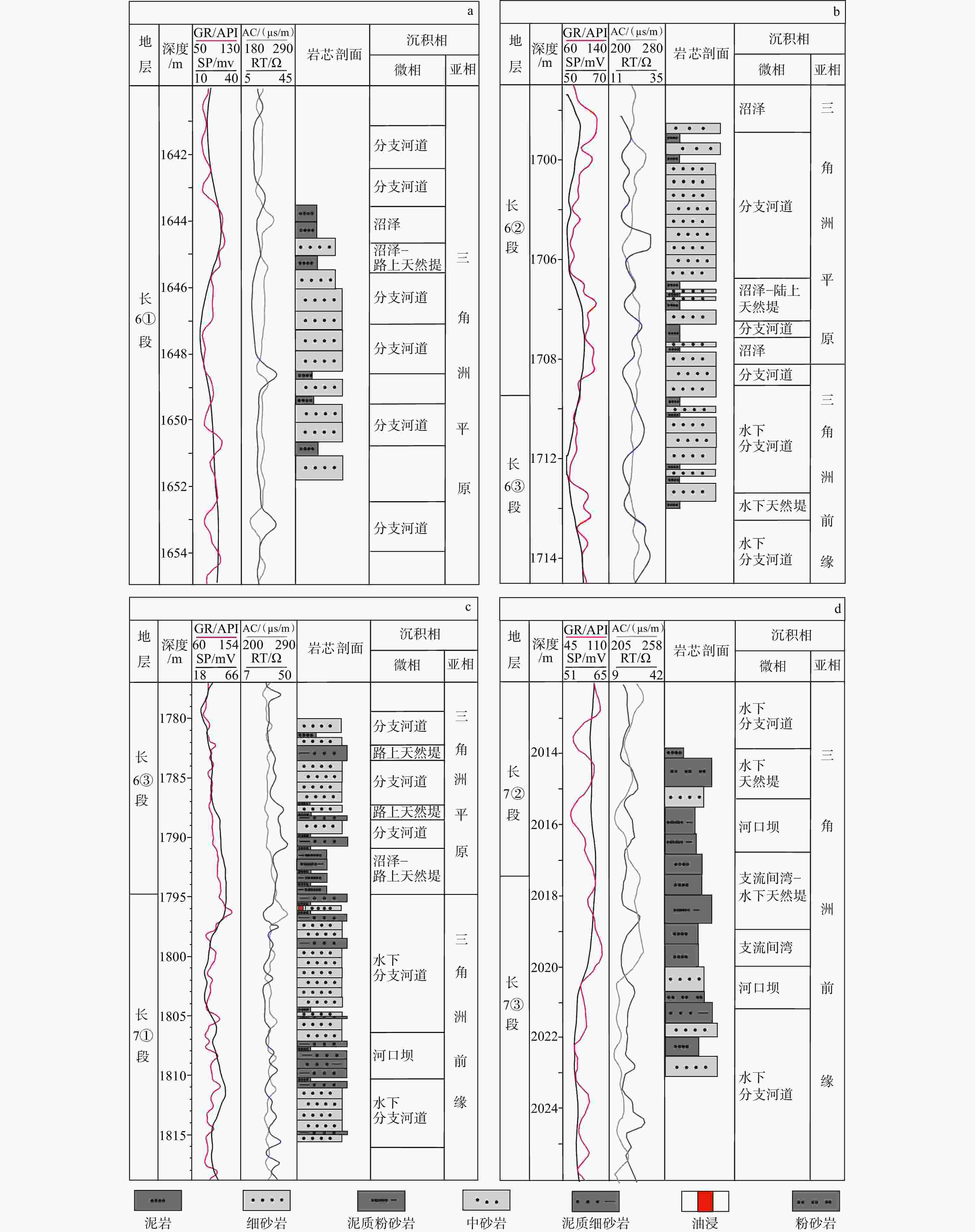
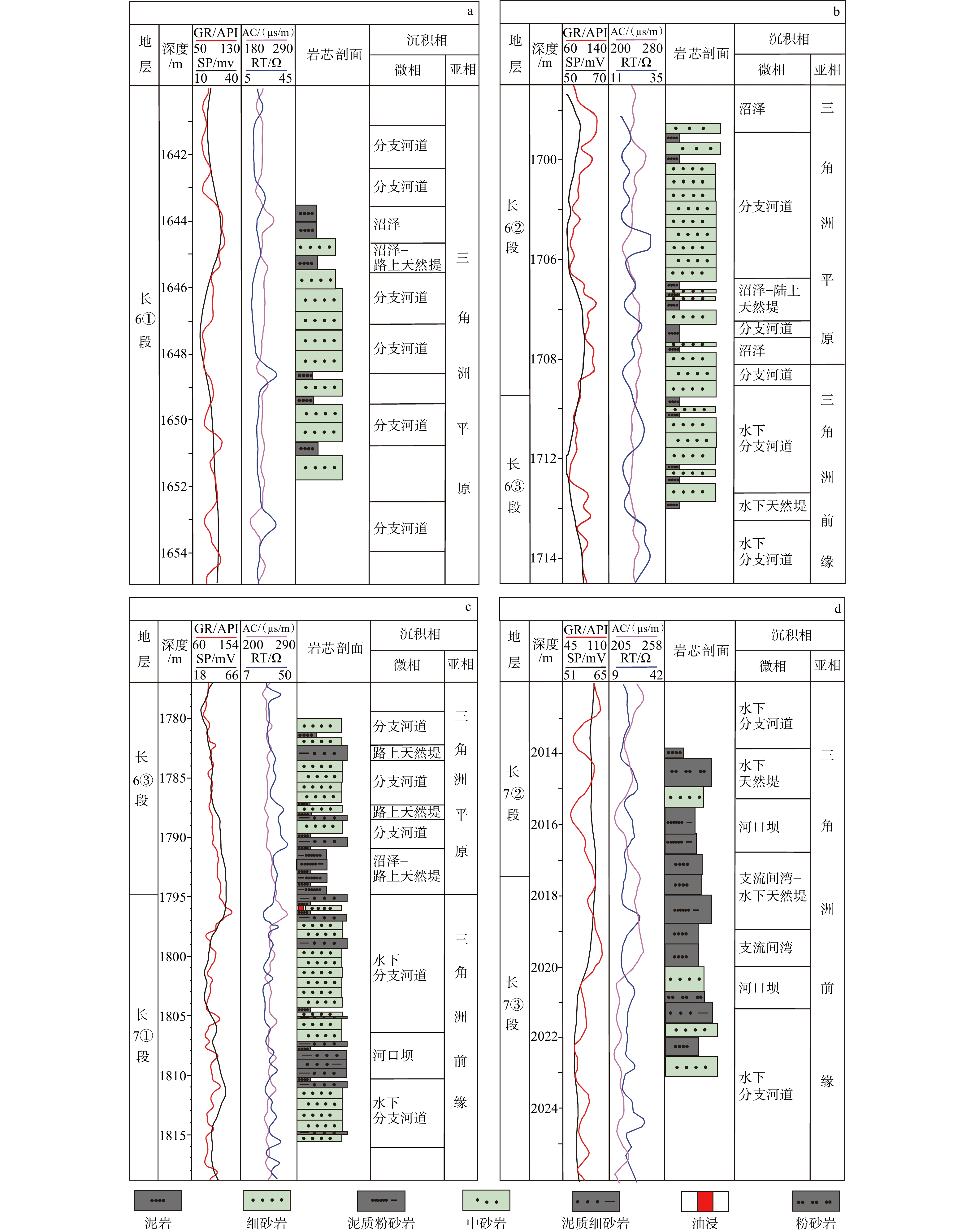
图 3 研究区长7—长6段综合柱状图
GR—自然伽马;AC—声波时差;SP—自然电位;RT—电阻率a—杨41井综合柱状图;b—靖12井综合柱状图;c—宝1井综合柱状图;d—杨59井综合柱状图
Figure 3. Composite stratigraphic columns of Chang 7 and Chang 6 Members in the study area
(a) Composite stratigraphic column of Well Yang 41; (b) Composite stratigraphic column of Well Jing 12; (c) Composite stratigraphic column Well Bao-1; (d) Composite stratigraphic column of Well Yang 59GR stands for natural gamma-ray, AC for acoustic transit time, SP for spontaneous potential, and RT for resistivity.
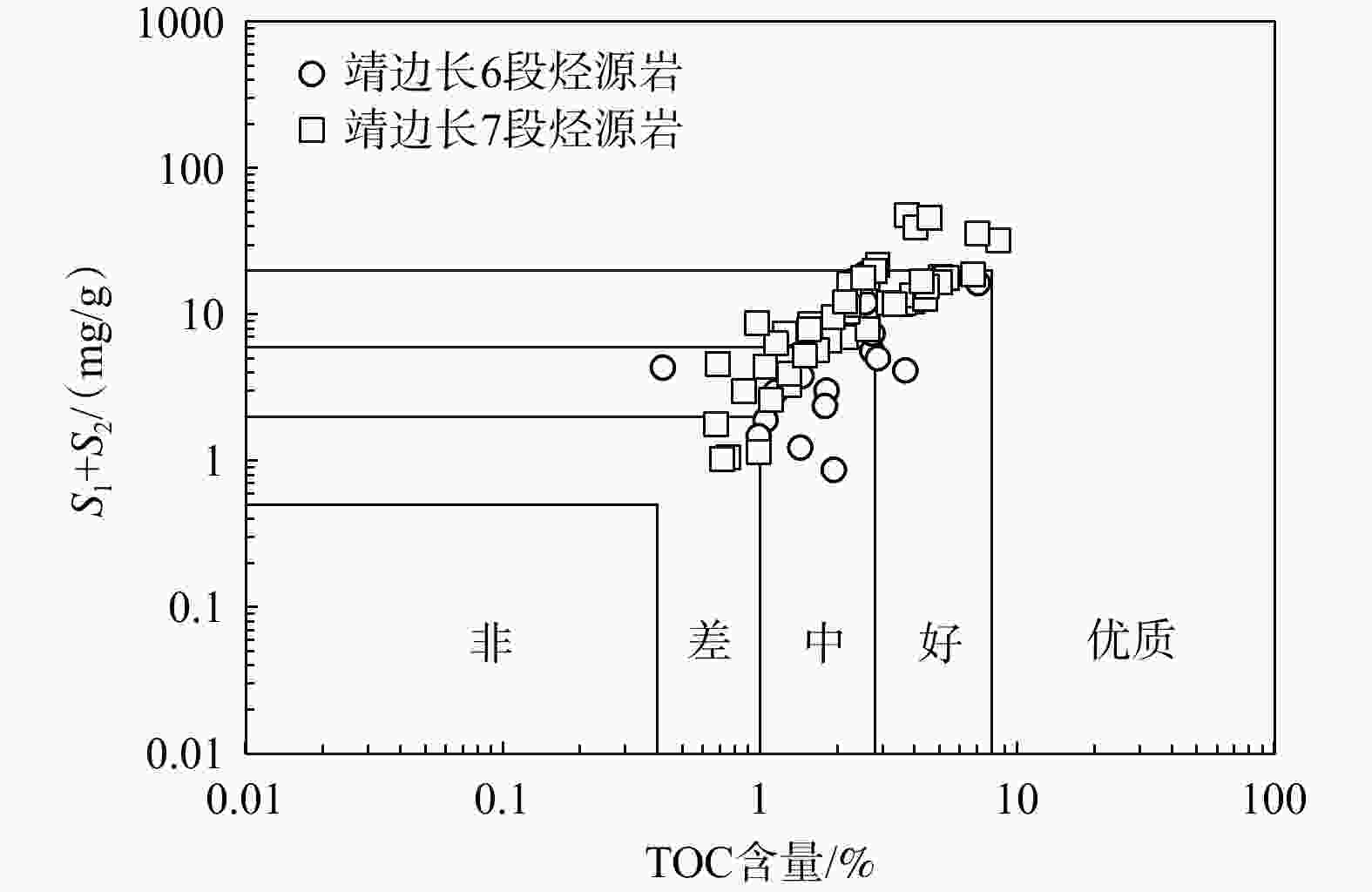
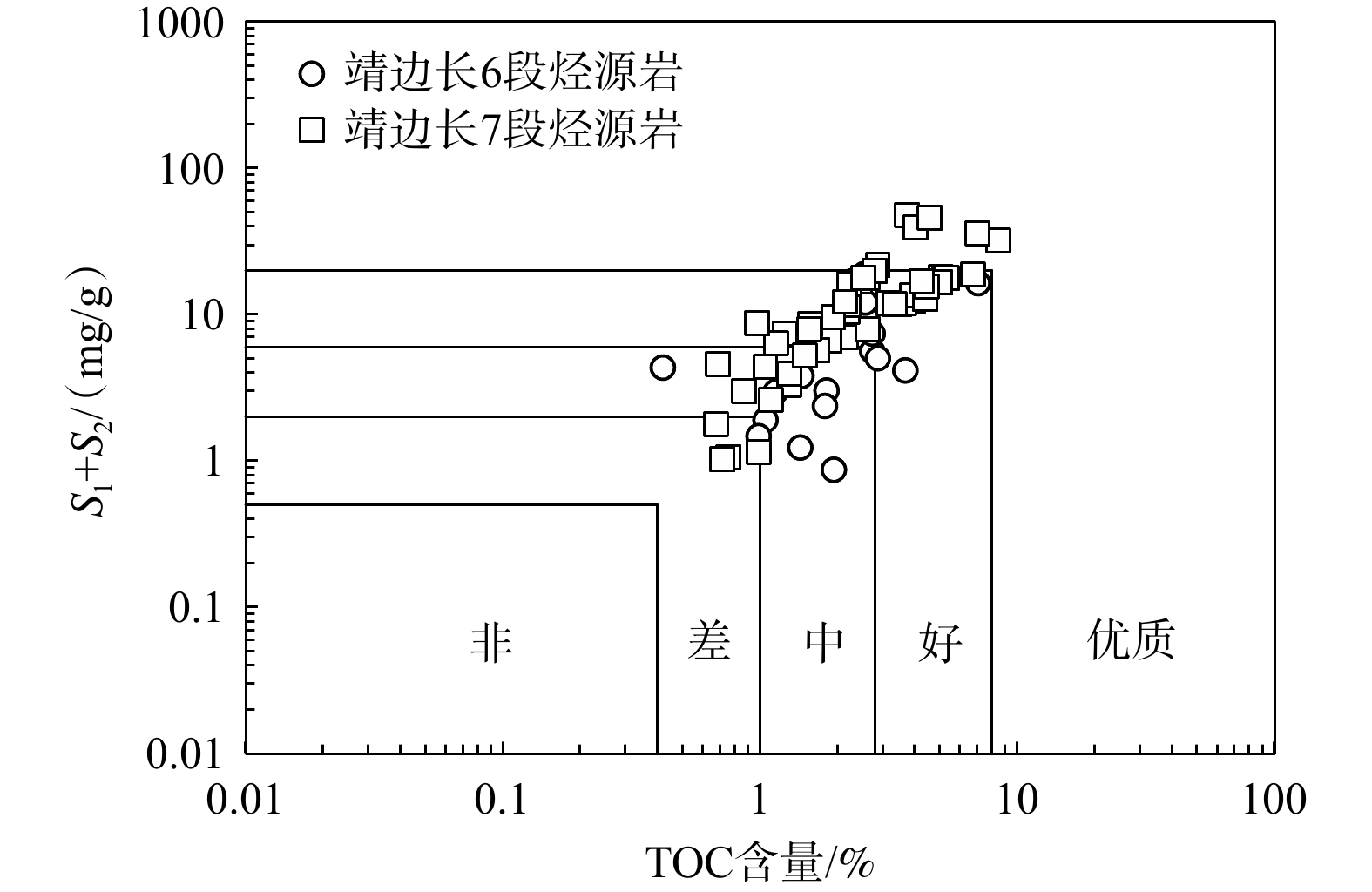
图 4 研究区烃源岩TOC含量和生烃潜量(S1+S2)交会图
Figure 4. Cross plot of TOC content vs. hydrocarbon generation potential (S1+S2) of hydrocarbon source rocks in the study area
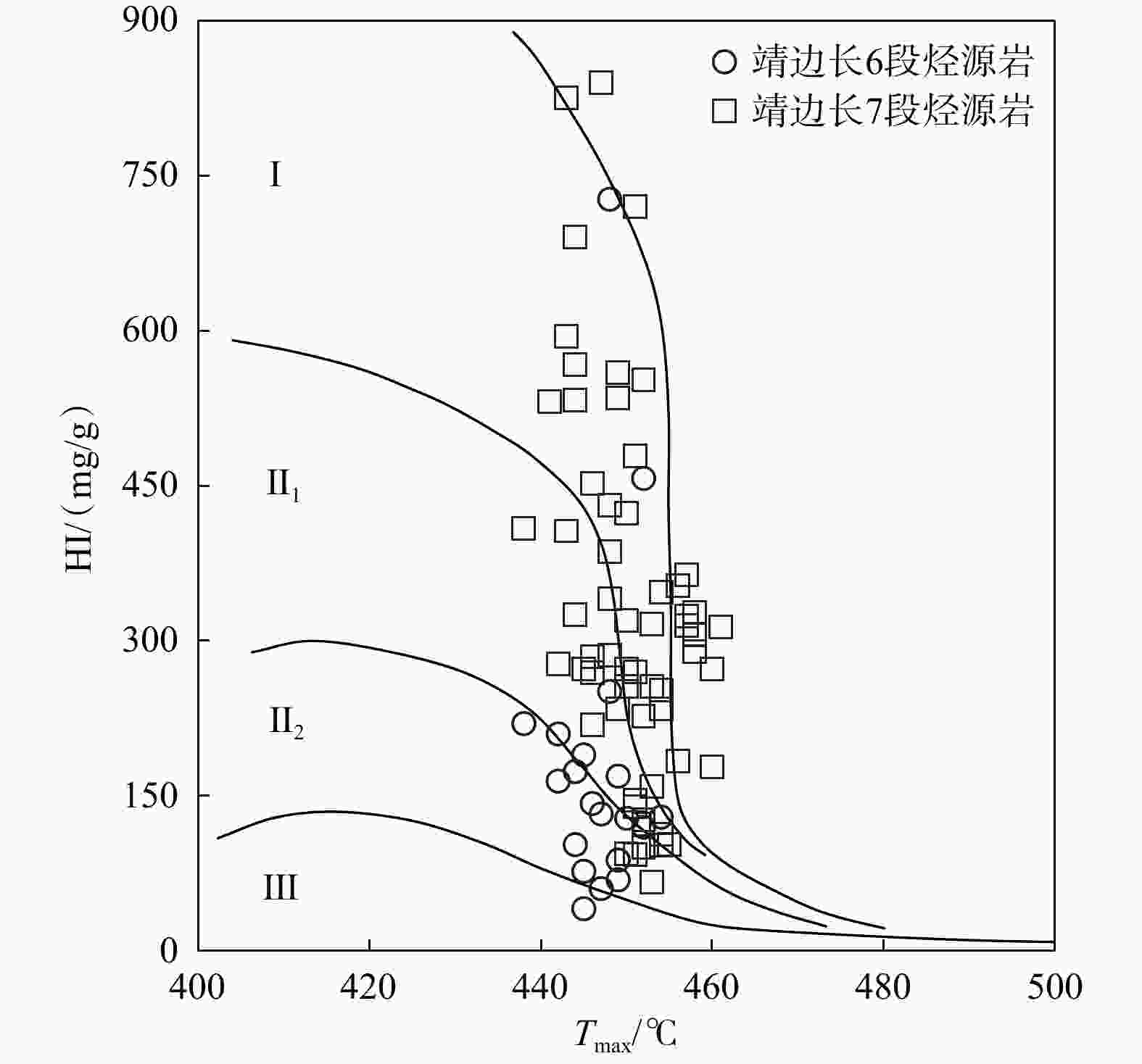
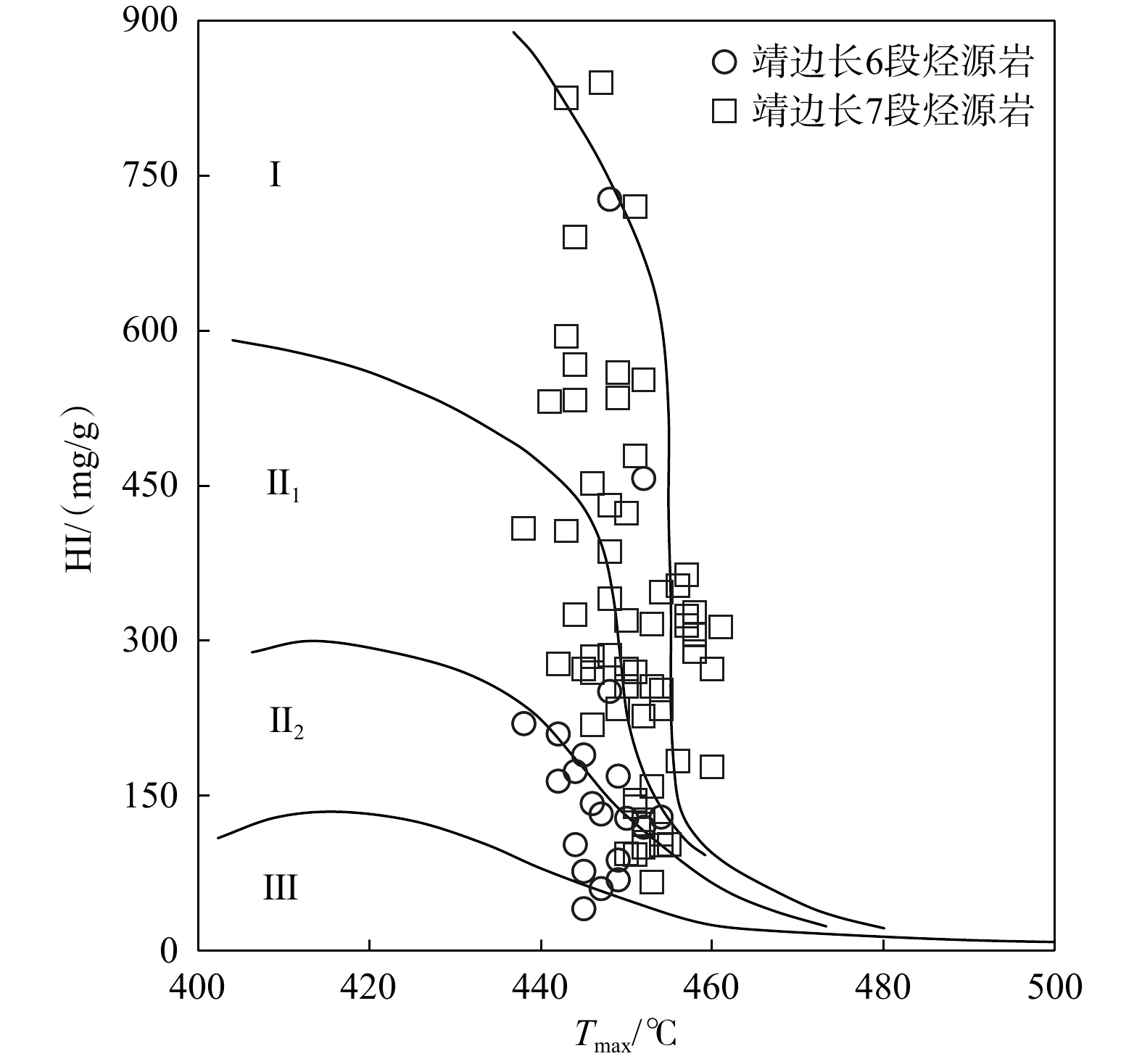
图 5 研究区烃源岩Tmax与HI交会图
Tmax 为最大热解峰温
Figure 5. Cross-plot of Tmax vs. HI for hydrocarbon source rocks in the study area
Tmax is defined as the maximum pyrolysis peak temperature.
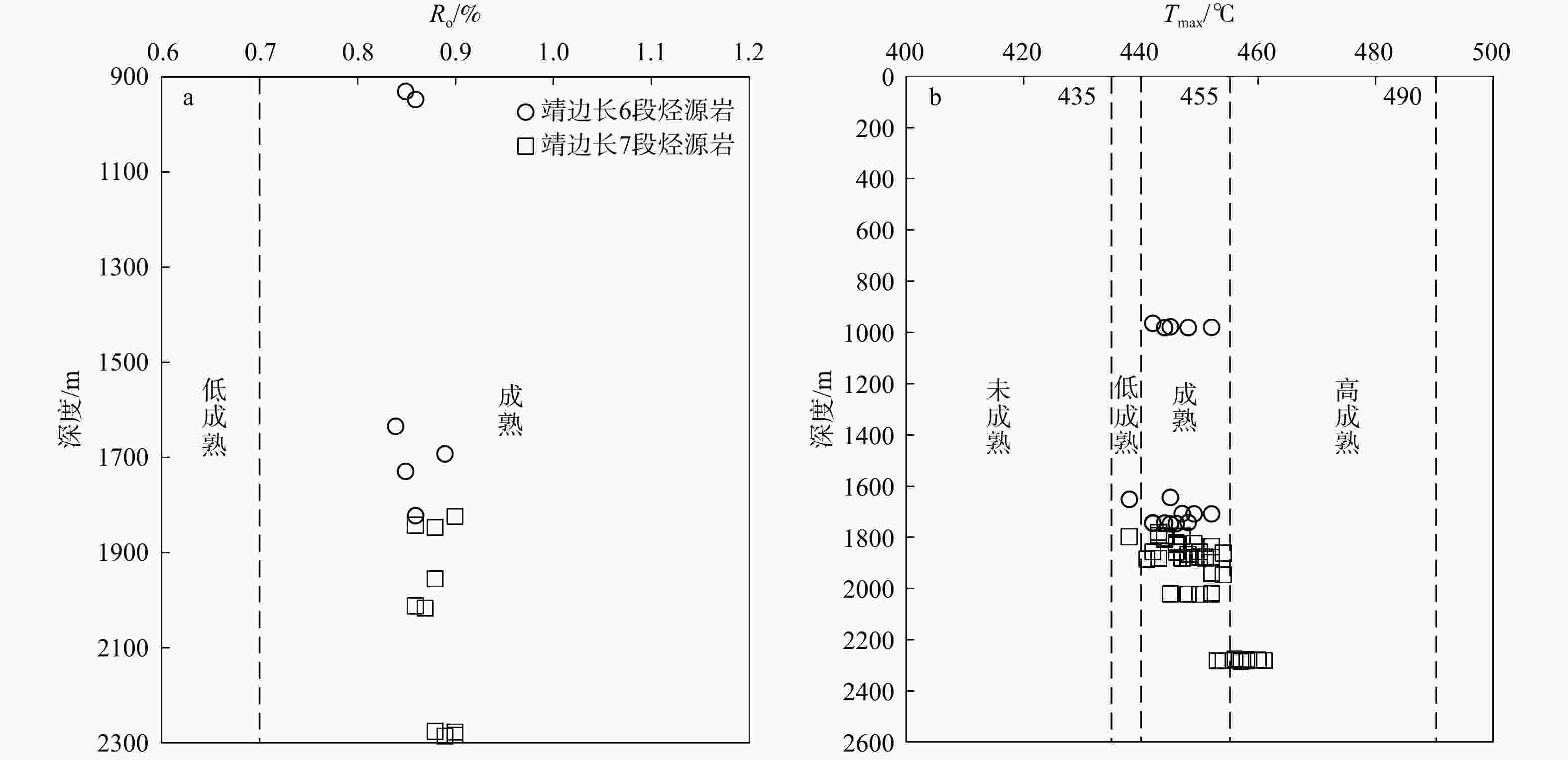
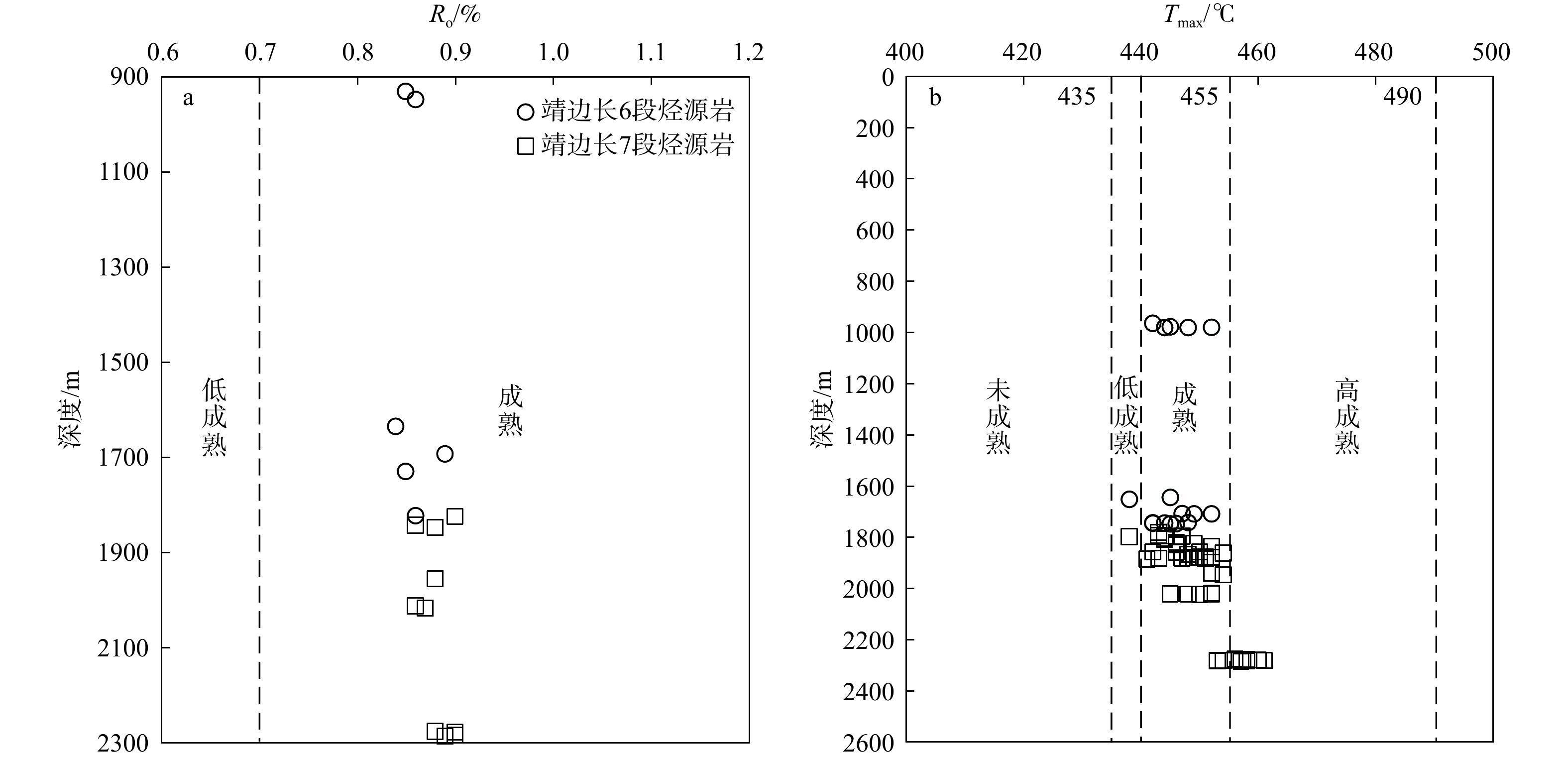
图 6 研究区烃源岩有机质成熟度评价
a—深度和Ro交会图;b—深度和Tmax交会图
Figure 6. Evaluation of organic matter maturity of hydrocarbon source rocks in the study area
(a) Cross plot of depth vs. Ro; (b) Cross plot of depth vs. Tmax
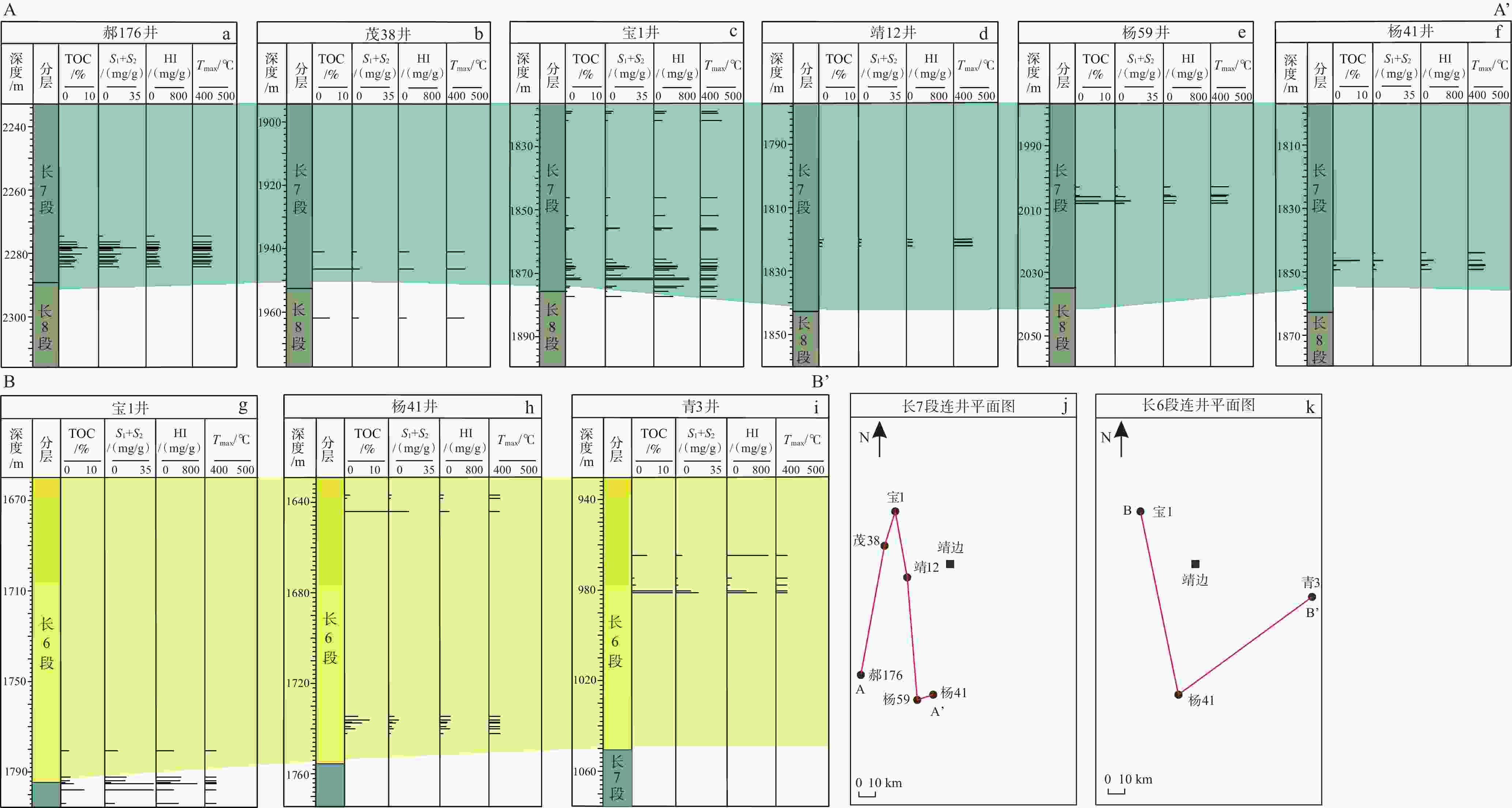
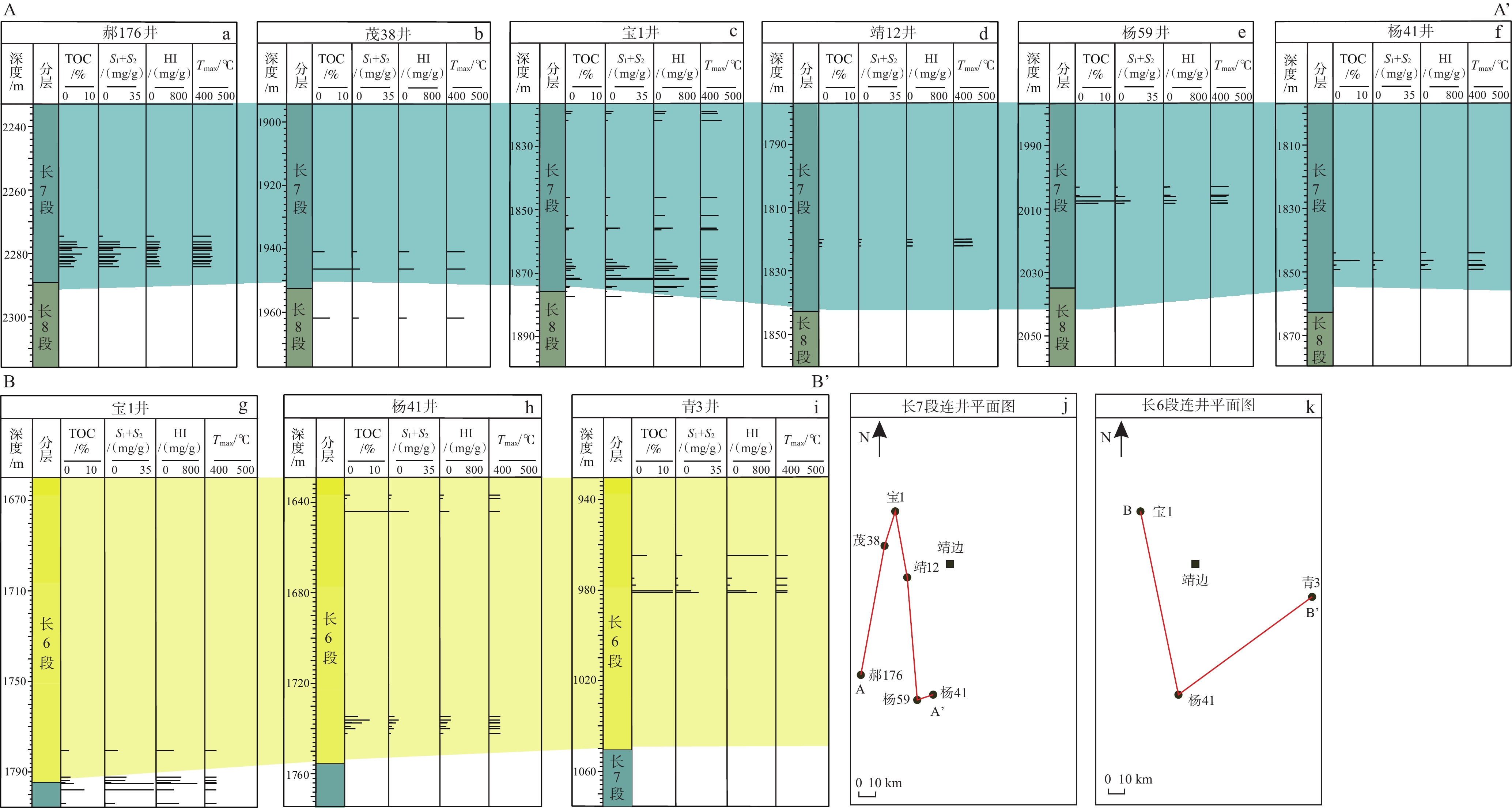
图 7 研究区综合地球化学连井剖面图
连井剖面纵向按实际深度绘制,横向井位为便于展示采用等间距排列,不代表实际井间距离;实际井位及剖面位置见平面图 a—郝176井长7段综合柱状图;b—茂38井长7段综合柱状图;c—宝1井长7段综合柱状图;d—靖12井长7段综合柱状图;e—杨59井长7段综合柱状图;f—杨41井长7段综合柱状图;g—宝1井长6段综合柱状图;h—杨41井长6段综合柱状图;i—青3井长6段综合柱状图;j—长7段连井平面图;k—长6段连井平面图
Figure 7. Composite geochemical correlation sections of hydrocarbon source rocks in the study area
The vertical scale of the well correlation profiles represents the actual depth, whereas the wells are equally spaced horizontally for visualization and do not represent the actual interwell distances. The actual well locations and profile positions are shown in the plan-view maps.(a) Composite stratigraphic column of the Chang 7 Member in Well Hao 176; (b) Composite stratigraphic column of the Chang 7 Member in Well Mao 38; (c) Composite stratigraphic column of the Chang 7 Member in Well Bao 1; (d) Composite stratigraphic column of the Chang 7 Member in Well Jing 12; (e) Composite stratigraphic column of the Chang 7 Member in Well Yang 59; (f) Composite stratigraphic column of the Chang 7 Member in Well Yang 41; (g) Composite stratigraphic column of the Chang 6 Member in Well Bao 1; (h) Composite stratigraphic column of the Chang 6 Member in Well Yang 41; (i) Composite stratigraphic column of the Chang 6 Member in Well Qing 3; (j) Well-log correlation panel of the Chang 7 Member; (k) Well-log correlation panel of the Chang 6 Member
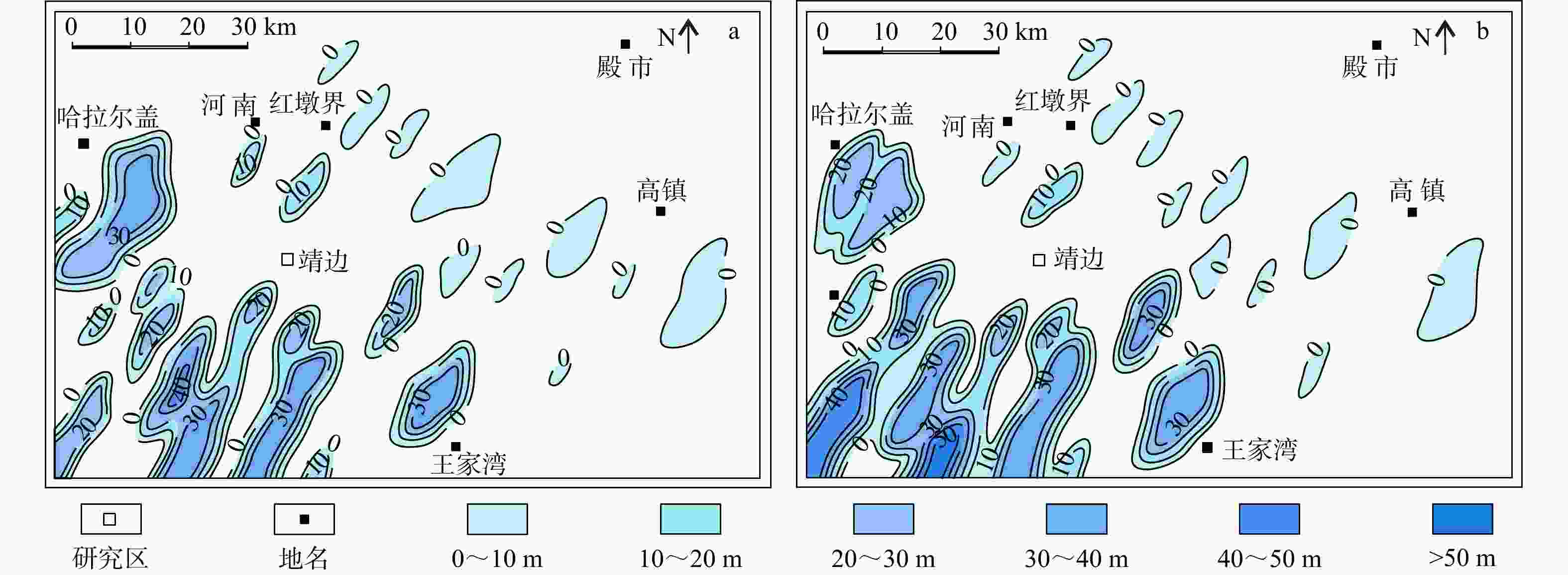
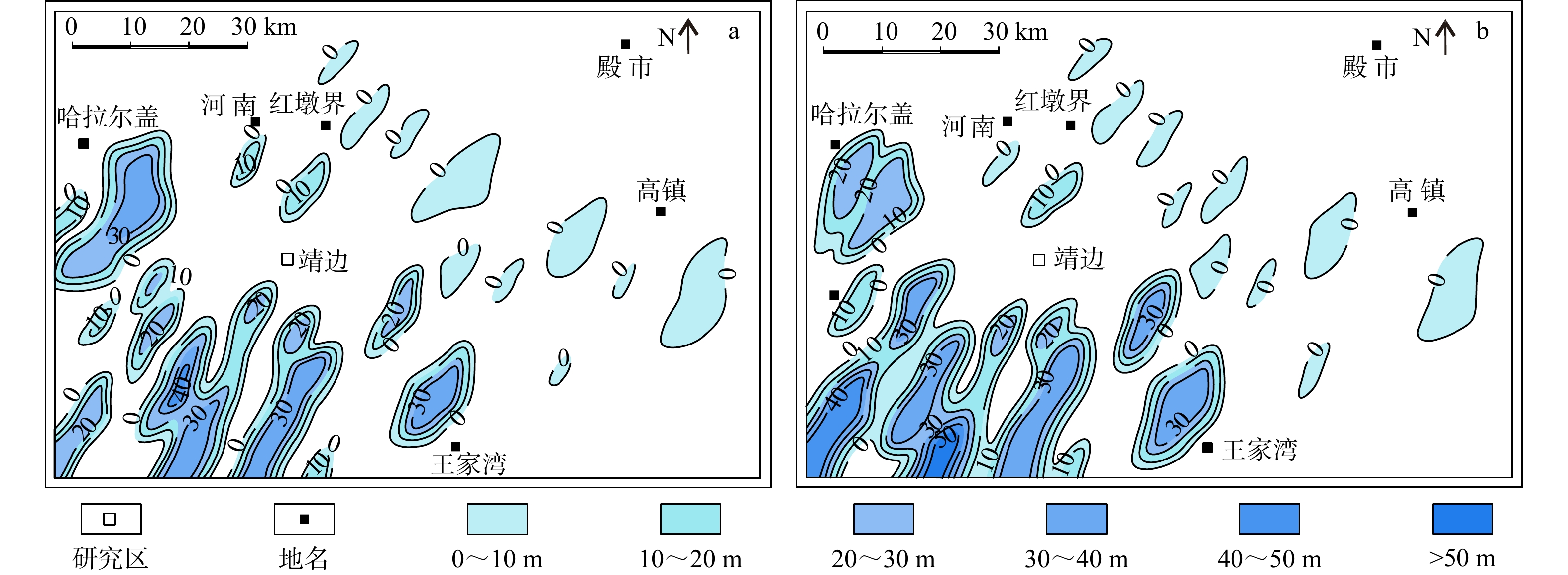
图 8 研究区烃源岩厚度等值线图
a—长6段烃源岩厚度图;b—长7段烃源岩厚度图
Figure 8. Isopach maps of hydrocarbon source rocks in the study area
(a) Isopach map of the Chang 6 Member source rocks; (b) Isopach map of the Chang 7 Member source rocks
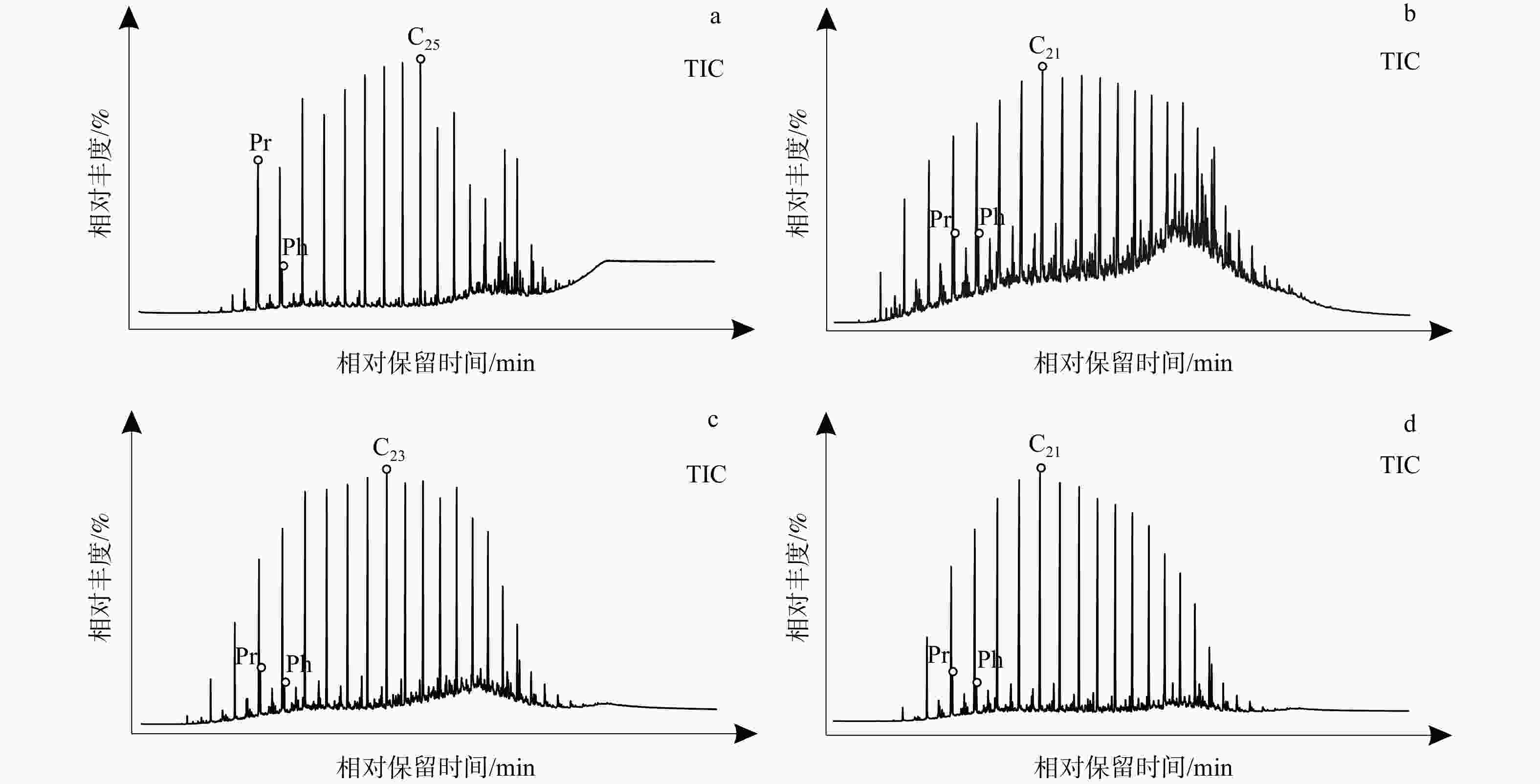
图 9 研究区长6段与长7段典型烃源岩可溶有机质中正构烷烃与类异戊二烯烃分布
Pr—姥鲛烷; Ph—植烷;TIC—总离子流色谱图a—杨41井,长6段,深度1650 m;b—茂38井,长7段,深度1946.4 m;c—靖12井,长6段,深度1706.7 m;d—杨41井,长7段,深度1857.64 m
Figure 9. Distributions of n-alkanes and isoprenoids in soluble organic matter from typical hydrocarbon source rocks of the Chang 6 and Chang 7 Members in the study area
Note:Pr:pristane; Ph:phytane; TIC:total ion chromatogram (a) Well Yang 41, Chang 6 Member, depth 1650 m; (b) Well Mao 38, Chang 7 Member, depth1946.4 m; (c) Well Jing 12, Chang 6 Member, depth1706.7 m; (d) Well Yang 41, Chang 7 Member, depth 1857.64 m
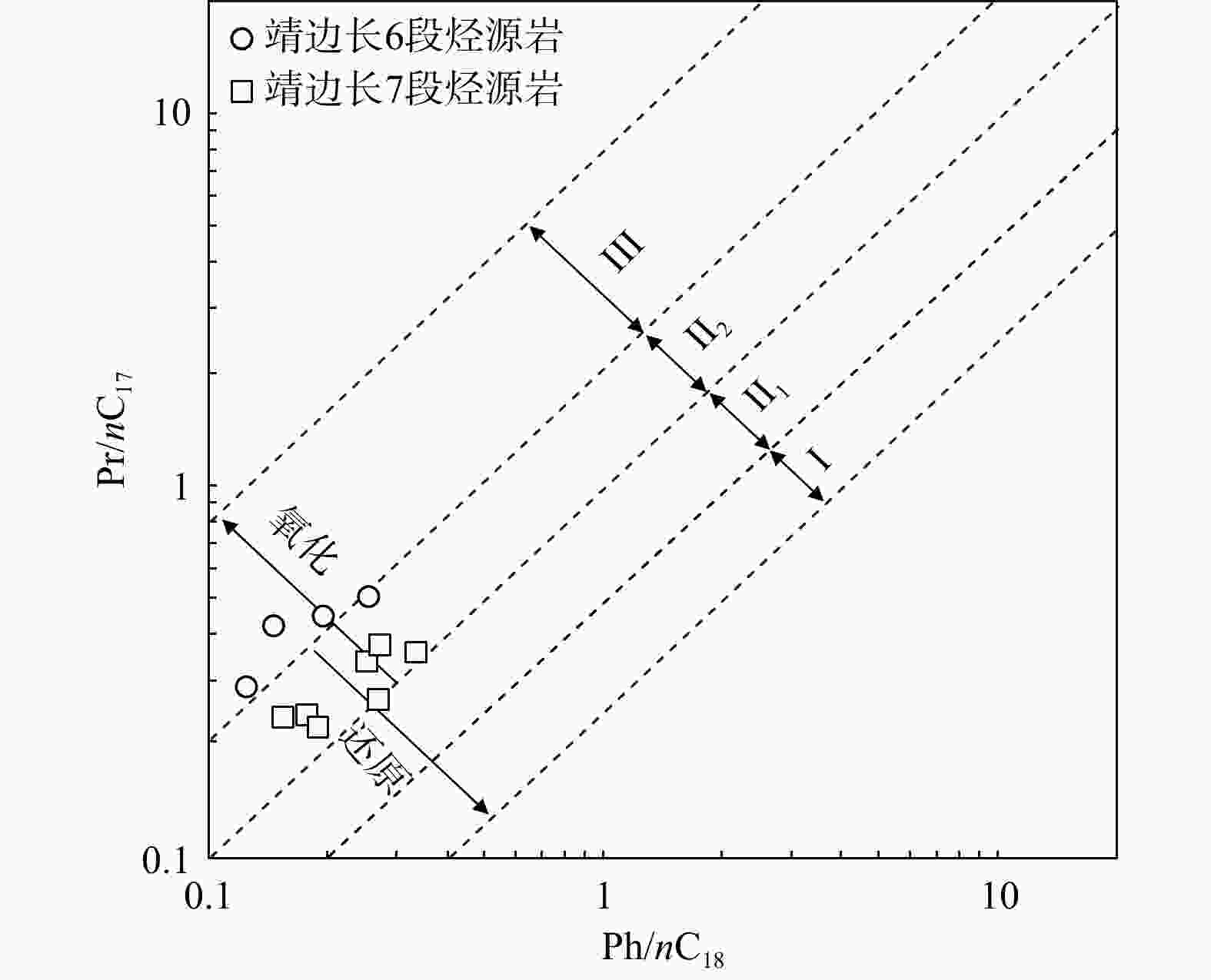
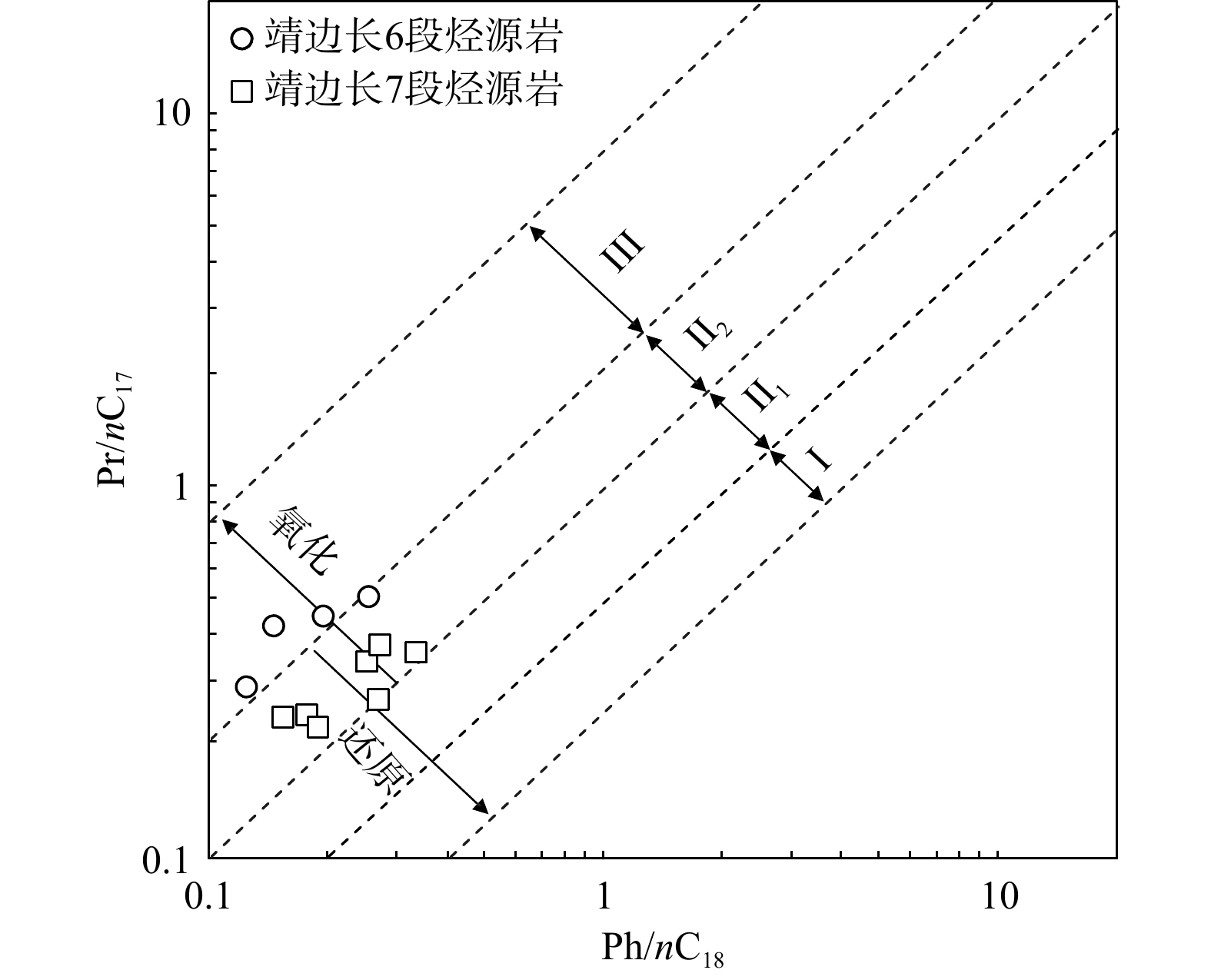
图 10 研究区烃源岩及张家滩页岩Ph/nC18和Pr/nC17关系图
Figure 10. Cross plot of Ph/nC18 vs. Pr/nC17 for hydrocarbon source rocks in the study area and the Zhangjiatan Shale
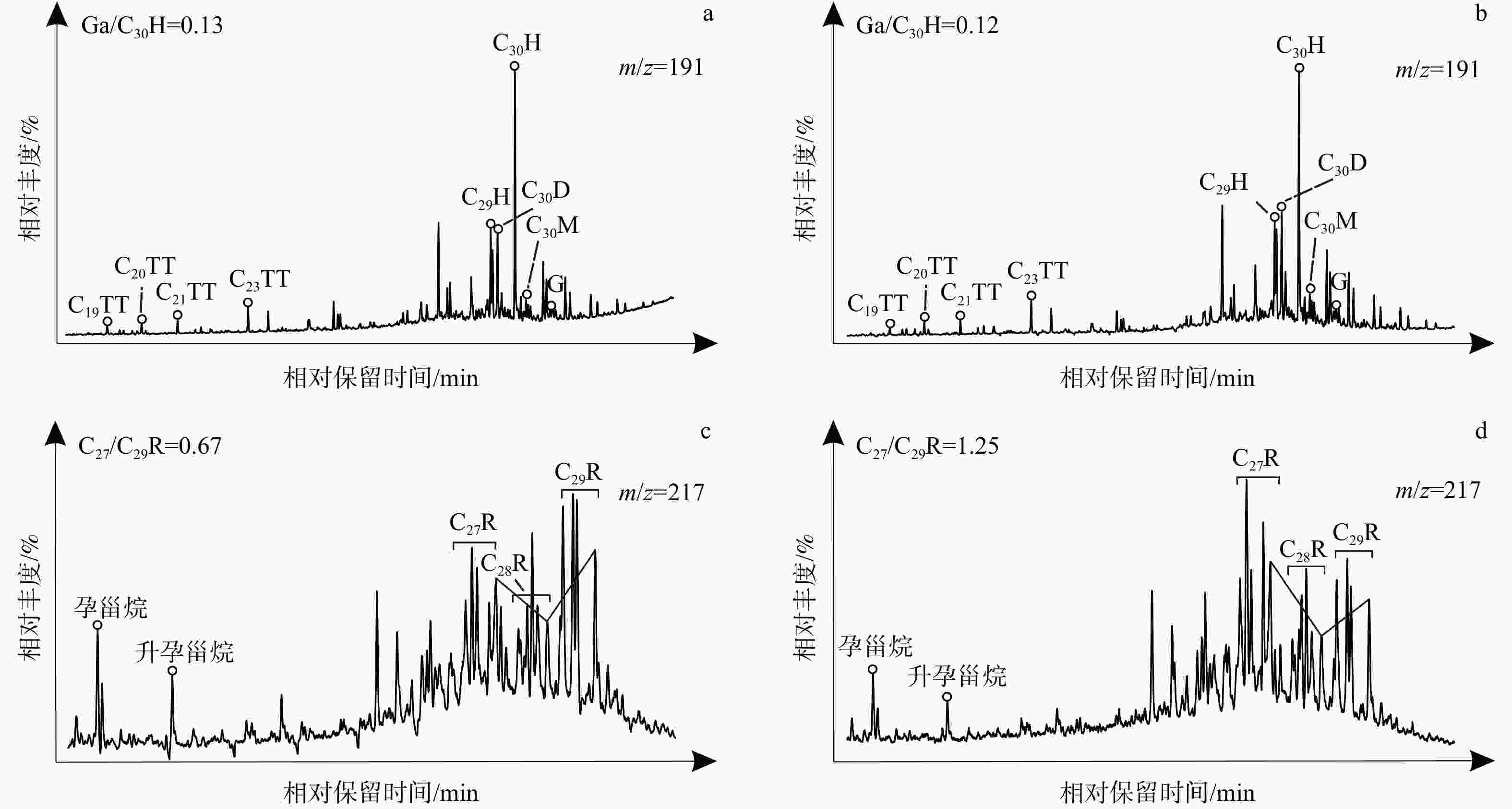
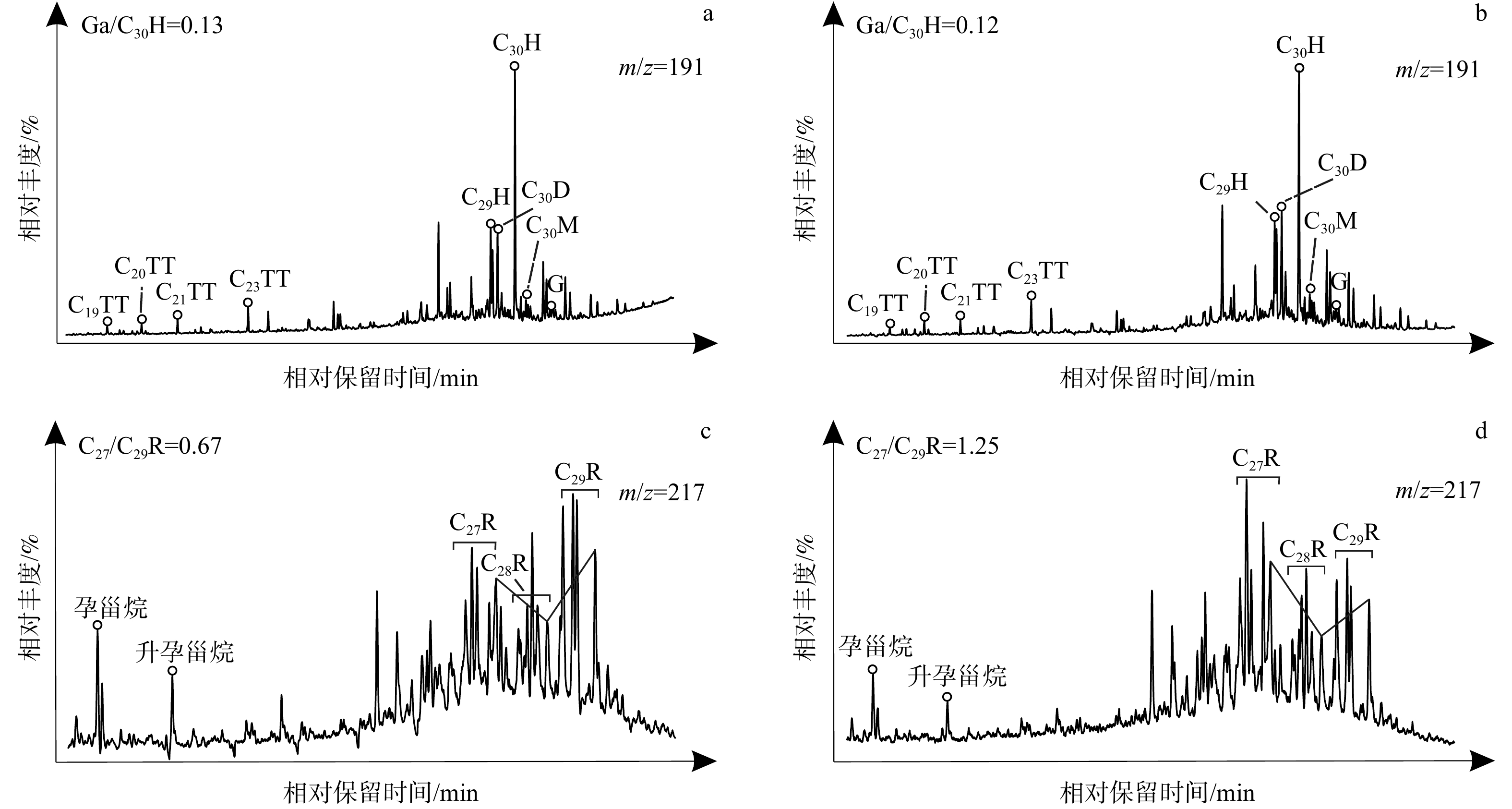
图 11 研究区长6段与长7段典型烃源岩可溶有机质萜烷与甾烷分布
m/z = 191—萜烷类化合物特征离子;m/z = 217—甾烷类化合物特征离子;C27/C29R—C27与C29规则甾烷相对含量比值;Ga/C30H—伽马蜡烷指数a—杨41井,长6段,深度1706.7 m;b—茂38井,长7段,深度1946.4 m;c—靖12井,长6段,深度1706.7 m;d—杨41井,长7段,深度1857.64 m
Figure 11. Distributions of terpanes and steranes in soluble organic matter from typical hydrocarbon source rocks of the Chang 6 and Chang 7 Members in the study area
(a) Well Yang 41, Chang 6 Member, depth 1650 m; (b) Well Mao 38, Chang 7 Member, depth 1946.4 m; (c) Well Jing 12, Chang 6 Member, depth 1706.7 m; (d) Well Yang 41, Chang 7 Member, depth 1857.64 mm/z = 191: characteristic ion of terpanes; m/z = 217: characteristic ion of steranes; C27/C29R: relative abundance ratio of C27 to C29 regular steranes; Ga/C30H: gammacerane index
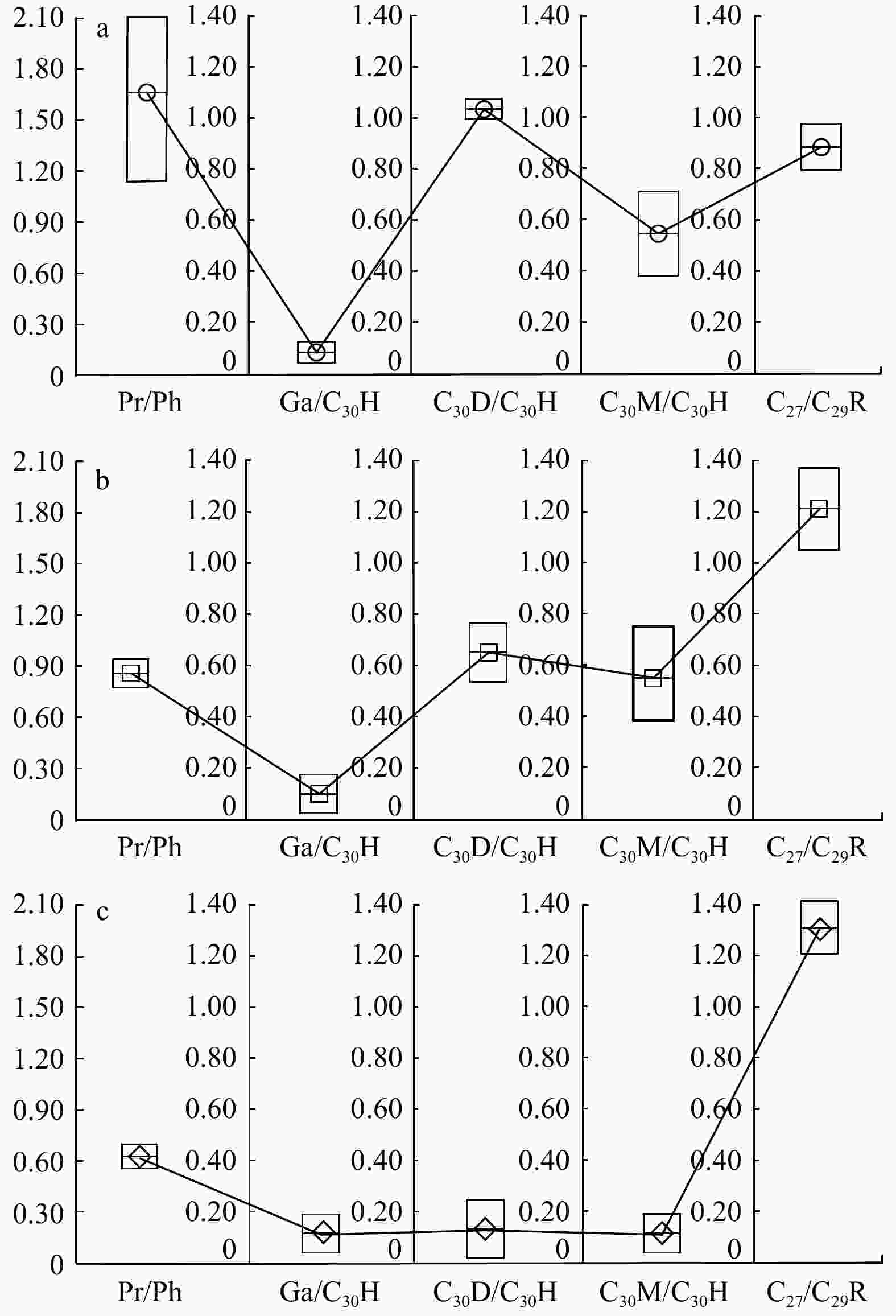
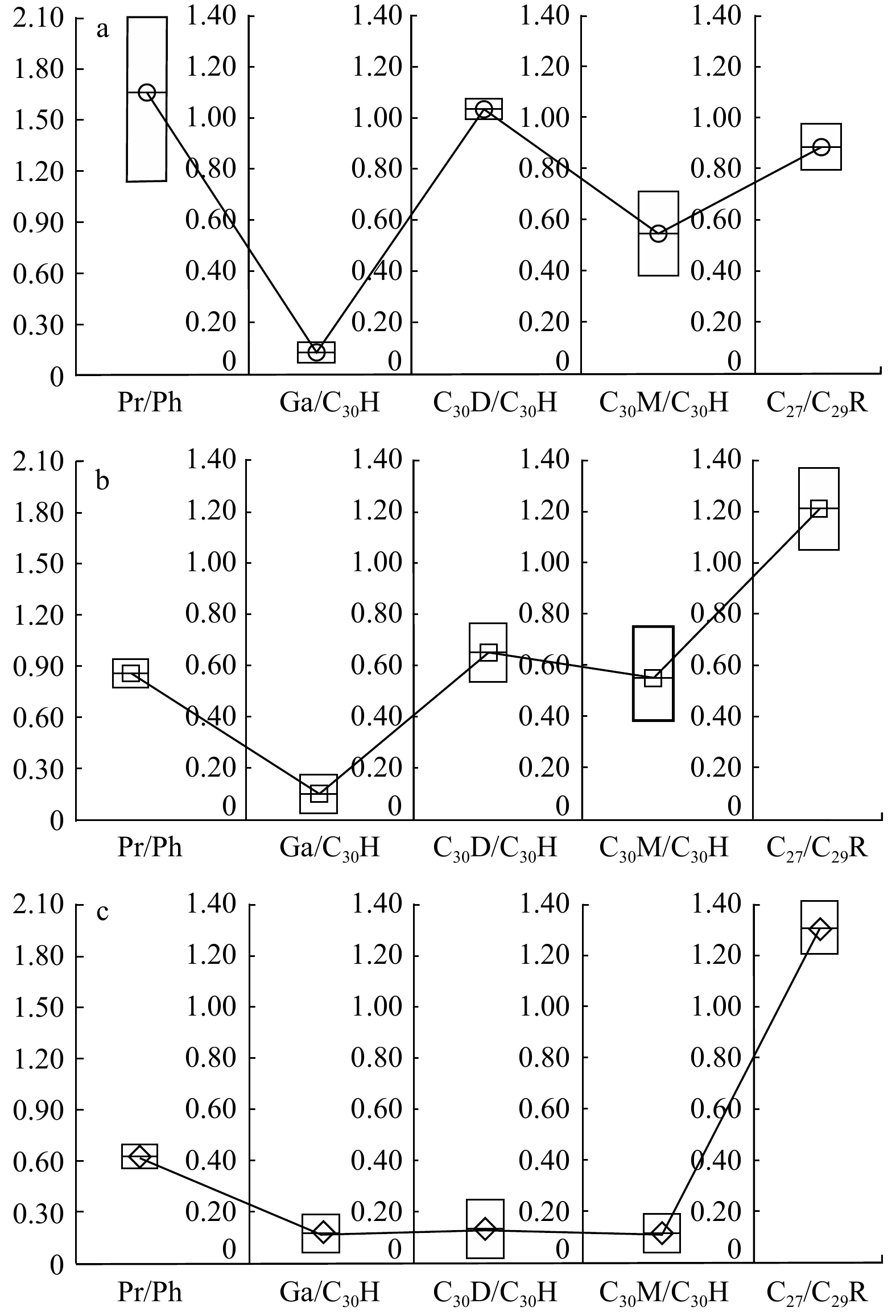
图 12 研究区烃源岩与张家滩页岩生物标志化合物参数组合
纵坐标数值表示各生物标志化合物参数的比值a—长6段烃源岩生物标志化合物参数组合;b—长7段烃源岩生物标志化合物参数组合;c—张家滩页岩生物标志化合物参数组合
Figure 12. Characteristic biomarker parameter combinations of hydrocarbon source rocks in the study area and the Zhangjiatan Shale (a) Chang 6 Member source rocks; (b) Chang 7 Member source rocks; (c) Zhangjiatan Shale
The ordinate values in the figure represent the ratios of various biomarker parameters
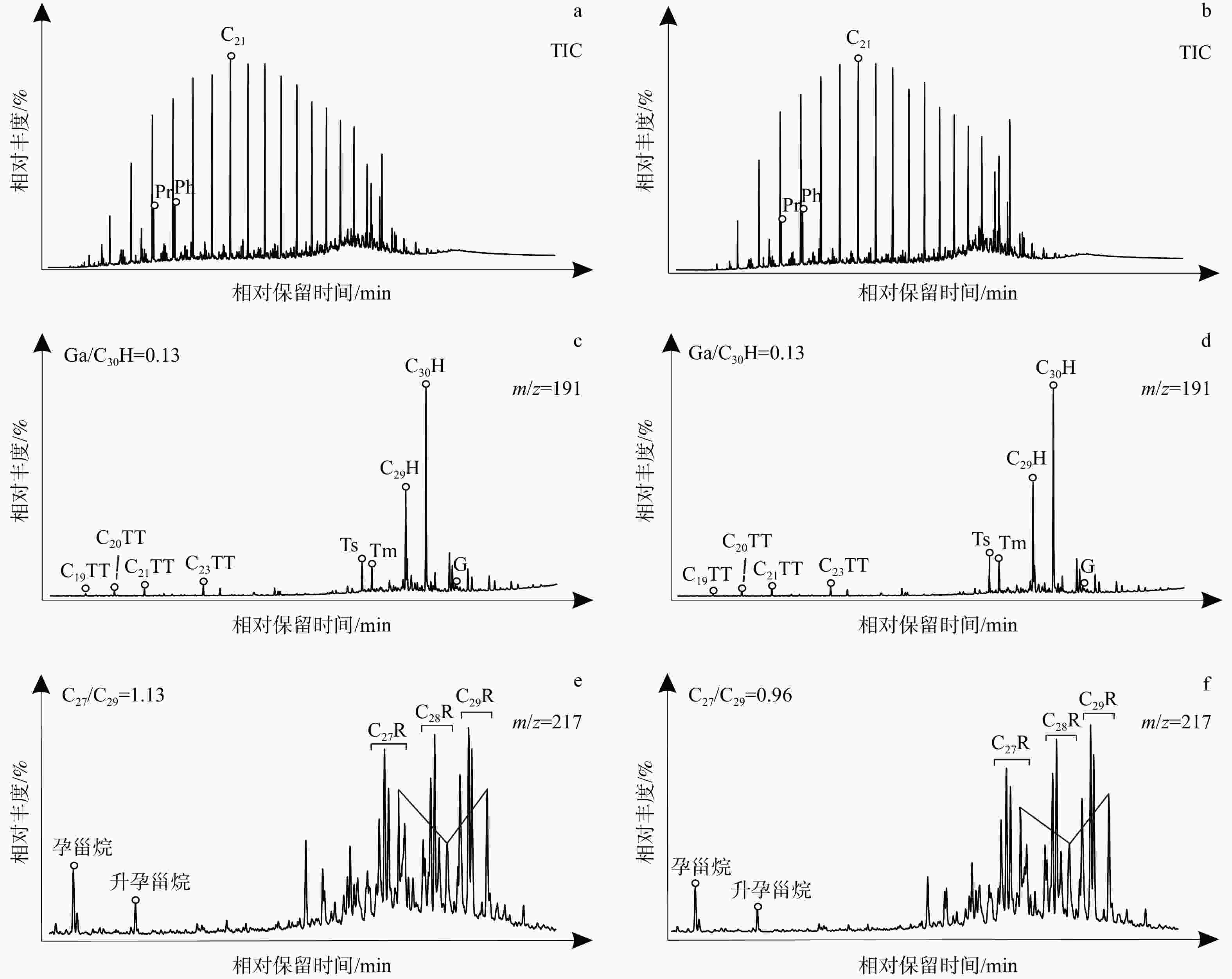
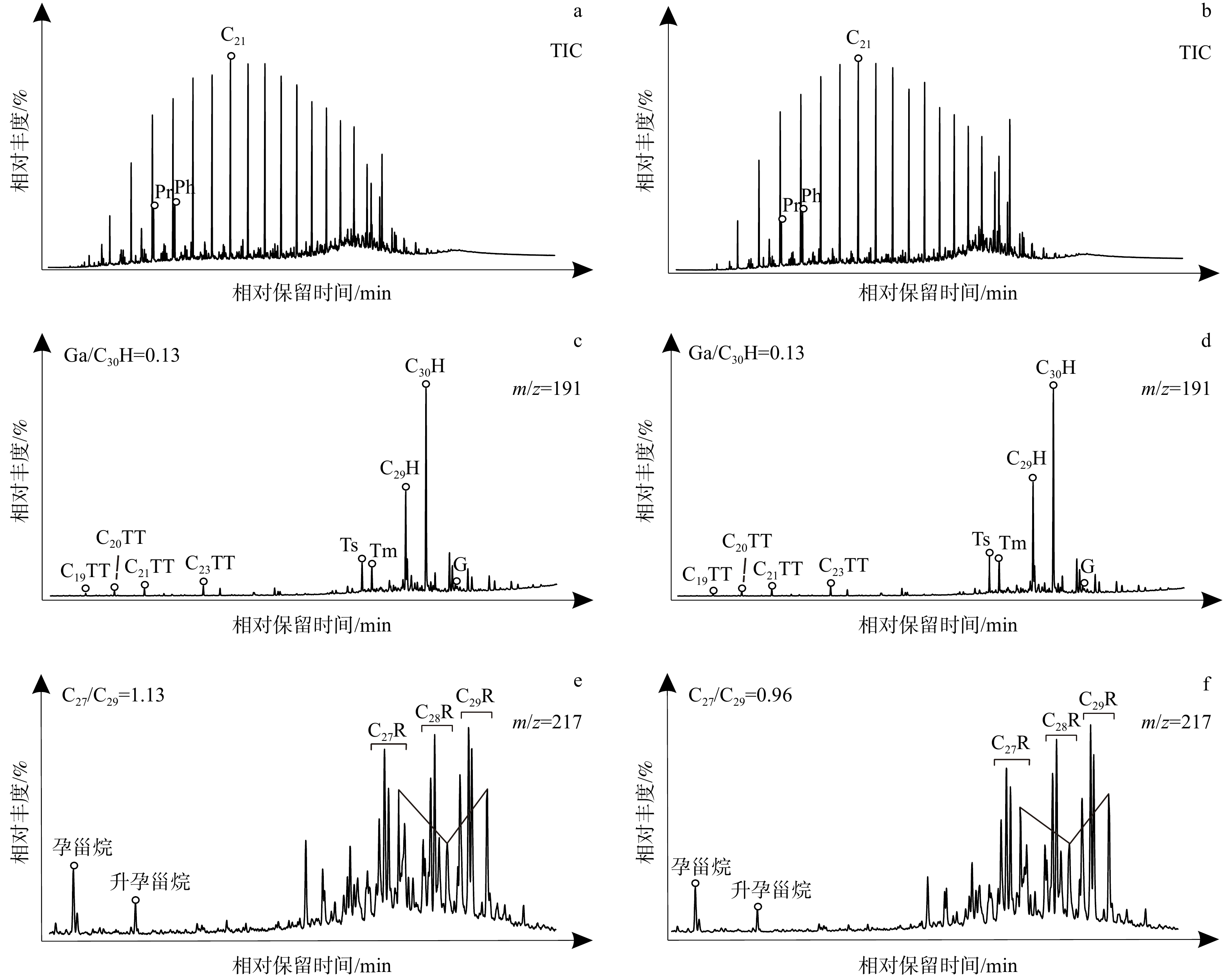
图 13 研究区原油中正构烷烃与类异戊二烯烃、萜烷与甾烷分布
Pr—姥鲛烷; Ph—植烷;TIC—总离子流色谱图;m/z = 191—萜烷类化合物特征离子;m/z = 217—甾烷类化合物特征离子;C27/C29R—C27与C29规则甾烷相对含量比值;Ga/C30H—伽马蜡烷指数a—天21-11井,延9段,深度1032 m;b—天9-21井,长2段,深度1278 m;c—天21-11井,延9段,深度1032 m;d—天9-21井,长2段,深度1278 m;e—天21-11井,延9段,深度1032 m;f—天9-21井,长2段,深度1278 m
Figure 13. Distributions of n-alkanes, isoprenoids, terpanes, and steranes from crude oils in the study area
Note: Pr:pristane; Ph:phytane; TIC:total ion chromatogram; m/z = 191: characteristic ion of terpanes; m/z = 217: characteristic ion of steranes; C27/C29R: relative abundance ratio of C27 to C29 regular steranes; Ga/C30H: gammacerane index(a) Well Tian 21-11, Yan 9 Member, depth 1032 m; (b) Well Tian 9-21, Chang 2 Member, depth 1278 m; (c) Well Tian 21-11, Yan 9 Member, depth 1032 m; (d) Well Tian 9-21, Chang 2 Member, depth 1278 m; (e) Well Tian 21-11, Yan 9 Member, depth 1032 m; (f) Well Tian 9-21, Chang 2 Member, depth 1278 m
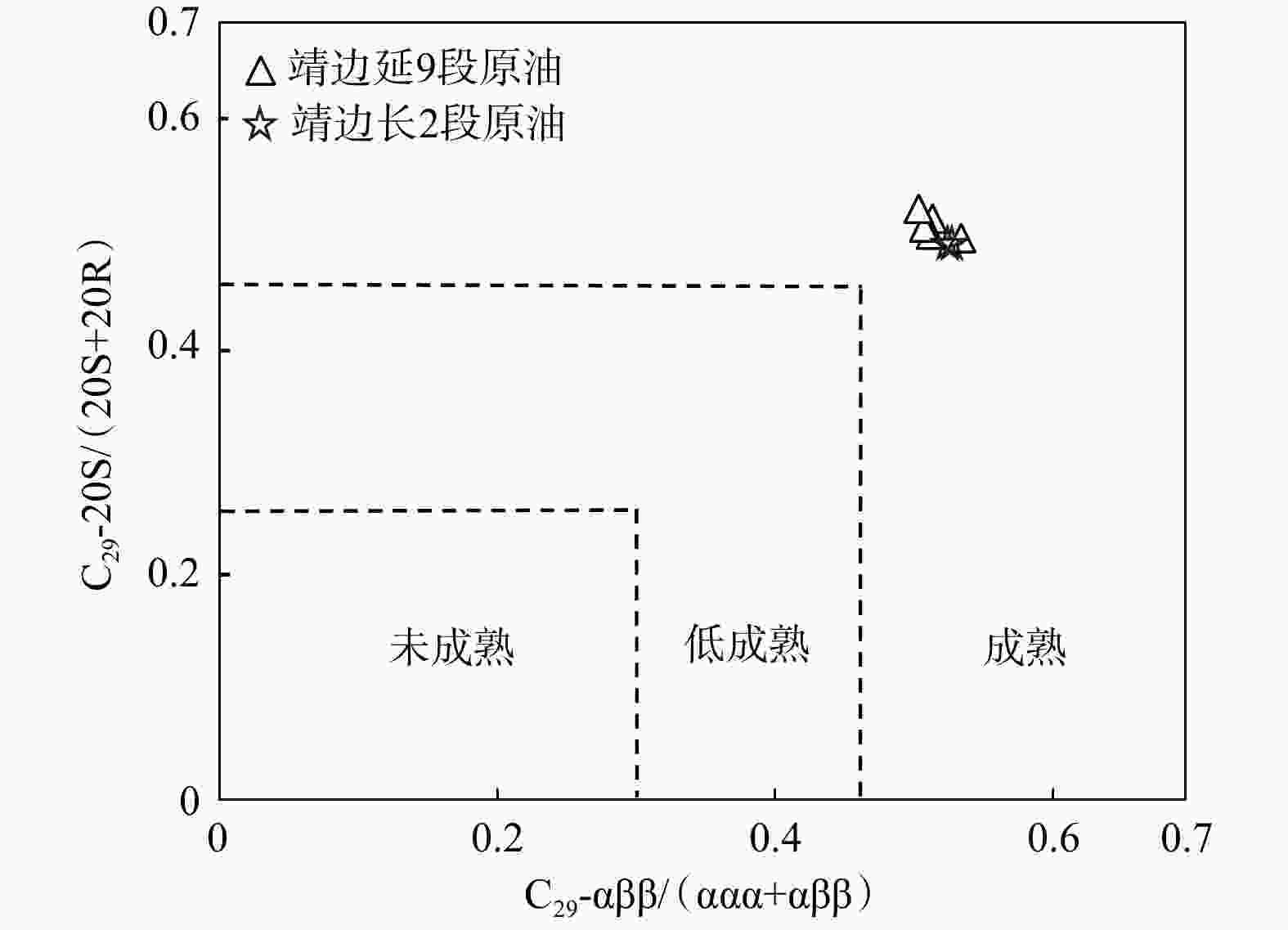
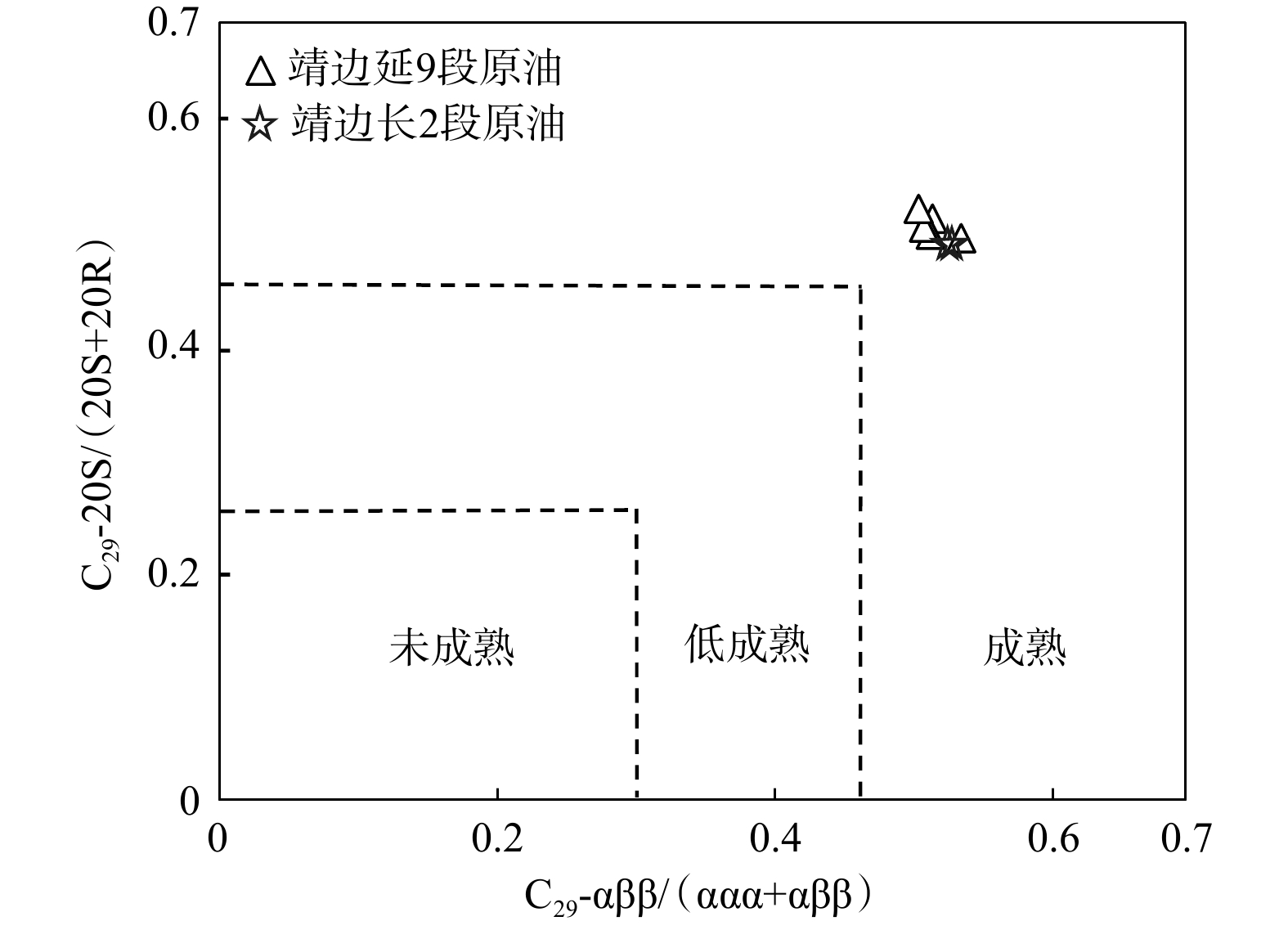
图 14 研究区原油C29-αββ/(ααα+αββ)和C29-20S/(20S+20R)关系图
Figure 14. Cross plot of C29-αββ/(ααα+αββ) vs. C29-20S/(20S+20R) from crude oil in the study area
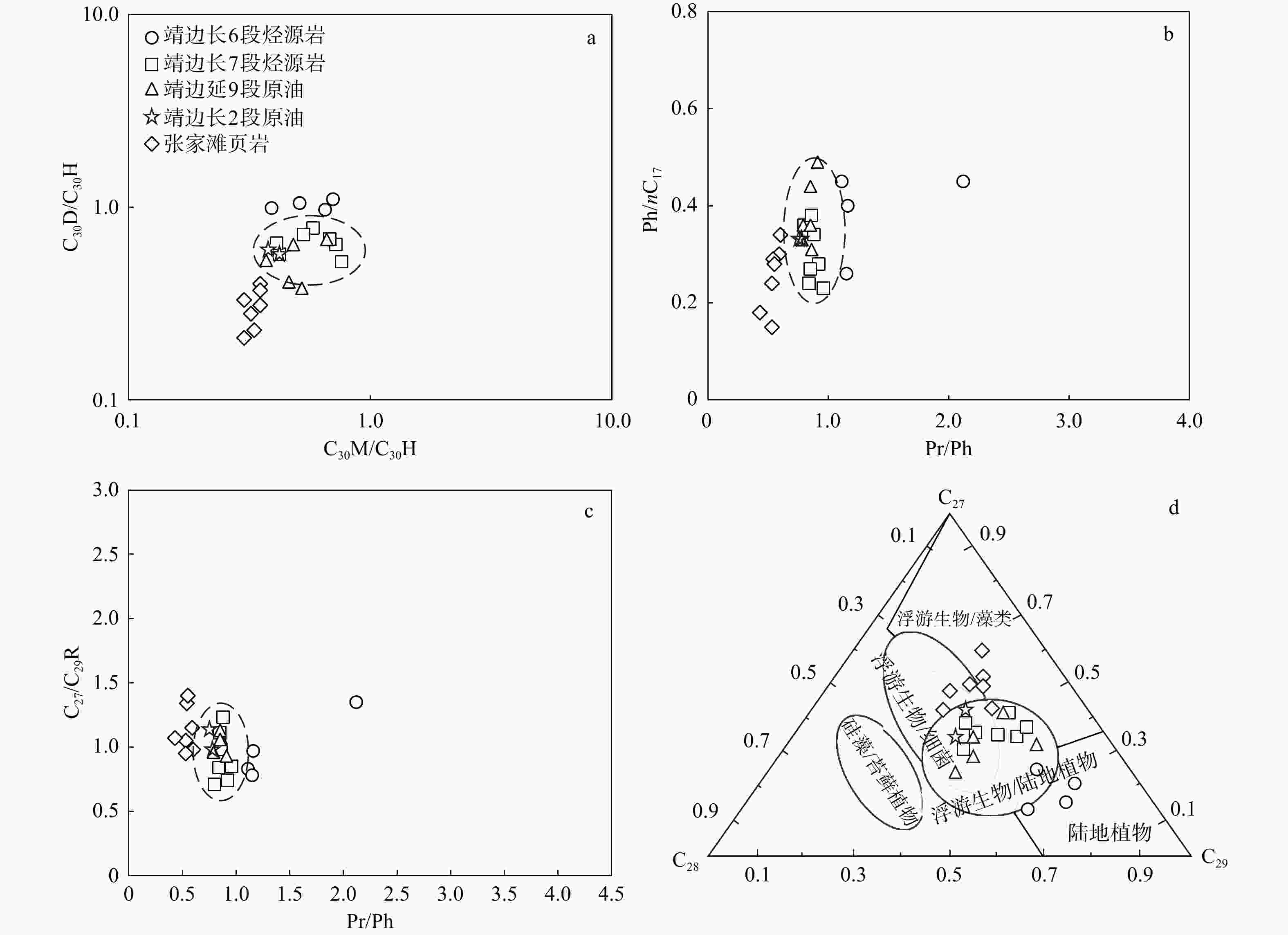
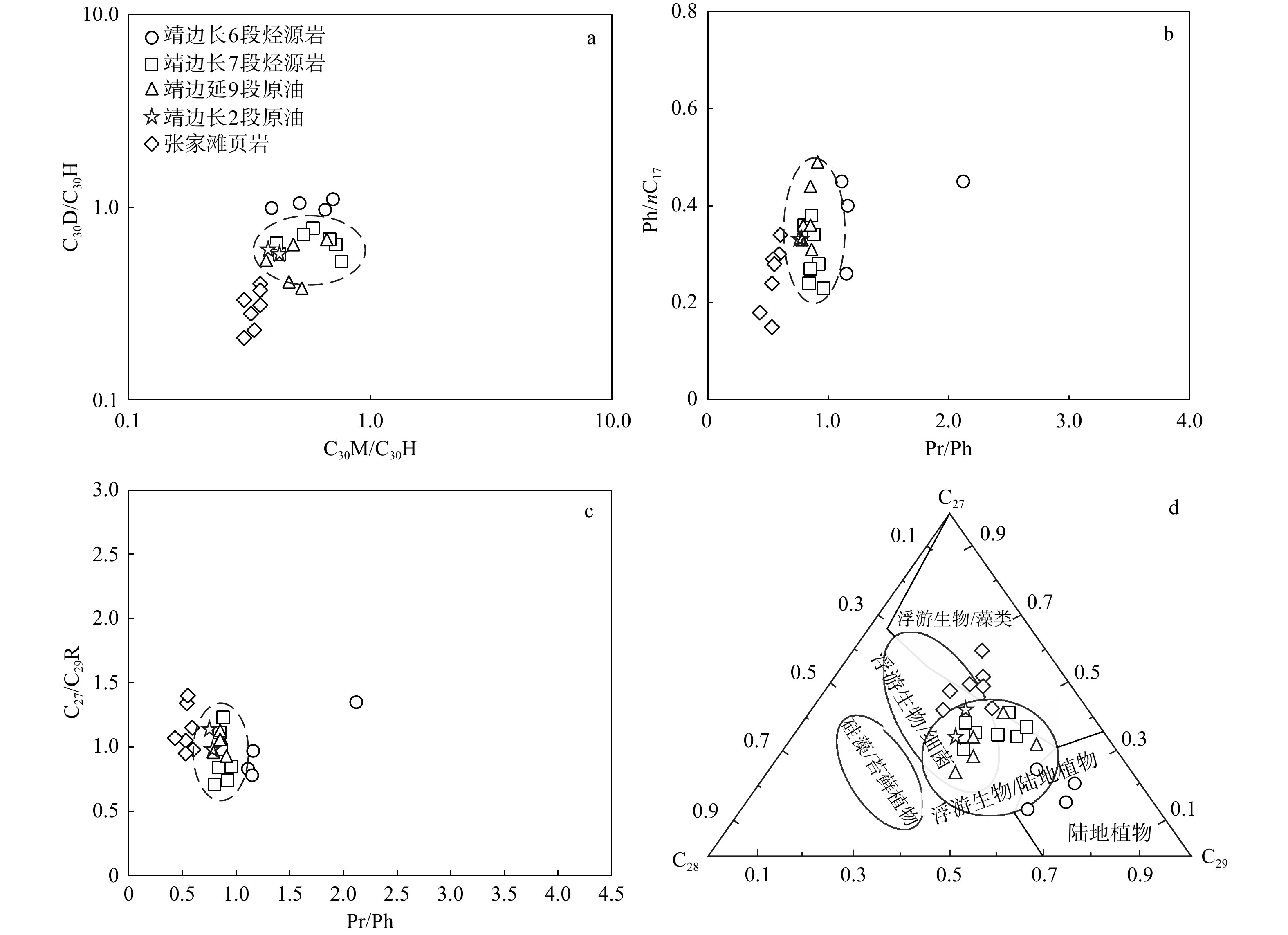
图 15 原油与烃源岩生物标志化合物对比图
a—C30D/C30H 和 C30M/C30H交会图;b—Pr/Ph vs. Pr/nC17交会图;c—Pr/Ph vs. C27/C29R交会图;d—C27, C28 和C29三角图
Figure 15. Comparison of biomarkers between crude oils and hydrocarbon source rocks in the study area
(a) Cross plot of C30D/C30H vs. C30M/C30H; (b) Cross plot of Pr/Ph vs. Pr/nC17; (c) Cross plot of Pr/Ph vs. C27/C29R; (d) Ternary diagram of C27, C28, and C29
表 1 研究区烃源岩地球化学数据
Table 1. Geochemical data of hydrocarbon source rocks in the study area
层位 TOC含量/% S1+S2/(mg/g) Tmax/℃ HI/(mg/g) Ro/% 丰度评价 长6段 $\dfrac{0.42~7.05}{2.26(21)} $ $\dfrac{0.87~18.88}{5.74(21)} $ $\dfrac{438~454}{446(21)} $ $\dfrac{41~1009}{179(21)} $ $\dfrac{0.84~0.89}{0.86(13)} $ 中等—好 长7段 $\dfrac{0.68~8.46}{2.84(62)} $ $\dfrac{1.02~47.93}{13.15(62)} $ $\dfrac{438~461}{451(62)} $ $\dfrac{67~1236}{344(62)} $ $\dfrac{0.86~0.9}{0.88(15)} $ 中等—优质 注:$ \dfrac{0.42~7.05}{2.26\left(21\right)} $表示$ \dfrac{最小值~最大值}{平均值(样品数)} $  下载: 导出CSV
表 2 研究区烃源岩生物标志化合物数据
Table 2. Selected molecular parameters from source rock samples in the study area
井号 深度 层位 样品类型 A B C D E F G H I 杨41 1741.9 m 长6段 泥岩 0.26 0.45 1.11 0.12 0.15 0.83 0.35 1.05 0.51 青3 976.9 m 长6段 泥岩 0.39 0.26 1.15 0.12 0.14 0.78 0.46 0.99 0.39 靖12 1706.7 m 长6段 泥岩 0.59 0.45 2.10 0.26 0.13 0.67 0.32 0.97 0.65 杨41 1650.0 m 长6段 泥岩 0.52 0.40 1.16 0.20 0.06 0.97 0.18 1.10 0.70 茂38 1946.4 m 长7段 泥岩 0.72 0.27 0.85 0.27 0.06 1.11 0.36 0.65 0.41 郝176 2282.6 m 长7段 泥岩 1.23 0.23 0.96 0.19 0.18 0.85 0.45 0.68 0.68 杨59 2021.8 m 长7段 泥岩 0.63 0.36 0.80 0.33 0.18 0.71 0.39 0.52 0.76 杨41 1855.0 m 长7段 泥岩 0.68 0.34 0.88 0.25 0.13 1.23 0.28 0.78 0.58 青3 979.5 m 长7段 泥岩 0.92 0.38 0.86 0.27 0.14 0.98 0.34 0.57 0.42 郝176 2277.3 m 长7段 泥岩 1.33 0.24 0.84 0.18 0.17 0.84 0.47 0.64 0.72 注:A为nC21−/nC22+;B为Pr/nC17;C为Pr/Ph;D为Ph/nC18;E为Ga/C30H;F为C27/C29R;G为C27重排甾烷/(重排甾烷+规则甾烷);H为C30D/C30H;I为C30M/C30H
下载: 导出CSV
表 3 研究区原油生物标志化合物数据
Table 3. Selected molecular parameters from crude oil in the study area
井名 深度 层位 样品类型 A B C D E F G H I J K 新161井 1118 m 延9段 原油 0.87 0.15 0.31 0.31 0.86 1.07 0.29 0.51 0.51 0.48 0.64 天26-141井 1011 m 延9段 原油 0.73 0.13 0.49 0.49 0.91 0.93 0.29 0.51 0.52 0.66 0.68 杨45-11井 1000 m 延9段 原油 0.85 0.21 0.36 0.41 0.79 0.96 0.32 0.51 0.51 0.46 0.41 天21-11井 1032 m 延9段 原油 0.74 0.13 0.44 0.44 0.85 1.13 0.28 0.53 0.50 0.52 0.38 杨加41-151井 1026 m 延9段 原油 0.92 0.13 0.36 0.39 0.85 1.06 0.28 0.50 0.53 0.37 0.53 天9-21井 1278 m 长2段 原油 0.82 0.13 0.33 0.38 0.78 0.98 0.23 0.53 0.50 0.42 0.59 天11-20井 1284 m 长2段 原油 0.77 0.14 0.33 0.40 0.76 1.14 0.24 0.53 0.50 0.38 0.62 注:A为nC21−/nC22+;B为Ga/C30H;C为Pr/nC17;D为Ph/nC18;E为Pr/Ph;F为C27/C29R;G为C27重排甾烷/(重排甾烷+规则甾烷);H为C29-αββ/(ααα+αββ);I为C29-20S/(20S+20R);J为C30M/C30H;K为C30D/C30H
下载: 导出CSV
-
[1] CHEN Z L, LIU G D, WEI Y Z, et al., 2017. Distribution pattern of tricyclic terpanes and its influencing factors in the Permian source rocks from Mahu Depression in the Junggar Basin[J]. Oil & Gas Geology, 38(2): 311-322. (in Chinese with English abstract) [2] CHEN R S, 1992. Petroleum geology[M]. Wuhan: China University of Geosciences Press. (in Chinese with English abstract) [3] DAI Y, TAN J Q, XIE W Q, 2022. Study on hydrocarbon generation potential and sedimentary environment of shale in the first member of Qingshankou Formation in central depression of Songliao Basin[J]. Unconventional Oil & Gas, 9(5): 9-24. (in Chinese with English abstract) [4] DENG X Q, FU J H, YAO J L, et al., 2011. Sedimentary facies of the Middle-Upper Triassic Yanchang Formation in Ordos Basin and breakthrough in petroleum exploration[J]. Journal of Palaeogeography, 13(4): 443-455. (in Chinese with English abstract) [5] DIAO H, JIANG Y M, CHEN Z Y, et al., 2026. Reconstruction of paleoenvironment of the Eocene source rocks in the Xihu Sag, East China Sea, based on major and trace elements and biomarkers[J]. Rock and Mineral Analysis, 45(1): 31-44. (in Chinese with English abstract) [6] DIDYK B M, SIMONEIT B R T, BRASSELL S C, et al., 1978. Organic geochemical indicators of palaeoenvironmental conditions of sedimentation[J]. Nature, 272(5650): 216-222. doi: 10.1038/272216a0 [7] DUAN Y, 2012. Geochemical characteristics of crude oil in fluvial deposits from Maling oilfield of Ordos Basin, China[J]. Organic Geochemistry, 52: 35-43. doi: 10.1016/j.orggeochem.2012.08.010 [8] EGLINTON G, HAMILTON R J, 1967. Leaf Epicuticular Waxes: The waxy outer surfaces of most plants display a wide diversity of fine structure and chemical constituents[J]. Science, 156(3780): 1322-1335. doi: 10.1126/science.156.3780.1322 [9] FENG Q, ZHOU H F, ZHANG Y, et al., 2018. Organic geochemical characteristics and geological significance of the Middle-Upper Triassic source rock in the southeast of Junggar Basin[J]. Bulletin of Science and Technology, 34(11): 73-81. (in Chinese with English abstract) [10] FU J H, DENG X Q, CHU M J, et al., 2013. Features of deepwater lithofacies, Yanchang formation in Ordos Basin and its petroleum significance[J]. Acta Sedimentologica Sinica, 31(5): 928-938. (in Chinese with English abstract) [11] FU J H, LI S X, XU L M, et al., 2018. Paleo-sedimentary environmental restoration and its significance of Chang 7 member of Triassic Yanchang Formation in Ordos Basin, NW China[J]. Petroleum Exploration & Development, 45(6): 936-946. (in Chinese with English abstract) doi: 10.1016/s1876-3804(18)30104-6 [12] FU J H, LI S X, NIU X B, et al., 2020. Geological characteristics and exploration of shale oil in Chang 7 member of Triassic Yanchang Formation, Ordos Basin, NW China[J]. Petroleum Exploration and Development, 47(5): 870-883. (in Chinese with English abstract) [13] FU J H, GUO W, LI S X, et al., 2021. Characteristics and exploration potential of muti-type shale oil in the 7th member of Yanchang Formation, Ordos Basin[J]. Natural Gas Geoscience, 32(12): 1749-1761. (in Chinese with English abstract) [14] FU J H, WANG L, CHEN X, et al., 2023. Progress and prospects of shale oil exploration and development in the seventh member of Yanchang Formation in Ordos Basin[J]. China Petroleum Exploration, 28(5): 1-14. (in Chinese with English abstract) [15] GAO B, WU X L, ZHANG Y, et al., 2022. Hydrocarbon generation and evolution characteristics of Triassic Zhangjiatan oil shale in southern Ordos Basin[J]. Petroleum Geology & Experiment, 44(1): 24-32. (in Chinese with English abstract) [16] GAO P M, 2024. Characteristics and hydrocarbon generation and expulsion potential of Chang7 shale oil source rocks in Wuqi Area, Ordos Basin[J]. Unconventional Oil & Gas, 11(3): 10-18. (in Chinese with English abstract) [17] General Administration of Quality Supervision, Inspection and Quarantine of the People's Republic of China, Standardization Administration of the People’s Republic of China, 2013. Rock pyrolysis analysis: GB/T 18602-2012[S]. Beijing: Standards Press of China. (in Chinese) [18] HE Y H, WANG Y G, DU Y J, et al., 2023. Geochemical characteristics of crude oils in the Zhijing area, Ordos Basin: Implication for oil accumulation in the Yan’an Formation[J]. Journal of Northwest University (Natural Science Edition), 53(3): 480-494. (in Chinese with English abstract) [19] HUANG Y J, BAI Y B, SUN B H, et al., 2020a. Characteristics and evaluation of Chang 7 source rock of Yanchang Formation in Fuxian area, Ordos Basin[J]. Lithologic Reservoirs, 32(1): 66-75. (in Chinese with English abstract) [20] HUANG Y J, GENG J K, BAI Y B, et al., 2020b. Geochemical characteristics and oil-source correlation of crude oils in 6th and 7th members of Yanchang Formation, Fuxian area, Ordos Basin[J]. Petroleum Geology & Experiment, 42(2): 281-288. (in Chinese with English abstract) [21] JIA H C, LU Y B, ZHAO X C, et al., 2023. Formation pressure restoration and its effect on oil and gas accumulation in Chang6 member of Wuqi Oilfield, Ordos Basin[J]. Unconventional Oil & Gas, 10(5): 56-64. (in Chinese with English abstract) [22] LI C, TONG C B, YANG F, et al., 2025. Study on pore system characteristics and controlling factors of Yanchang Formation shale, Ordos Basin[J]. Unconventional Oil & Gas, 12(3): 22-32. (in Chinese with English abstract) [23] LI C H, GE Y, JIN X, et al., 2022. Sedimentological evolution during the Early Jurassic Fuxian period in Ordos Basin: palaeoclimatic response to Toarcian Oceanic Anoxic Event[J]. Journal of Palaeogeography, 24(4): 697-712. (in Chinese with English abstract) [24] LI J B, LIU Z J, ZHANG C, et al., 2024. Geochemical characteristics of gas field water and sources of lithium from Majiagou Formation in Jingbian area of Ordos Basin, China[J]. Journal of Earth Sciences and Environment, 46(5): 651-662. (in Chinese with English abstract) [25] LI S M, PANG X Q, JIN Z J, 2002. Distribution and significance of steroids in Bamianhe Oilfield, East China[J]. Earth Science—Journal of China University of Geosciences, 27(6): 711-717. (in Chinese with English abstract) [26] LI Z Q, ZHANG R C, LIANG X M, et al., 2024. Chemical kinetics models of organic matter (Vitrinite and Bitumen) reflectance: retrospect and advances[J]. Earth Science, 49(11): 4130-4155. (in Chinese with English abstract) [27] LIANG X W, WANG H H, NIU X B, et al., 2011. Source rock evaluation and oil-source rock correlation in Triassic Yanchang Formation of the middle-western Ordos Basin, China[J]. Journal of Chengdu University of Technology (Science & Technology Edition), 38(4): 402-407. (in Chinese with English abstract) [28] LIU R H, LI J, XIAO Z Y, et al., 2019. Geochemical characteristics and implication for gas and oil source correlation in the Tugeerming area of the Kuqa Depression, Tarim Basin[J]. Natural Gas Geoscience, 30(4): 574-581. (in Chinese with English abstract) doi: 10.1016/j.jnggs.2019.06.001 [29] LIU Y Z, GANG W Z, CHEN G, et al., 2018. Geochemical characteristics of aromatic hydrocarbons of Chang7 source rocks from the Yanchi-Dingbian Area, Ordos Basin[J]. Acta Sedimentologica Sinica, 36(4): 818-828. (in Chinese with English abstract) [30] National Energy Administration, 2012. Method of determining microscopically the reflectance of vitrinite in sedimentary: SY/T 5124-2012[S]. Beijing: Petroleum Industry Press. (in Chinese) [31] PETERS K E, MOLDOWAN J M, 1991. Effects of source, thermal maturity, and biodegradation on the distribution and isomerization of homohopanes in petroleum[J]. Organic Geochemistry, 17(1): 47-61. doi: 10.1016/0146-6380(91)90039-M [32] PETERS K E, WALTERS C C, MOLDOWAN J M, 2005. The biomarker guide[M]. 2nd ed. Cambridge: Cambridge University Press: 1-1155. [33] QIU X W, LIU C Y, MAO G Z, et al., 2014. Late Triassic tuff intervals in the Ordos basin, Central China: their depositional, petrographic, geochemical characteristics and regional implications[J]. Journal of Asian Earth Sciences, 80: 148-160. doi: 10.1016/j.jseaes.2013.11.004 [34] SEIFERT W K, MOLDOWAN J M, 1986. Use of biological markers in petroleum exploration[J]. Methods in Geochemistry and Geophysics, 24: 261-290. [35] SHI Z Q, HAN Y L, ZHAO J X, 2002. Fans at the early Jurassic Fuxian Stage in Ordos Basin[J]. Journal of Chengdu University of Technology, 29(4): 390-393. (in Chinese with English abstract) [36] SINNINGHE DAMSTÉ J S, KENIG F, KOOPMANS M P, et al., 1995. Evidence for gammacerane as an indicator of water column stratification[J]. Geochimica et Cosmochimica Acta, 59(9): 1895-1900. doi: 10.1016/0016-7037(95)00073-9 [37] Standardization Committee for Petroleum Geological Exploration, 1996. Geochemical evaluation method for continental hydrocarbon source rocks: SY/T 5735-1995[S]. Beijing: Petroleum Industry Press. (in Chinese) [38] State Administration for Market Regulation, National Standardization Administration, 2022. Determination for total organic carbon in sedimentary rock: GB/T 19145-2022[S]. Beijing: Standards Press of China. (in Chinese) [39] SUN B, YUAN W, WANG S M, et al., 2025. Characteristics and oil-source correlation of Chang 7 member source rocks in Haotan area, Ordos Basin[J]. Fault-Block Oil & Gas Field, 32(3): 353-362. (in Chinese with English abstract) [40] TANG J Y, SHI Z, SONG H X, et al., 2016. Hydrocarbon source evaluation and oil source contrast of the Yanchang Formation in Fu-Huang exploration area, Ordos Basin[J]. Journal of Southwest Petroleum University (Science & Technology Edition), 38(3): 11-20. (in Chinese with English abstract) [41] WANG A G, LI C Y, JING X H, et al., 2023. Difference, origin and oil source significance of tricyclic terpenes in Chang 7 source rocks in Ordos Basin[J]. Journal of China University of Petroleum (Edition of Natural Science), 47(4): 48-59. (in Chinese with English abstract) [42] WANG X J, SUN B, LI J H, et al., 2026. Development characteristics and geological significance of Chang 7 member effective source rocks in Sanbian area, Ordos Basin[J]. Natural Gas Geoscience, 37(1): 12-23. (in Chinese with English abstract) [43] WANG X Z, REN L Y, ZHANG L X, et al., 2013. Oil and source rock correlation of lower assemblage of Yanchang Formation in Wuqi and Dingbian areas, Ordos Basin[J]. Petroleum Geology & Experiment, 35(4): 426-431. (in Chinese with English abstract) [44] WANG Z X, LIU G D, YUAN G J, et al., 2024. Characteristics and reservoir control of source rocks of Triassic Chang 7 member in Qingcheng area, Ordos Basin[J]. Lithologic Reservoirs, 36(5): 133-144. (in Chinese with English abstract) [45] WEI Z F, WANG Y L, WU C J, et al., 2015. Geochemical characteristics of source rock from Upper Permian Longtan Formation in Sichuan Basin[J]. Natural Gas Geoscience, 26(8): 1613-1618. (in Chinese with English abstract) [46] WU Y, CHEN Y B, XU Z Y, et al. , 2025. Analysis of the hydrocarbon accumulation process of the Chang 10 member of the Yanchang Formation in the Zhijing to Ansai Area, Ordos Basin[J]. Journal of Northeast Petroleum University, 49(1): 33-44, 60. (in Chinese with English abstract) [47] YAN Z, REN D Z, WANG H, et al., 2024. Factors affecting movable fluid saturation and pore structures of Jurassic Yan'an Formation in the Shenmu area of the Ordos Basin[J]. Unconventional Oil & Gas, 11(5): 122-131. (in Chinese with English abstract) [48] YANG X Y, TANG Y J, HONG H T, et al., 2022. An abnormal assemblage of molecular markers and its geochemical significance in the Da'anzhai member of the central Sichuan Basin[J]. Geological Bulletin of China, 41(4): 669-681. (in Chinese with English abstract) [49] YANG X Y, LV X X, HUANG Y H, et al., 2023. The depositional environment of the lacustrine source rocks in the Eocene middle number of the Liushagang Formation of the Weixinan Sag, Beibuwan Basin, China: implications from organic geochemical analyses[J]. Minerals, 13: 575. [50] YIN J T, YU Y X, JIANG C F, et al., 2017. Relationship between element geochemical characteristic and organic matter enrichment in Zhangjiatan Shale of Yanchang Formation, Ordos Basin[J]. Journal of China Coal Society, 42(6): 1544-1556. (in Chinese with English abstract) [51] YUAN Z, SI H J, MA Y, et al., 2024. Characteristics and paleogeographic pattern of source-to-sink system of the Jurassic Yan’an Formation in Ordos Basin[J]. Journal of Northwest University (Natural Science Edition), 54(6): 1104-1120. (in Chinese with English abstract) [52] ZHANG H, LEI H W, ZHANG T, et al., 2018. Geochemical characteristics of Yan 9 crude oil and oil-source correlation in western Jingbian Oil Field, Ordos Basin[J]. Petroleum Geology & Experiment, 40(6): 836-842. (in Chinese with English abstract) [53] ZHANG W Z, YANG H, ZAN C L, et al., 2016. Geochemical study of Paleozoic gas reservoirs in a highly mature area on the south-central Yishan slope, Ordos Basin[J]. Geochimica, 45(6): 614-622. (in Chinese with English abstract) [54] ZHANG X L, PING H W, YANG X, et al., 2024. Comparison of hydrocarbon generation, expulsion periods, and accumulation periods of source rocks in member 7 of the Yanchang Formation in the Jinghe Oilfield, southern Ordos Basin[J]. Bulletin of Geological Science and Technology, 43(1): 108-121. (in Chinese with English abstract) [55] ZHANG Y Y, YANG S S, LIU Y Q, et al., 2023. Enrichment regularity of Y–9 reservoir of Yan’an Formation in Shawagou Area of Jingbian Oilfield, Ordos Basin[J]. Northwestern Geology, 56(2): 213-224. (in Chinese with English abstract) [56] ZHAO J Z, GAO Z D, MENG X G, et al., 2025. Geological conditions for tight oil enrichment and its exploration potential of gravity-flow deposits from the 7th to 9th oil groups of the Triassic Yanchang Formation, Ordos Basin: discussion on the petroleum exploration paradigms of downwarped lacustrine basins[J]. Oil & Gas Geology, 46(5): 1367-1391. (in Chinese with English abstract) [57] 陈哲龙, 柳广弟, 卫延召, 等, 2017. 准噶尔盆地玛湖凹陷二叠系烃源岩三环萜烷分布样式及影响因素[J]. 石油与天然气地质, 38(2): 311-322. doi: 10.11743/ogg20170211 [58] 陈荣书, 1992. 石油天然气地质学[M]. 武汉: 中国地质大学出版社. [59] 代宇, 谭静强, 谢文泉, 2022. 松辽盆地中央凹陷青山口组一段页岩生烃潜力及沉积环境研究[J]. 非常规油气, 9(5): 9-24. [60] 邓秀芹, 付金华, 姚泾利, 等, 2011. 鄂尔多斯盆地中及上三叠统延长组沉积相与油气勘探的突破[J]. 古地理学报, 13(4): 443-455. [61] 刁慧, 蒋一鸣, 陈忠云, 等, 2026. 基于主微量元素和生物标志物重建东海西湖凹陷始新世烃源岩发育古环境[J]. 岩矿测试, 45(1): 31-44. doi: 10.15898/j.ykcs.202506060152 [62] 冯乔, 周海峰, 张耀, 等, 2018. 准噶尔盆地东南缘中上三叠统烃源岩有机地球化学特征及意义[J]. 科技通报, 34(11): 73-81. doi: 10.13774/j.cnki.kjtb.2018.11.013 [63] 付金华, 邓秀芹, 楚美娟, 等, 2013. 鄂尔多斯盆地延长组深水岩相发育特征及其石油地质意义[J]. 沉积学报, 31(5): 928-938. doi: 10.14027/j.cnki.cjxb.2013.05.011 [64] 付金华, 李士祥, 徐黎明, 等, 2018. 鄂尔多斯盆地三叠系延长组长7段古沉积环境恢复及意义[J]. 石油勘探与开发, 45(6): 936-946. doi: 10.11698/PED.2018.06.02 [65] 付金华, 李士祥, 牛小兵, 等, 2020. 鄂尔多斯盆地三叠系长7段页岩油地质特征与勘探实践[J]. 石油勘探与开发, 47(5): 870-883. [66] 付金华, 郭雯, 李士祥, 等, 2021. 鄂尔多斯盆地长7段多类型页岩油特征及勘探潜力[J]. 天然气地球科学, 32(12): 1749-1761. doi: 10.11764/j.issn.1672-1926.2021.07.016 [67] 付金华, 王龙, 陈修, 等, 2023. 鄂尔多斯盆地长7页岩油勘探开发新进展及前景展望[J]. 中国石油勘探, 28(5): 1-14. doi: 10.3969/j.issn.1672-7703.2023.05.001 [68] 高波, 武晓玲, 张英, 等, 2022. 鄂尔多斯盆地南部张家滩油页岩生烃演化特征[J]. 石油实验地质, 44(1): 24-32. doi: 10.11781/sysydz202201024 [69] 高攀明, 2024. 鄂尔多斯盆地吴起地区长7页岩油烃源岩特征及生排烃潜力[J]. 非常规油气, 11(3): 10-18. doi: 10.19901/j.fcgyq.2024.03.02 [70] 国家能源局, 2012. 沉积岩中镜质体反射率测定方法: SY/T 5124-2012[S]. 北京: 石油工业出版社. [71] 国家市场监督管理总局, 国家标准化管理委员会, 2022. 沉积岩中总有机碳测定: GB/T 19145-2022[S]. 北京: 中国标准出版社. [72] 贺永红, 王爱国, 杜彦军, 等, 2023. 鄂尔多斯盆地志靖地区原油地化特征及其对延安组成藏的启示[J]. 西北大学学报(自然科学版), 53(3): 480-494. doi: 10.16152/j.cnki.xdxbzr.2023-03-019 [73] 黄彦杰, 白玉彬, 孙兵华, 等, 2020a. 鄂尔多斯盆地富县地区延长组长7烃源岩特征及评价[J]. 岩性油气藏, 32(1): 66-75. [74] 黄彦杰, 耿继坤, 白玉彬, 等, 2020b. 鄂尔多斯盆地富县地区延长组长6、长7段原油地球化学特征及油源对比[J]. 石油实验地质, 42(2): 281-288. doi: 10.11781/sysydz202002281 [75] 贾浩宸, 刘玉博, 赵小春, 等, 2023. 鄂尔多斯盆地吴起油田长6段地层古压力及其对油气聚集作用的分析[J]. 非常规油气, 10(5): 56-64. doi: 10.19901/j.fcgyq.2023.05.08 [76] 李婵, 童长兵, 杨凡, 等, 2025. 鄂尔多斯盆地延长组页岩孔隙系统发育特征及影响因素研究[J]. 非常规油气, 12(3): 22-32. [77] 李昌昊, 葛禹, 金鑫, 等, 2022. 鄂尔多斯盆地早侏罗世富县期沉积演化: 大洋缺氧事件前后陆地气候变化的响应[J]. 古地理学报, 24(4): 697-712. [78] 李进步, 刘志军, 张晨, 等, 2024. 鄂尔多斯盆地靖边地区马家沟组气田水地球化学特征及锂来源[J]. 地球科学与环境学报, 46(5): 651-662. doi: 10.19814/j.jese.2024.03023 [79] 李素梅, 庞雄奇, 金之钧, 2002. 八面河地区原油、烃源岩中甾类化合物的分布特征及其应用[J]. 地球科学——中国地质大学学报, 27(6): 711-717. [80] 李志强, 张如才, 梁雪梅, 等, 2024. 有机质(镜质体和沥青)反射率化学动力学模型: 回顾与进展[J]. 地球科学, 49(11): 4130-4155. doi: 10.3799/dqkx.2023.183 [81] 梁晓伟, 王海红, 牛小兵, 等, 2011. 鄂尔多斯盆地中西部延长组烃源岩评价及油-源对比[J]. 成都理工大学学报(自然科学版), 38(4): 402-407. [82] 刘如红, 李剑, 肖中尧, 等, 2019. 塔里木盆地库车坳陷吐格尔明地区油气地球化学特征及烃源探讨[J]. 天然气地球科学, 30(4): 574-581. doi: 10.11764/j.issn.1672-1926.2018.12.019 [83] 刘亚洲, 刚文哲, 陈果, 等, 2018. 鄂尔多斯盆地盐池—定边地区长7段烃源岩芳烃地球化学特征[J]. 沉积学报, 36(4): 818-828. [84] 时志强, 韩永林, 赵俊兴, 2002. 鄂尔多斯盆地早侏罗世富县期冲积扇沉积[J]. 成都理工学院学报, 29(4): 390-393. [85] 石油地质勘探专业标准化委员会, 1996. 陆相烃源岩地球化学评价方法: SY/T 5735—1995[S]. 北京: 石油工业出版社. [86] 孙勃, 袁伟, 王淑敏, 等, 2025. 鄂尔多斯盆地郝滩地区长7段烃源岩特征及油源对比[J]. 断块油气田, 32(3): 353-362. doi: 10.6056/dkyqt202503001 [87] 唐建云, 史政, 宋红霞, 等, 2016. 富黄探区延长组烃源岩评价与油源对比[J]. 西南石油大学学报(自然科学版), 38(3): 11-20. [88] 王爱国, 李春雨, 井向辉, 等, 2023. 鄂尔多斯盆地长7烃源岩三环萜烷的差异性、成因及其油源意义[J]. 中国石油大学学报(自然科学版), 47(4): 48-59. doi: 10.3969/j.issn.1673-5005.2023.04.005 [89] 王香增, 任来义, 张丽霞, 等, 2013. 鄂尔多斯盆地吴起—定边地区延长组下组合油源对比研究[J]. 石油实验地质, 35(4): 426-431. doi: 10.11781/sysydz201304426 [90] 王秀娟, 孙勃, 李继宏, 等, 2026. 鄂尔多斯盆地三边地区长7段烃源岩发育特征及地质意义[J]. 天然气地球科学, 37(1): 12-23. [91] 王子昕, 柳广弟, 袁光杰, 等, 2024. 鄂尔多斯盆地庆城地区三叠系长7段烃源岩特征及控藏作用[J]. 岩性油气藏, 36(5): 133-144. [92] 魏志福, 王永莉, 吴陈君, 等, 2015. 四川盆地上二叠统龙潭组烃源岩的地球化学特征及对有机质来源和沉积环境的指示意义[J]. 天然气地球科学, 26(8): 1613-1618. doi: 10.11764/j.issn.1672-1926.2015.08.1613 [93] 吴悠, 陈一博, 胥中义, 等, 2025. 鄂尔多斯盆地志靖—安塞地区延长组10段油气成藏过程分析[J]. 东北石油大学学报, 49(1): 33-44, 60. doi: 10.3969/j.issn.2095-4107.2025.01.003 [94] 阎珍, 任大忠, 王虎, 等, 2024. 鄂尔多斯盆地神木地区侏罗系延安组煤层孔隙结构及可动流体饱和度影响因素[J]. 非常规油气, 11(5): 122-131. [95] 杨孝勇, 唐友军, 洪海涛, 等, 2022. 川中地区大安寨段分子标志物异常组合及其地球化学意义[J]. 地质通报, 41(4): 669-681. doi: 10.12097/j.issn.1671-2552.2022.04.011 [96] 尹锦涛, 俞雨溪, 姜呈馥, 等, 2017. 鄂尔多斯盆地张家滩页岩元素地球化学特征及与有机质富集的关系[J]. 煤炭学报, 42(6): 1544-1556. doi: 10.13225/j.cnki.jccs.2016.1342 [97] 袁珍, 司豪杰, 马瑶, 等, 2024. 鄂尔多斯盆地侏罗系延安组源-汇系统特征及古地理格局[J]. 西北大学学报(自然科学版), 54(6): 1104-1120. [98] 张海, 雷华伟, 张涛, 等, 2018. 鄂尔多斯盆地靖边油田西部延9原油地球化学特征与油源[J]. 石油实验地质, 40(6): 836-842. doi: 10.11781/sysydz201806836 [99] 张文正, 杨华, 昝川莉, 等, 2016. 鄂尔多斯盆地伊陕斜坡中南部高热演化地区古生界天然气地球化学研究[J]. 地球化学, 45(6): 614-622. [100] 张新乐, 平宏伟, 杨鑫, 等, 2024. 鄂尔多斯盆地南缘泾河油田长7段烃源岩生、排烃期与油气成藏期对比[J]. 地质科技通报, 43(1): 108-121. doi: 10.19509/j.cnki.dzkq.tb20220409 [101] 张瑶瑶, 杨水胜, 刘宇琪, 等, 2023. 鄂尔多斯盆地靖边油田沙洼沟地区延安组延9油藏富集规律[J]. 西北地质, 56(2): 213-224. doi: 10.12401/j.nwg.2022033 [102] 赵靖舟, 高振东, 孟选刚, 等, 2025. 鄂尔多斯盆地陕北地区三叠系延长组长7—长9油层组重力流沉积致密油富集条件与勘探潜力: 兼论拗陷型湖盆的石油勘探范式[J]. 石油与天然气地质, 46(5): 1367-1391. [103] 中华人民共和国国家质量监督检验检疫总局, 中国国家标准化管理委员会, 2013. 岩石热解分析: GB/T 18602-2012[S]. 北京: 中国标准出版社. -

 下载:
下载:



计量
- 文章访问数: 419
- HTML全文浏览量: 101
- PDF下载量: 308
- 被引次数: 0
