


Composition, tectonic framework, and evolution of the Luxi Orogenic Belt in the North China Craton during the Late Neoarchean
-
摘要: 地球早期地壳的增生和演化是早前寒武纪研究的核心科学问题。华北克拉通作为全球最古老的克拉通之一,新太古代晚期(2.50~2.48 Ga)经历了复杂的克拉通化过程并伴随强烈的地壳增生和改造。鲁西花岗−绿岩带位于华北克拉通东部,已有的岩石学、地球化学、年代学和构造变形研究显示,鲁西地区发育一系列指示新太古代晚期地壳增生的证据,包括以肥城‒滕州岩浆弧和新太古代晚期变质火山岩为代表的陆缘弧和岛弧岩浆岩、以鲁山‒沂水岩浆岩带为代表的后碰撞壳源岩浆记录、新太古代晚期变沉积岩所代表的弧后盆地沉积以及板块斜向汇聚导致的大型走滑剪切变形。出露于鲁西地区中部的>2.60 Ga的英云闪长岩、奥长花岗岩、花岗闪长岩(TTG岩系)和表壳岩组合代表一个与胶辽地块具有明显亲缘性的古老陆块。因此,鲁西花岗−绿岩带是一个位于胶辽地块西缘的增生型造山带,即鲁西造山带。弧−陆高角度斜向碰撞和巨量幔源岩浆底垫分别代表了胶辽地块西缘水平和垂向地壳增生。该造山带在新太古代到古元古代末期经历了初始洋壳形成、俯冲到陆内伸展等构造演化阶段。新太古代晚期,华北克拉通东部胶辽地块周缘发生了广泛的地壳增生作用,这一过程受控于以板块热俯冲为特征的早期板块构造体制。Abstract:
Objective The growth and evolution of the early Earth’s crust are hot topics in Precambrian research. As one of the oldest cratons in the world, the North China Craton (NCC) has undergone a complex cratonization process accompanied by crustal growth and reworking. Methods Existing petrological, geochemical, chronological, and structural geological studies are summarized to reveal the tectonic evolution of the Luxi granite–greenstone belt in the eastern NCC. Results Multiple lines of evidence indicate late Neoarchean crustal growth, including continental arc and arc magmatic rocks represented by the Feicheng‒Tengzhou magmatic arc and late Neoarchean volcanic rocks, post-collisional crustal-derived magmatism represented by the Lushan‒Yishui magmatic belt, sedimentation in a back-arc basin defined by late Neoarchean metamorphic sedimentary rocks, and the strike-slip shear deformation caused by the oblique convergence of plates. The >2.60 Ga tonalite, trondhjemite, granodiorite (TTG) suite and the supracrustal rock belt exposed in the central part of the Luxi area represent an ancient microcontinent with apparent affinity to the Jiaoliao Block. Conclusions Therefore, the Luxi granite–greenstone belt is an accretionary orogenic belt located on the western margin of the Jiaoliao Block, namely the Luxi Orogenic Belt. High-angle oblique arc-continent collision and underplating of large volumes of mantle-derived magma represent two crustal growth modes in horizontal and vertical directions, respectively. This orogenic belt has undergone multi-stage evolution, including the formation of initial oceanic crust, subduction, and intracontinental extension from the Neoarchean to the end of the Paleoproterozoic. [Significance] In the late Neoarchean, extensive crustal growth occurred around the Jiaoliao Block in the eastern NCC, which was controlled by an early plate tectonic regime characterized by hot subduction. -
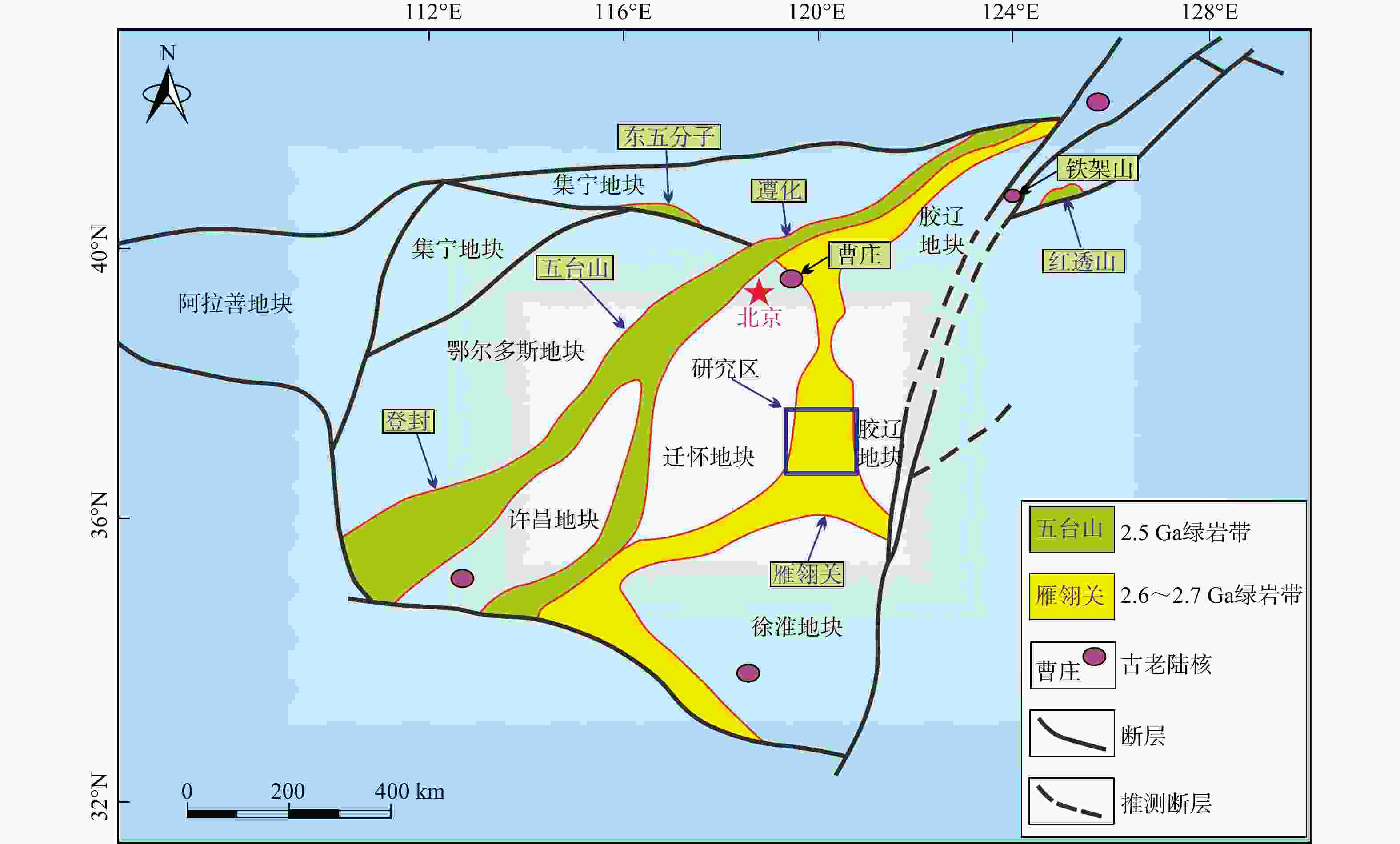
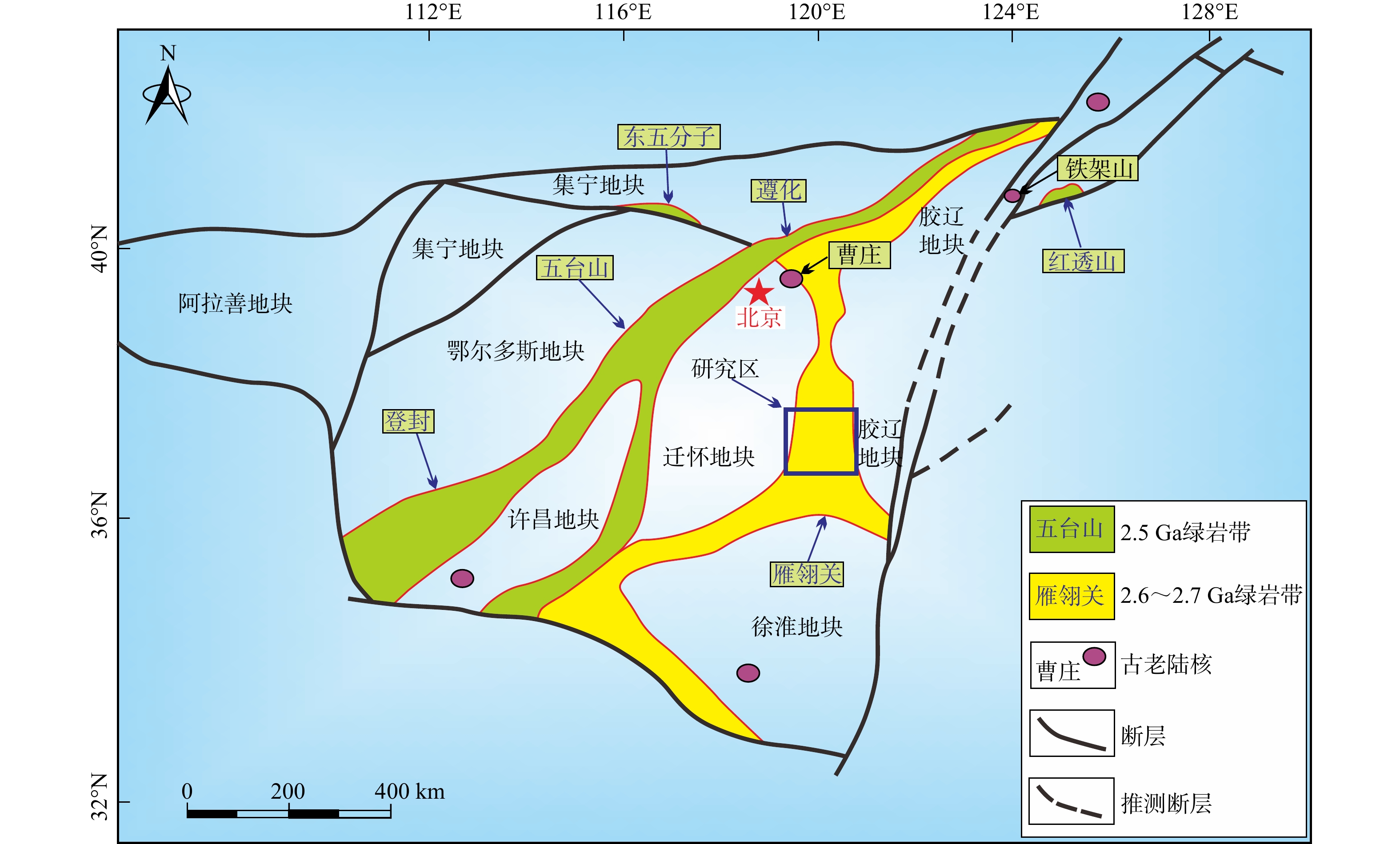
图 1 华北克拉通基底构造单元划分(Zhai and Santosh,2011)
Figure 1. Tectonic subdivision of the North China Craton basement (modified after Zhai and Santosh, 2011)
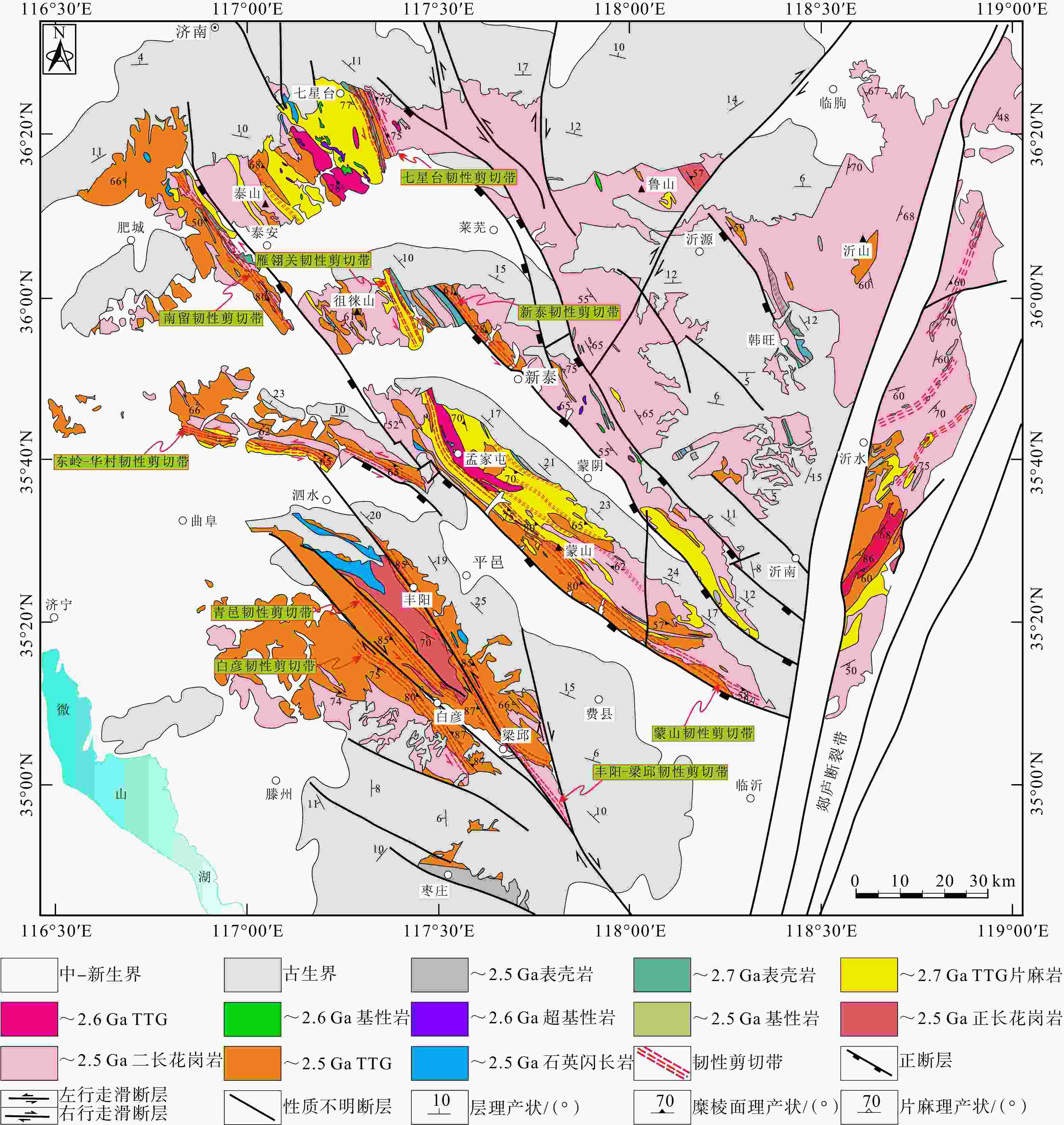
图 2 鲁西地区地质简图(山东省地质调查院,2021)
Figure 2. Simplified geological map of the Luxi area (modified after Shandong Institute of Geological Survey, 2021)
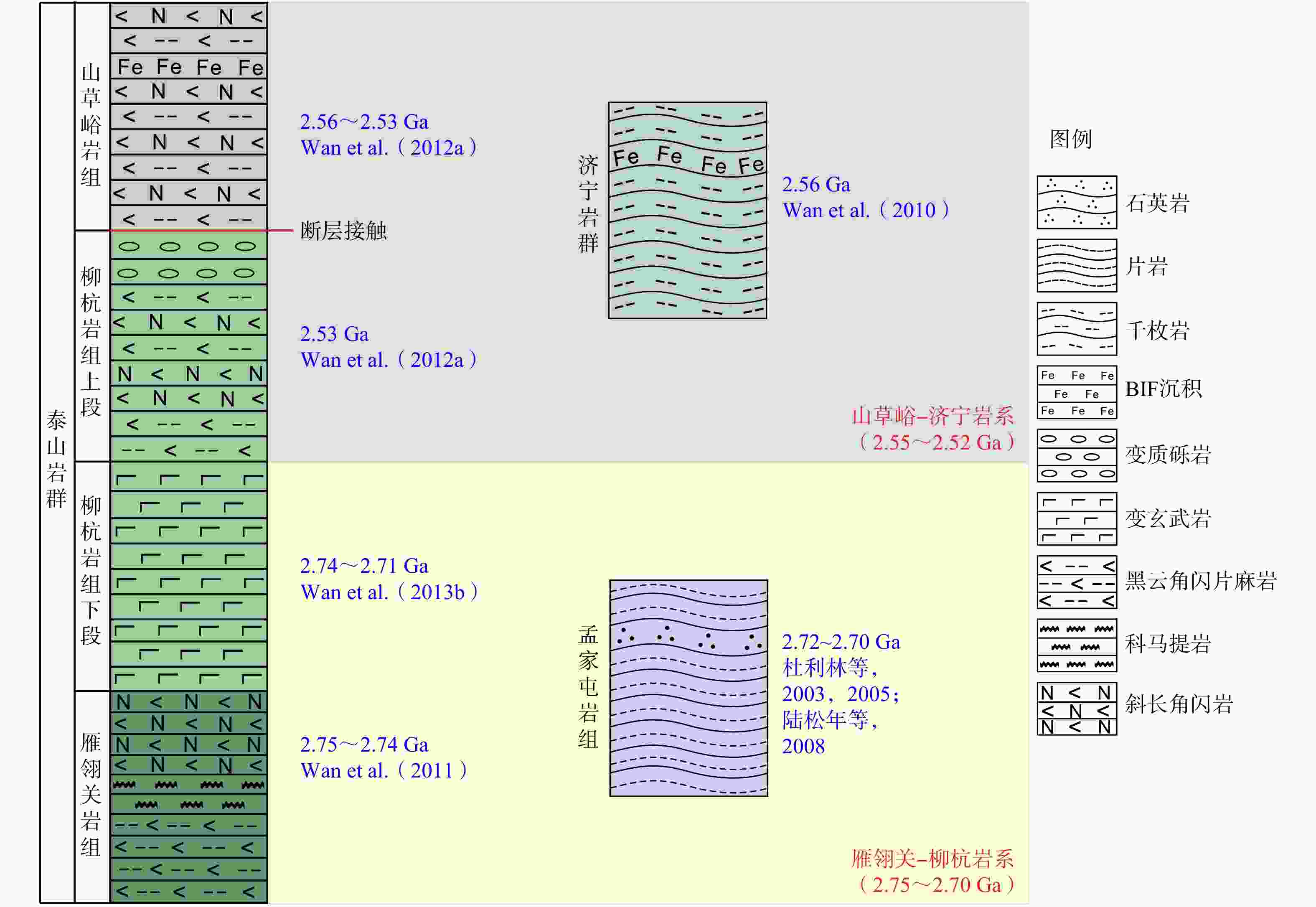
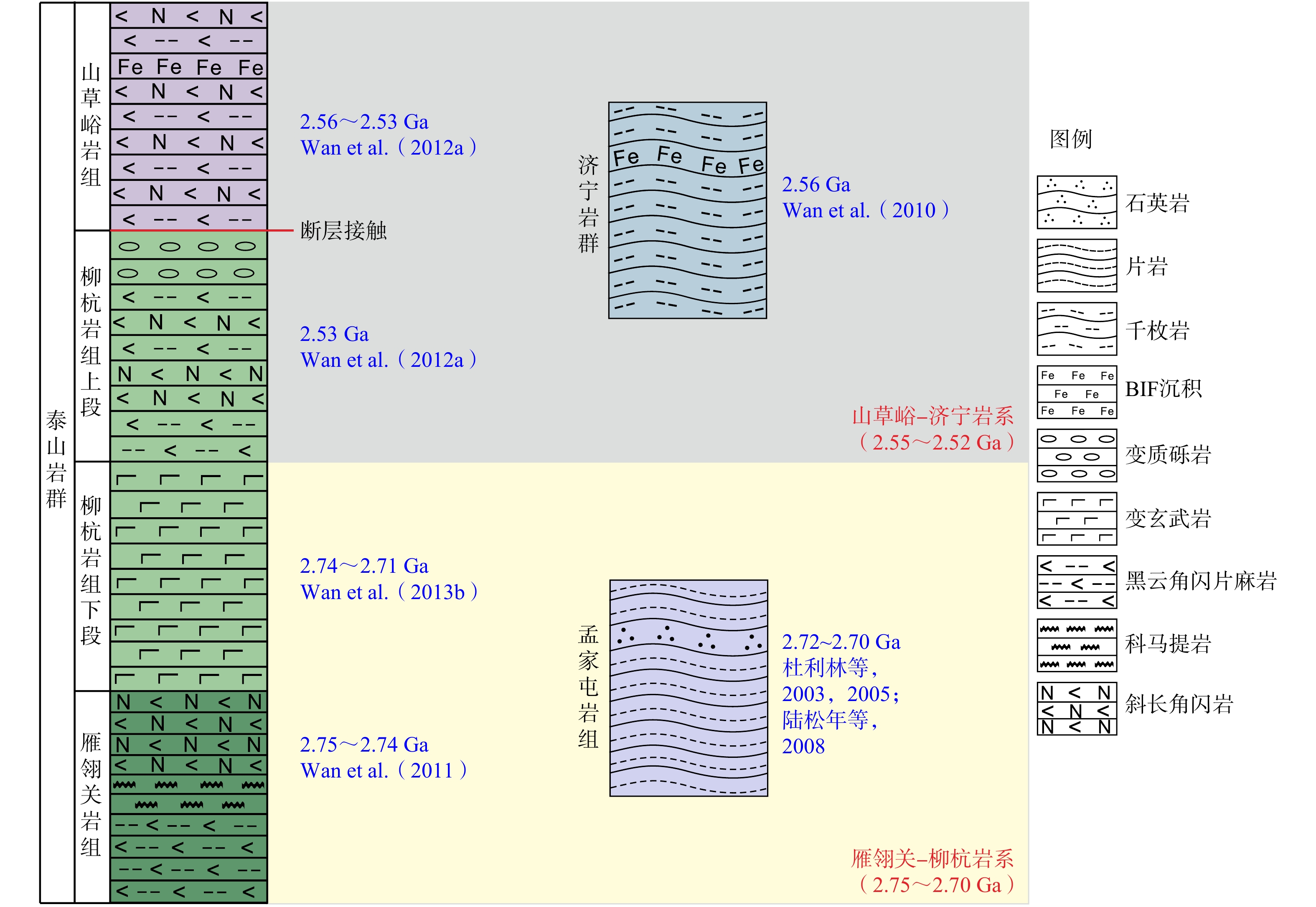
图 3 鲁西地区新太古代表壳岩地层柱状示意图
Figure 3. Stratigraphic column of the Neoarchean supracrustal rocks in the Luxi area
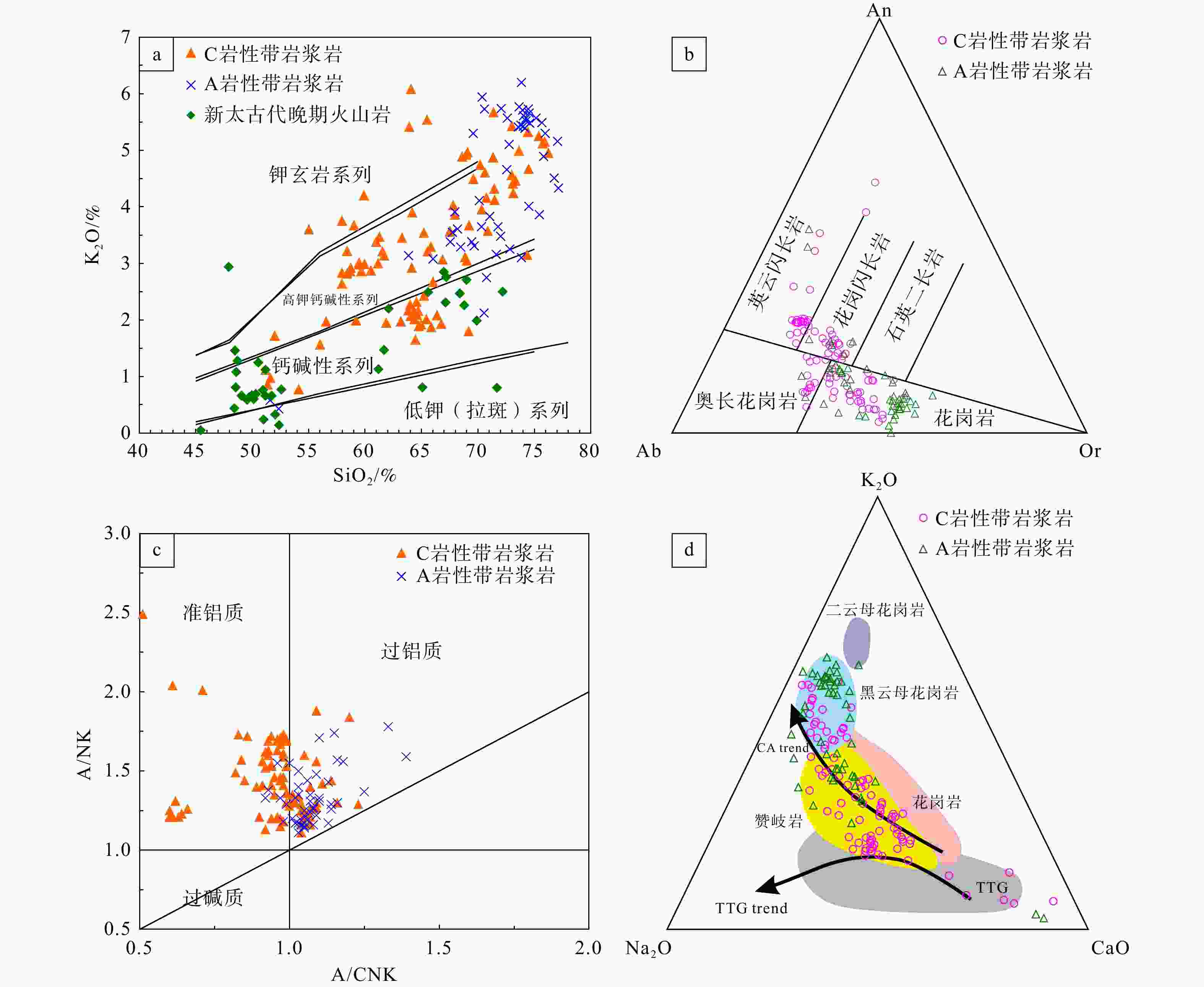
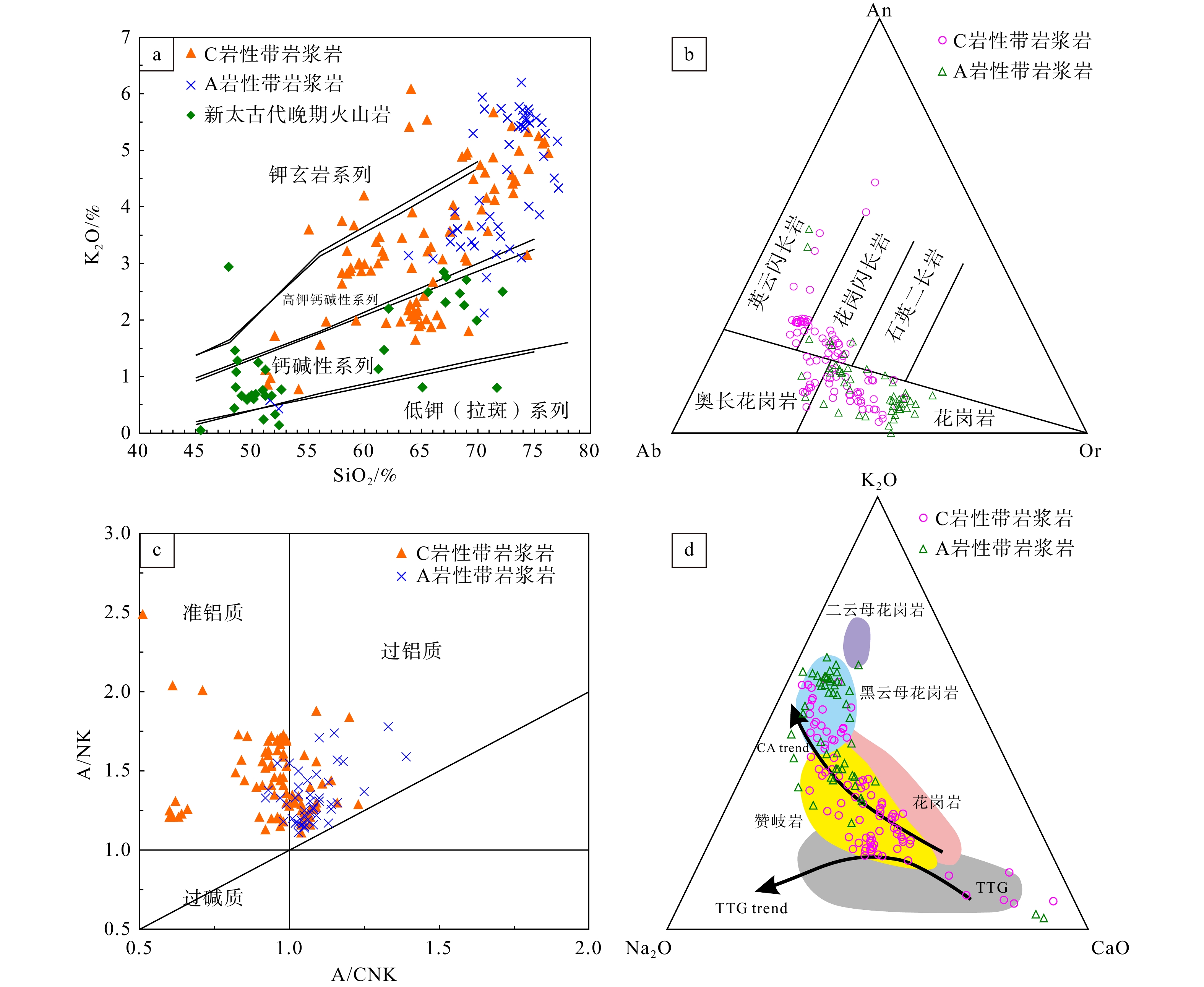
图 4 地球化学分类图解
新太古代晚期火山岩数据引自Wang et al.(2013c)、Gao et al.(2020);C岩性带岩浆岩数据引自Sun et al.(2019a,2020)、Wang et al.(2017b)、Peng et al.(2012)、Yu et al.(2021);A岩性带岩浆岩数据引自Wang et al.(2017b)、Wan et al.(2012b)、Gao et al.(2018)、Sun et al.(2020)a—SiO2-K2O分类图解(Laurent et al.,2013);b—An-Ab-Or分类图解(O’Connor,1965);c—A/NK-A/CNK图解(Maniar and Piccoli,1989);d—K2O-Na2O-CaO三角图解(Moyen et al.,2003)
Figure 4. Geochemical classification diagrams
(a) K2O versus SiO2 diagram (Laurent et al., 2013); (b) An versus Ab versus Or diagram (O’Connor, 1965); (c) A/NK versus A/CNK diagram (Maniar and Piccoli, 1989); (d) K2O versus Na2O versus CaO diagram (Moyen et al., 2003). Data on late Neoarchean volcanic rocks are cited from Wang et al., 2013c, Gao et al., 2020. Data on magmatic rocks in the C belt are cited from Sun et al., 2019a, 2020, Wang et al., 2017b, Peng et al., 2012, Yu et al., 2021. Data on magmatic rocks in the A Belt are cited from Wang et al., 2017b, Wan et al., 2012b, Gao et al., 2018, Sun et al., 2020.
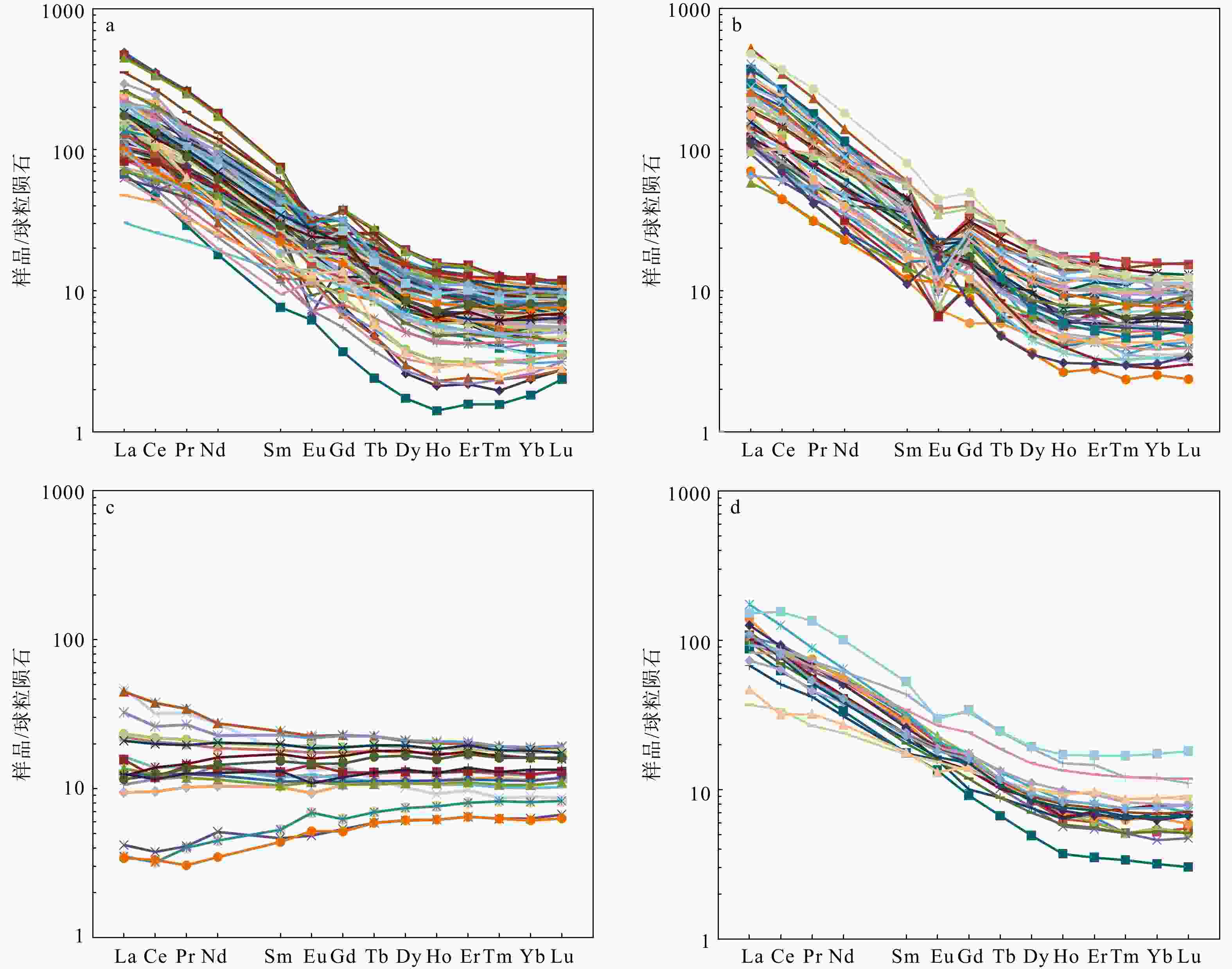
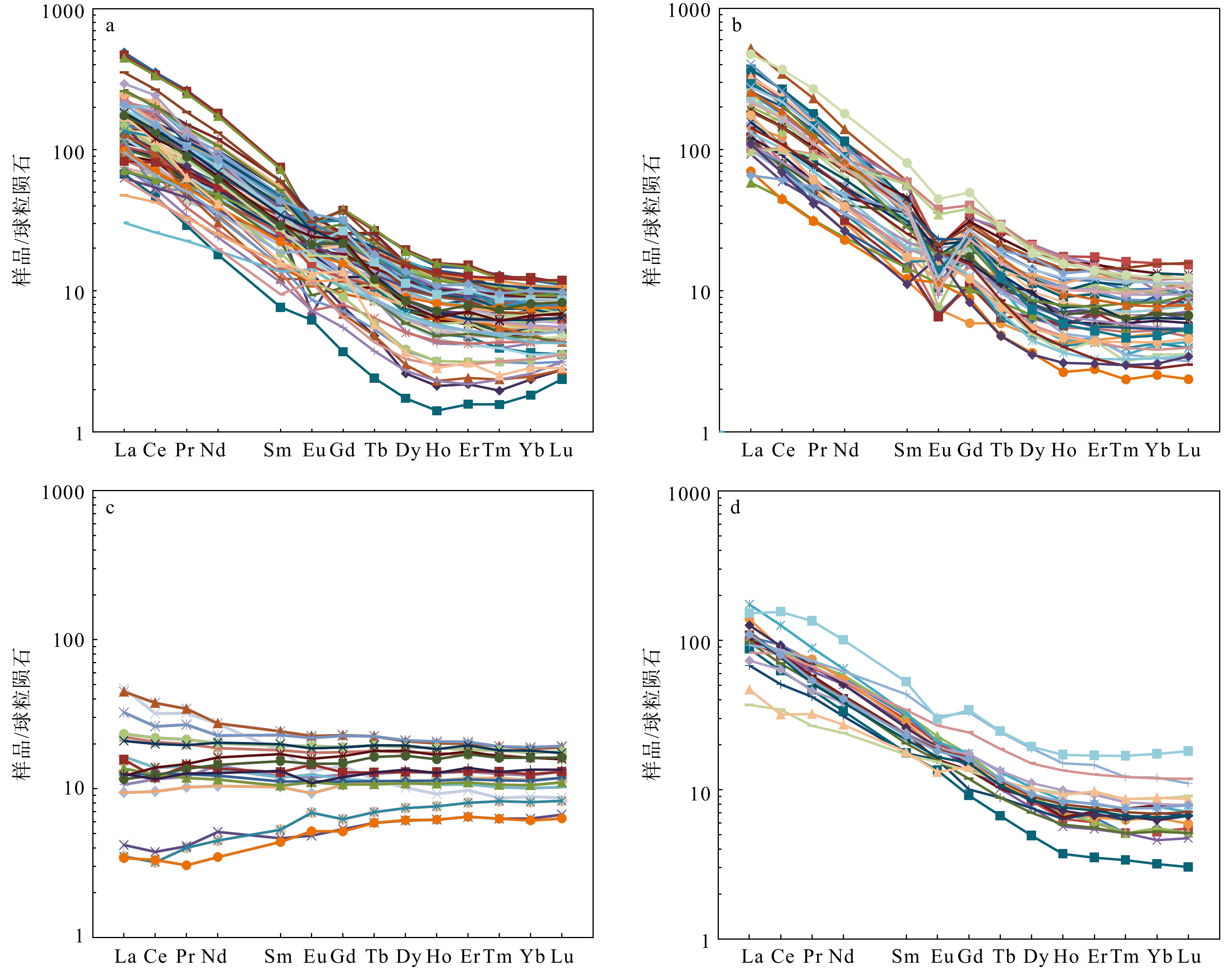
图 5 球粒陨石标准化稀土元素配分曲线(数据来源同图4)
a—C岩性带岩浆岩球粒陨石标准化稀土元素配分曲线;b—A岩性带岩浆岩球粒陨石标准化稀土元素配分曲线;c—新太古代晚期TH1型火山岩球粒陨石标准化稀土元素配分曲线;d—新太古代晚期TH2型火山岩球粒陨石标准化稀土元素配分曲线(TH1和TH2类型火山岩的分类方法据Condie et al.(1981))
Figure 5. Chondrite-normalized REE patterns (data sources are the same as in Fig. 4)
(a) Chondrite-normalized REE patterns for magmatic rocks of the C belt; (b) Chondrite-normalized REE patterns for magmatic rocks of the A belt; (c) Chondrite-normalized REE patterns for late Neoarchean TH1-type volcanic rocks; (d) Chondrite-normalized REE patterns for late Neoarchean TH2-type volcanic rocks. The classification of TH1 and TH2 volcanic rocks is based on Condie et al., 1981.
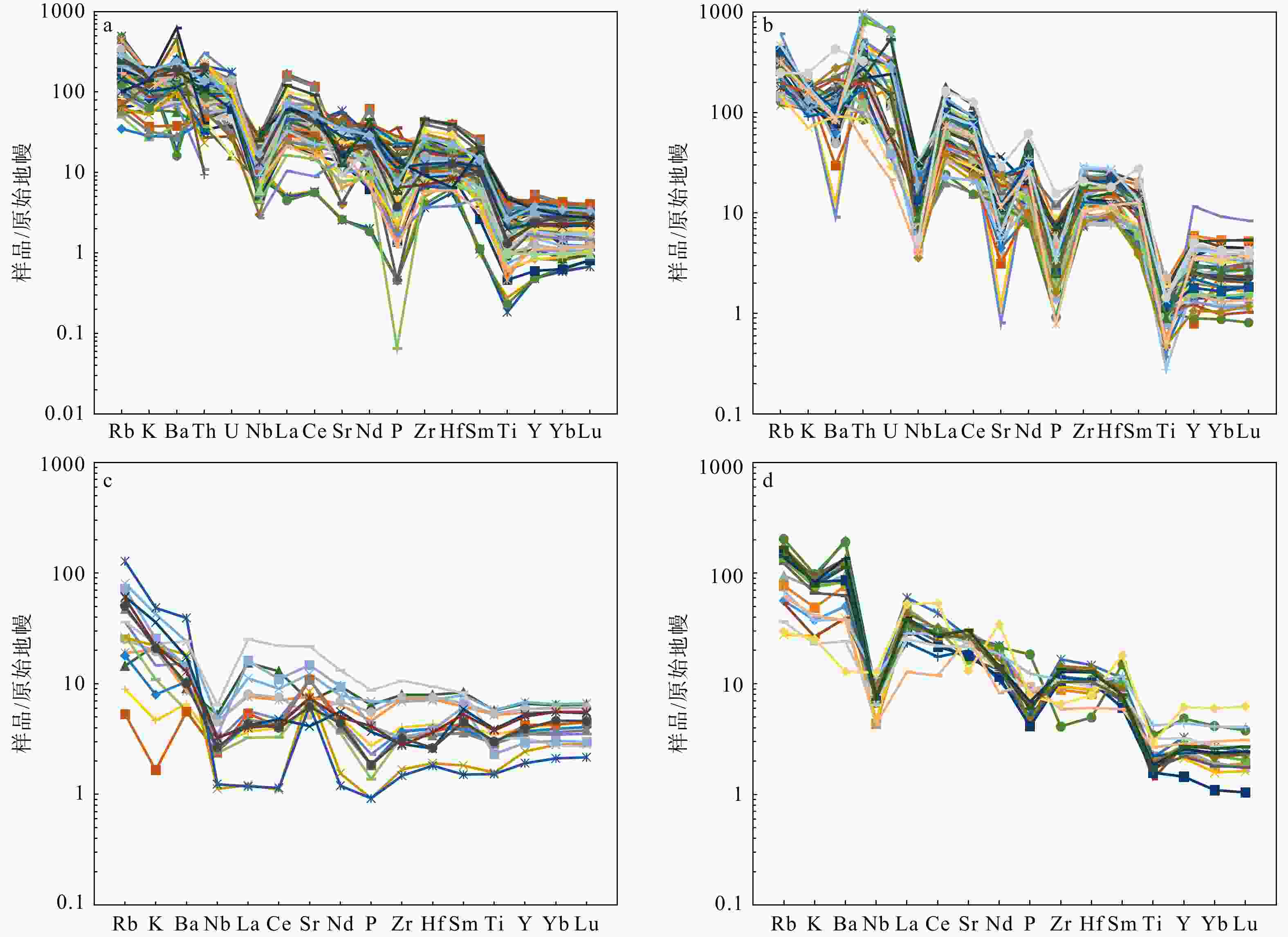
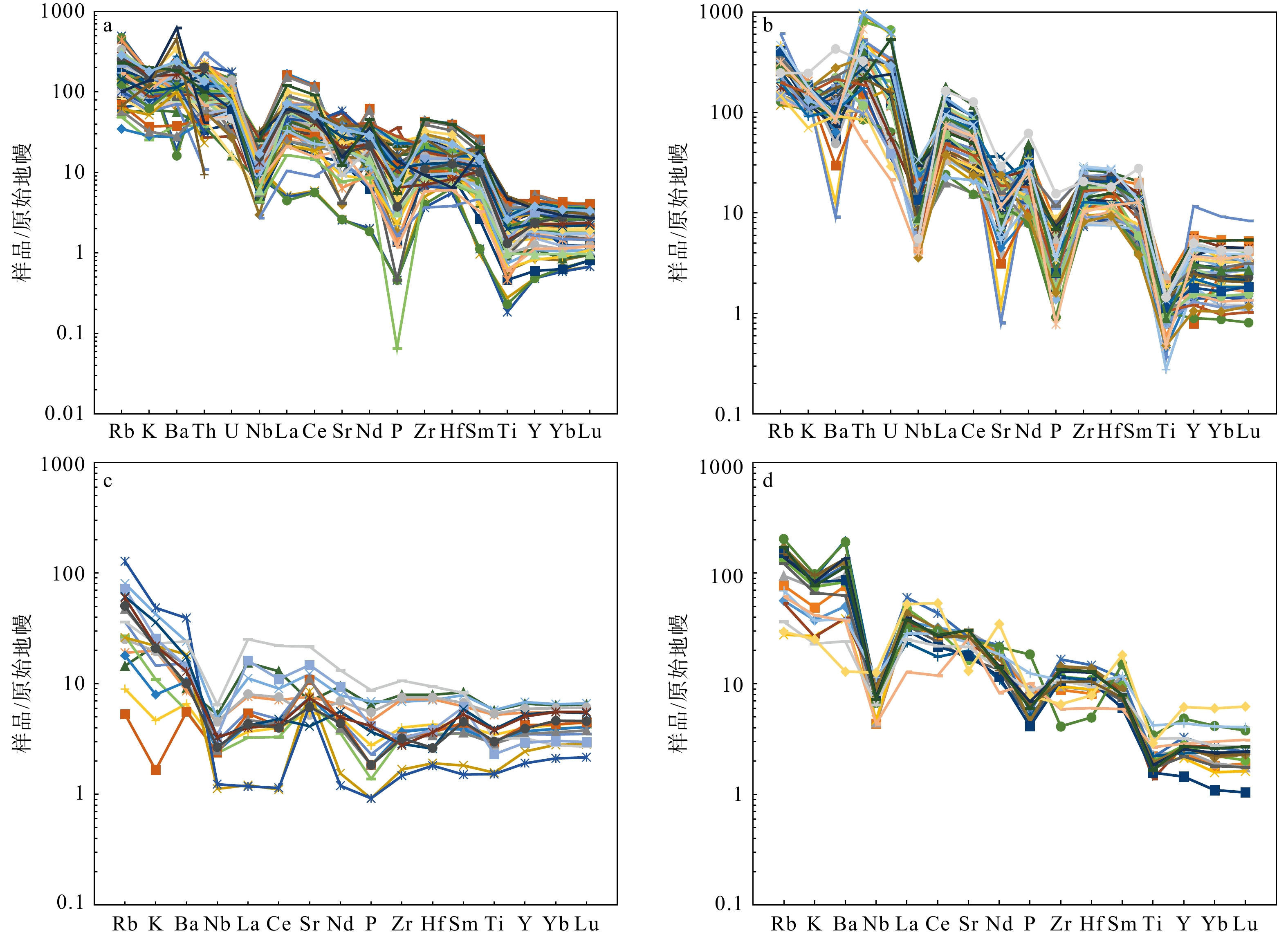
图 6 原始地幔标准化微量元素蛛网图(数据来源同图4)
a—C岩性带岩浆岩原始地幔标准化微量元素蛛网图;b—A岩性带岩浆岩原始地幔标准化微量元素蛛网图;c—新太古代晚期TH1型火山岩原始地幔标准化微量元素蛛网图;d—新太古代晚期TH2型火山岩原始地幔标准化微量元素蛛网图(TH1和TH2类型火山岩的分类方法据Condie et al.(1981))
Figure 6. Primitive mantle normalized diagrams for whole rock (data source is the same as for Fig. 4)
(a) Primitive mantle-normalized spider diagrams for magmatic rocks of the C belt; (b) Primitive mantle-normalized spider diagrams for magmatic rocks of the A belt; (c) Primitive mantle-normalized spider diagrams for late Neoarchean TH1-type volcanic rocks; (d) Primitive mantle-normalized spider diagrams for late Neoarchean TH2-type volcanic rocks. The TH1 and TH2 volcanic rock classification is based on Condie et al. (1981).
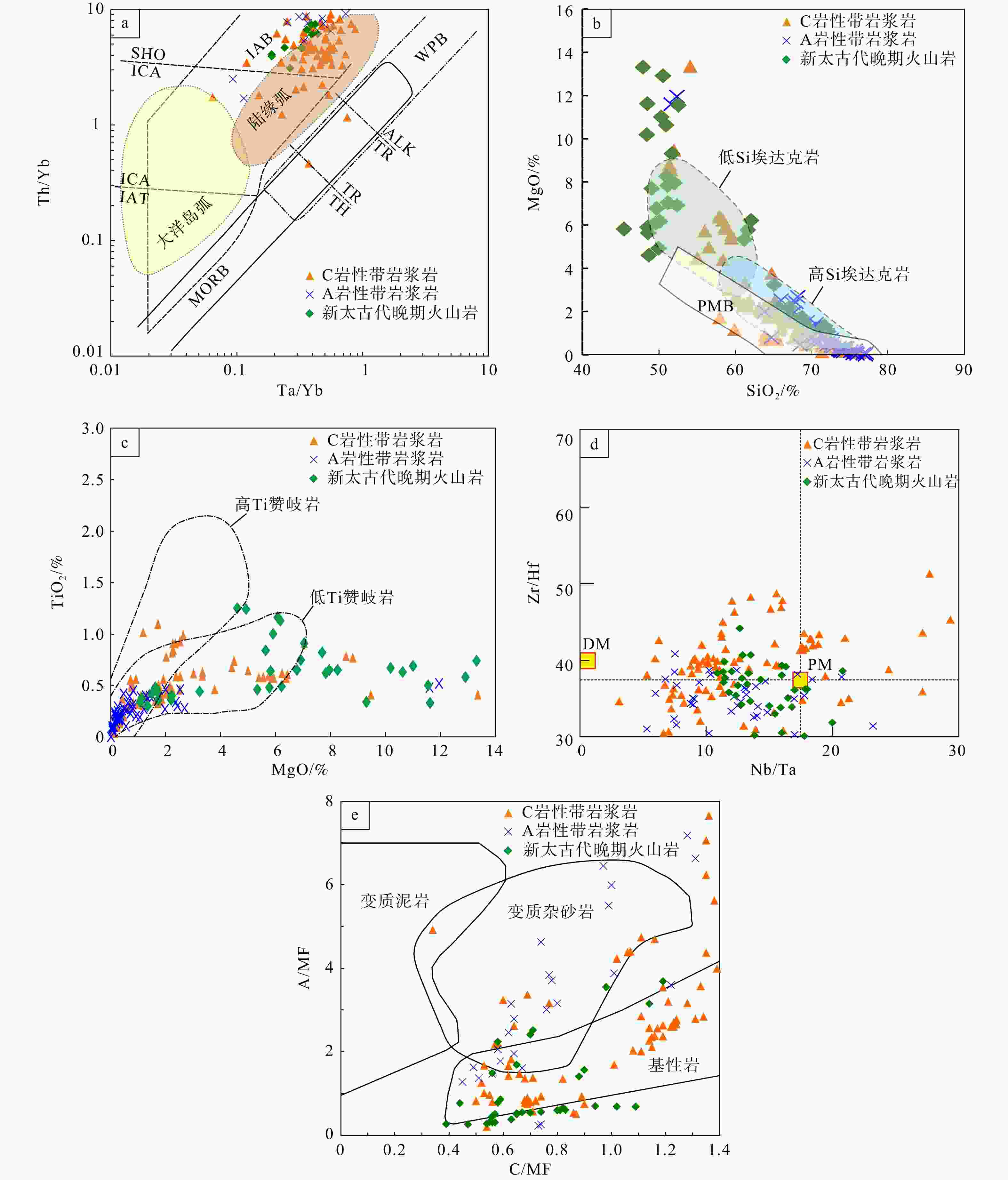
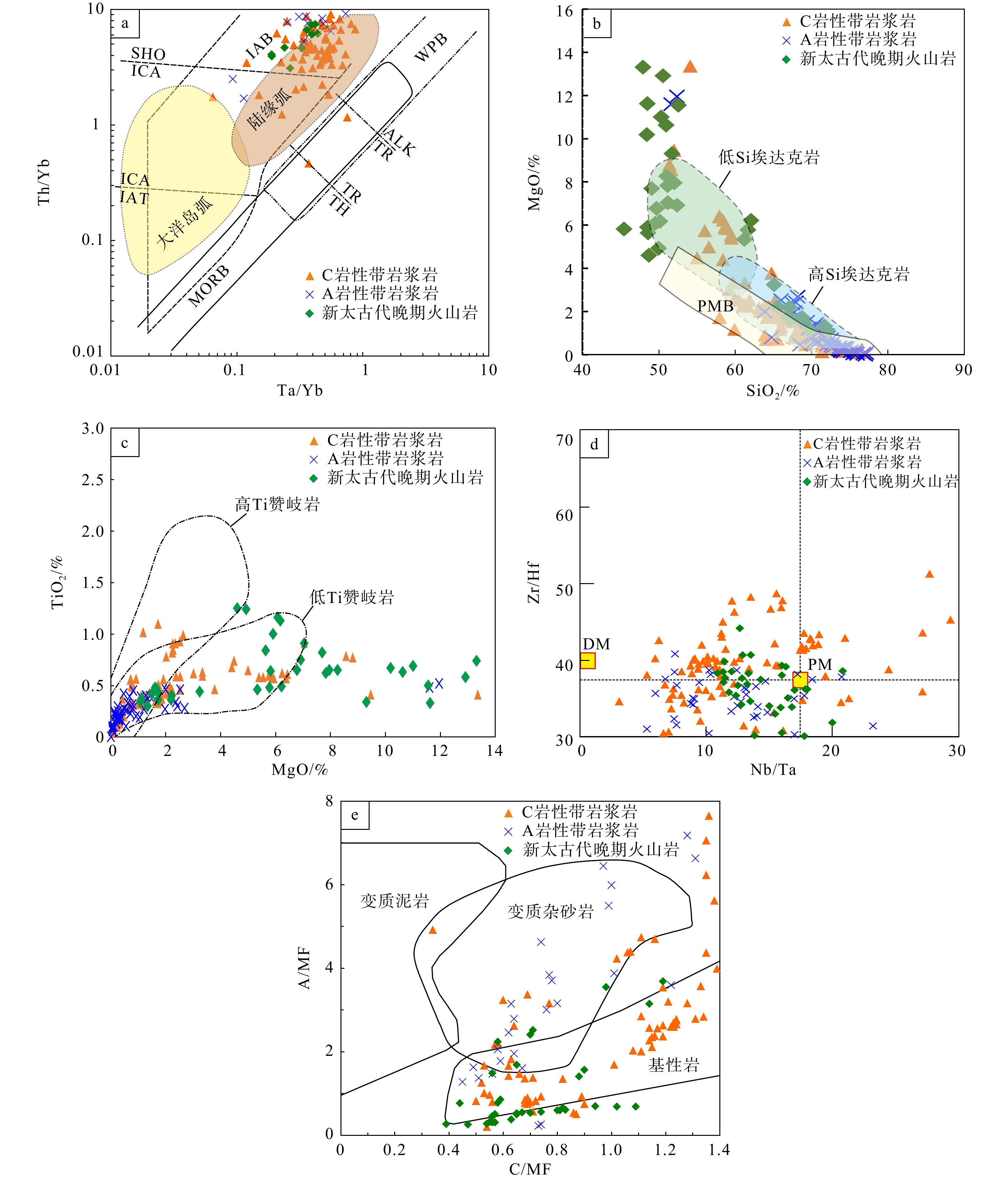
图 7 岩石成因判别图解(数据来源同图4)
IAB—岛弧玄武岩;IAT—岛弧拉斑玄武岩;ICA—岛弧钙碱性玄武岩;WPB—板内玄武岩;ALK—碱性玄武岩;TR—过渡玄武岩;TH—拉斑玄武岩;SHO—岛弧橄榄玄粗岩;MORB—大洋中脊玄武岩;N-MORB—正常型洋中脊玄武岩;E-MORB—富集型洋中脊玄武岩;PMB—由玄武岩或角闪岩部分熔融的熔体;PM—原始地幔;DM—亏损地幔a—Th/Yb-Ta/Yb判别图解(Pearce,1983);b—MgO-SiO2判别图解(Martin et al.,2005);c—Nb/Ta-Zr/Hf判别图解(数据引自Mcdonough,2003);d—TiO2-MgO赞岐岩判别图解(Martin et al.,2009);e—A/FM-C/FM岩浆源区判别图解(Altherr et al.,2000)
Figure 7. Petrogenetic identification diagram (data source is the same as for Fig. 4)
(a) Th/Yb versus Ta/Yb diagram (Pearce, 1983); (b) MgO versus SiO2 diagram (PMB—melts derived from partial melting of basalt or amphibolite; Martin et al., 2005); (c) Nb/Ta versus Zr/Hf diagram (PM—primitive mantle; DM—depleted mantle, data from Mcdonough, 2003); (d) TiO2 versus MgO diagram for distinguishing sanukite (Martin et al., 2009); (e) A/FM versus C/FM diagram showing magmatic sources (Altherr et al., 2000) AT—island arc tholeiite; ICA—island arc calc-alkaline basalt; WPB—within-plate basalt; ALK—alkaline basalt; TR—transitional basalt; TH—tholeiite; SHO—shoshonite; MORB—mid-ocean ridge basalt; N-MORB—normal mid-ocean ridge basalt; E-MORB—enriched mid-ocean ridge basalt.
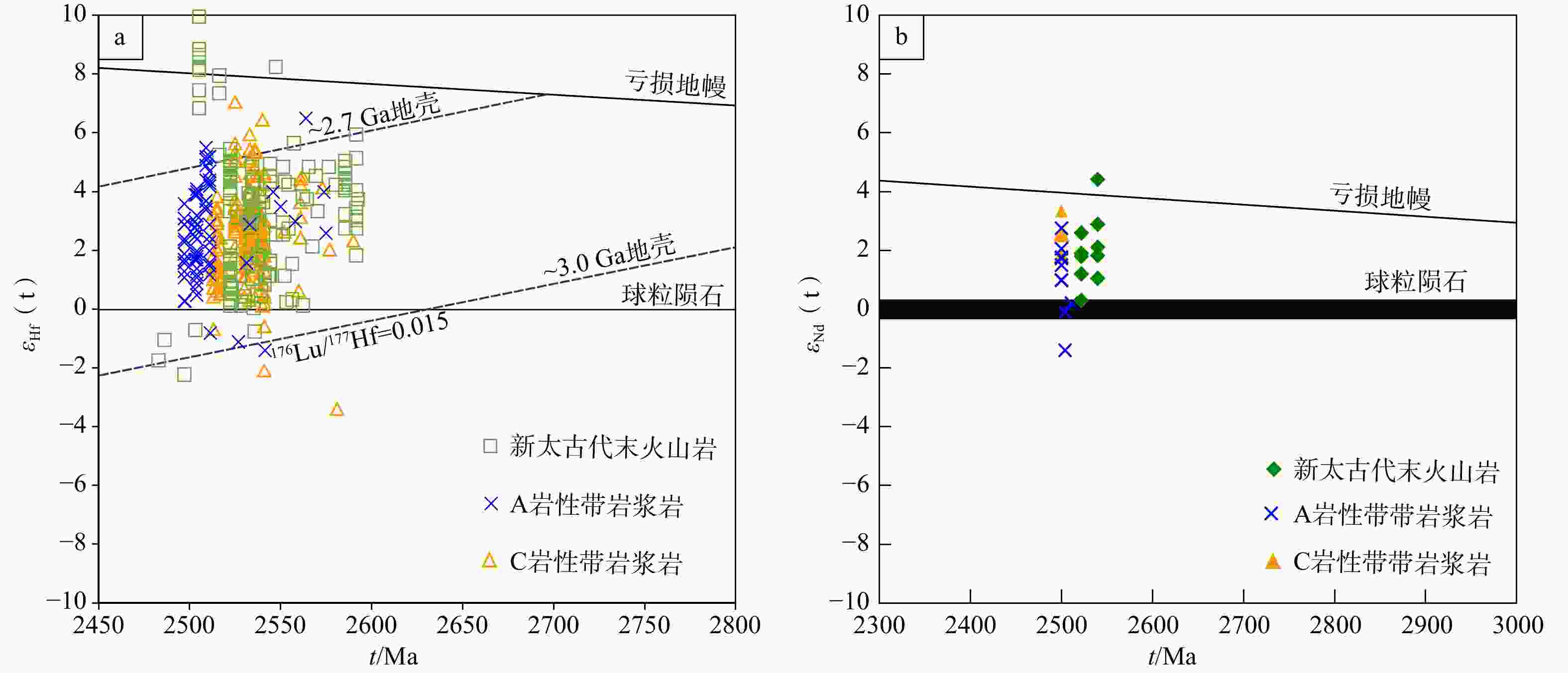
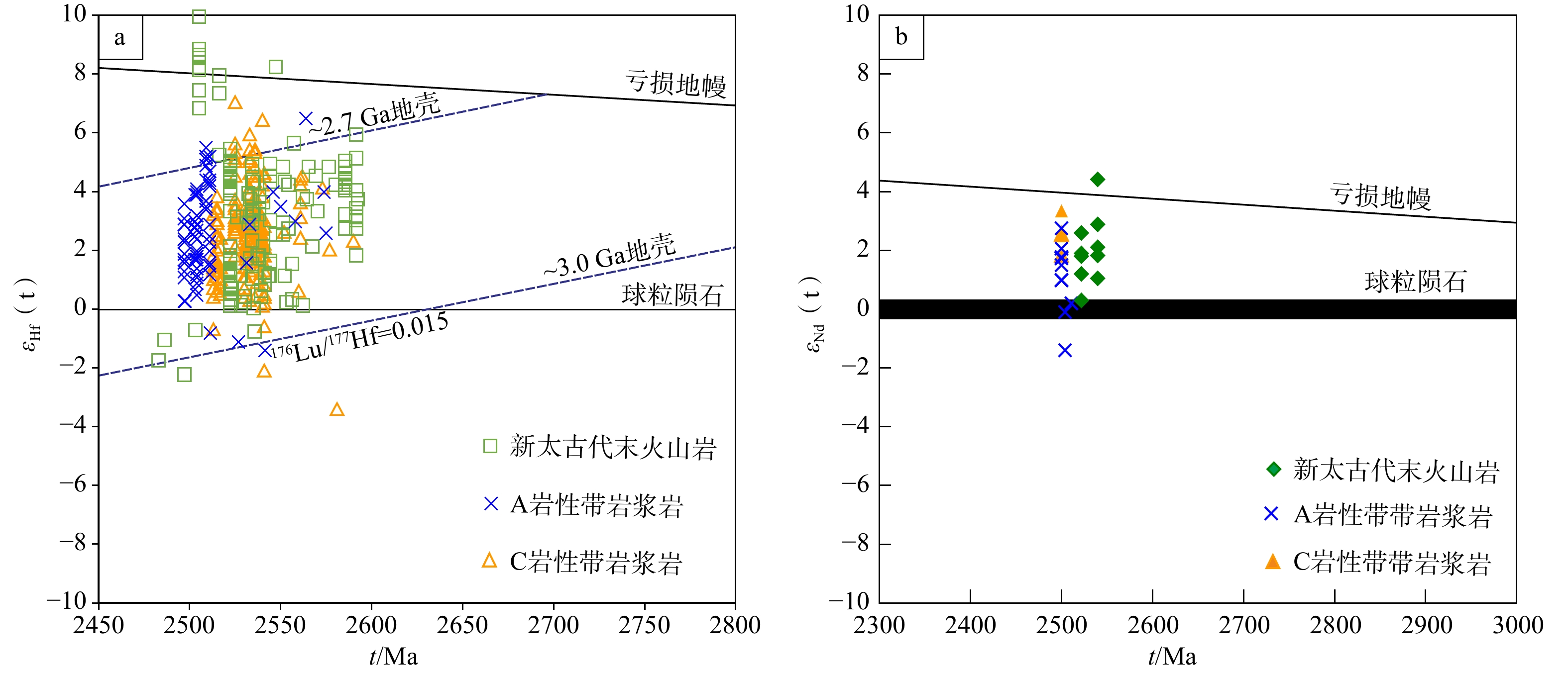
图 8 鲁西地区新太古代晚期岩浆岩Hf、Nd同位素图解
a—t-εHf(t)关系图解(数据引自Wang et al.,2013c;Guo et al.,2014;Gao et al.,2018,2020;Sun et al.,2019a,2020; Yu et al.,2021);b—t-εNd(t)关系图解(数据引自Jahn et al.,1988;Wang et al.,2013c;Peng et al.,2013;Gao et al.,2018)
Figure 8. Hf and Nd isotopic diagrams of late Neoarchean magmatic rocks in the Luxi area
(a) Crystallization age (t) versus εHf(t) diagram for zircons (data from Wang et al., 2013c; Guo et al., 2014; Gao et al., 2018, 2020; Sun et al., 2019a, 2020; Yu et al., 2021); (b) Crystallization age (t) versus εHf(t) diagram for whole-rocks (data from Jahn et al., 1988; Wang et al., 2013c; Peng et al., 2013; Gao et al., 2018)
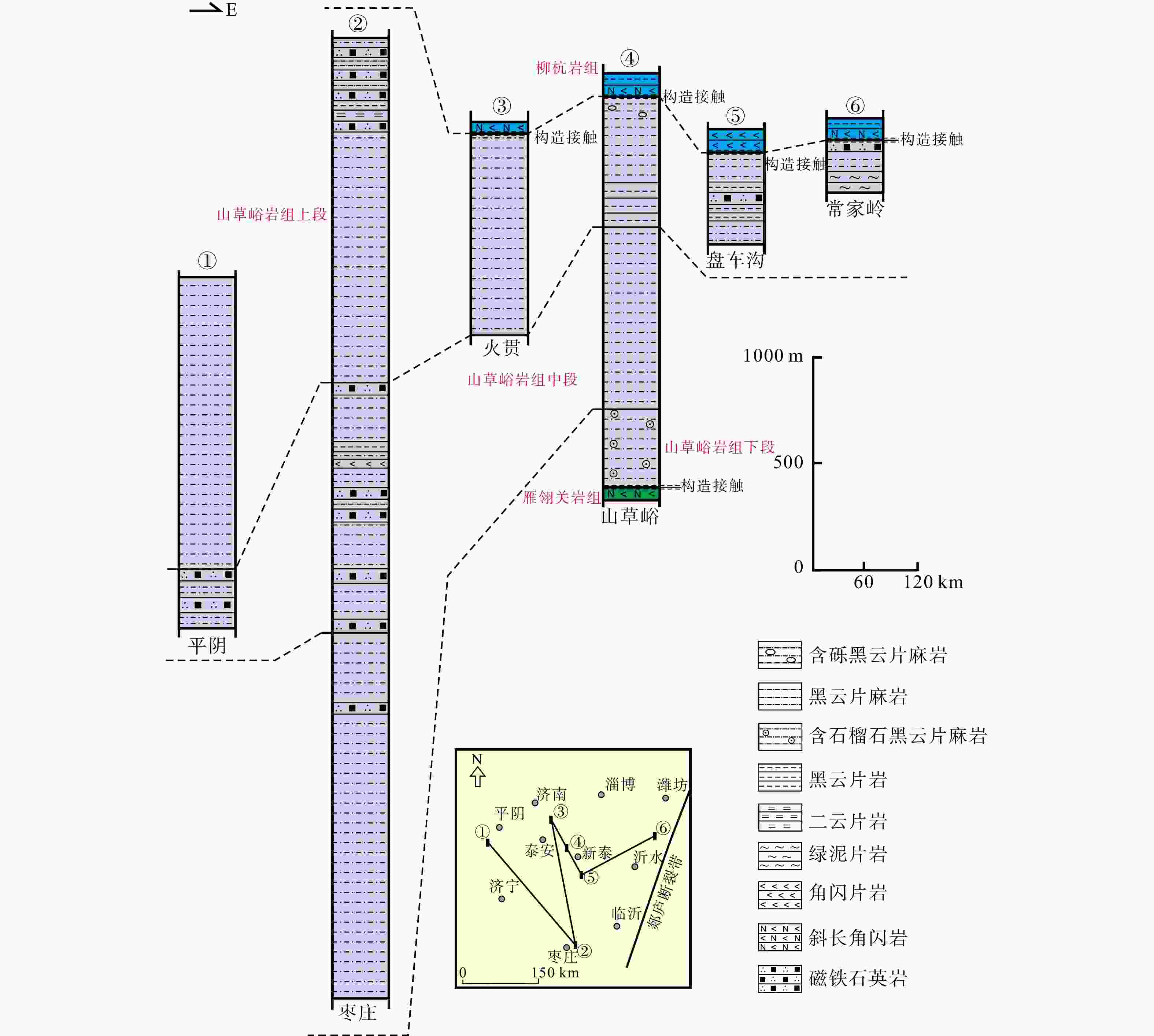
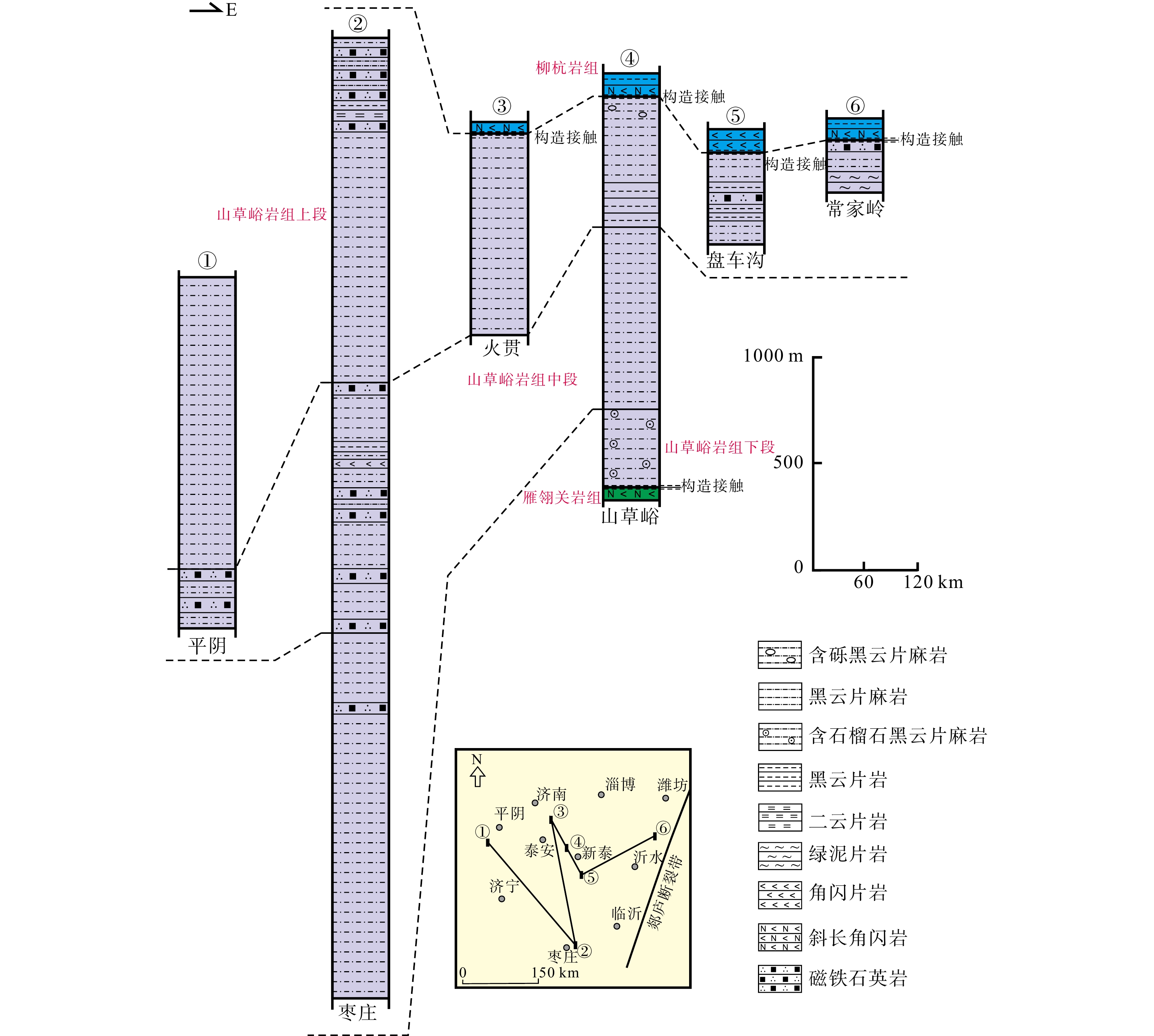
图 9 鲁西地区山草峪岩组地层柱状图
Figure 9. Stratigraphic column of the Shancaoyu Formation in the Luxi area
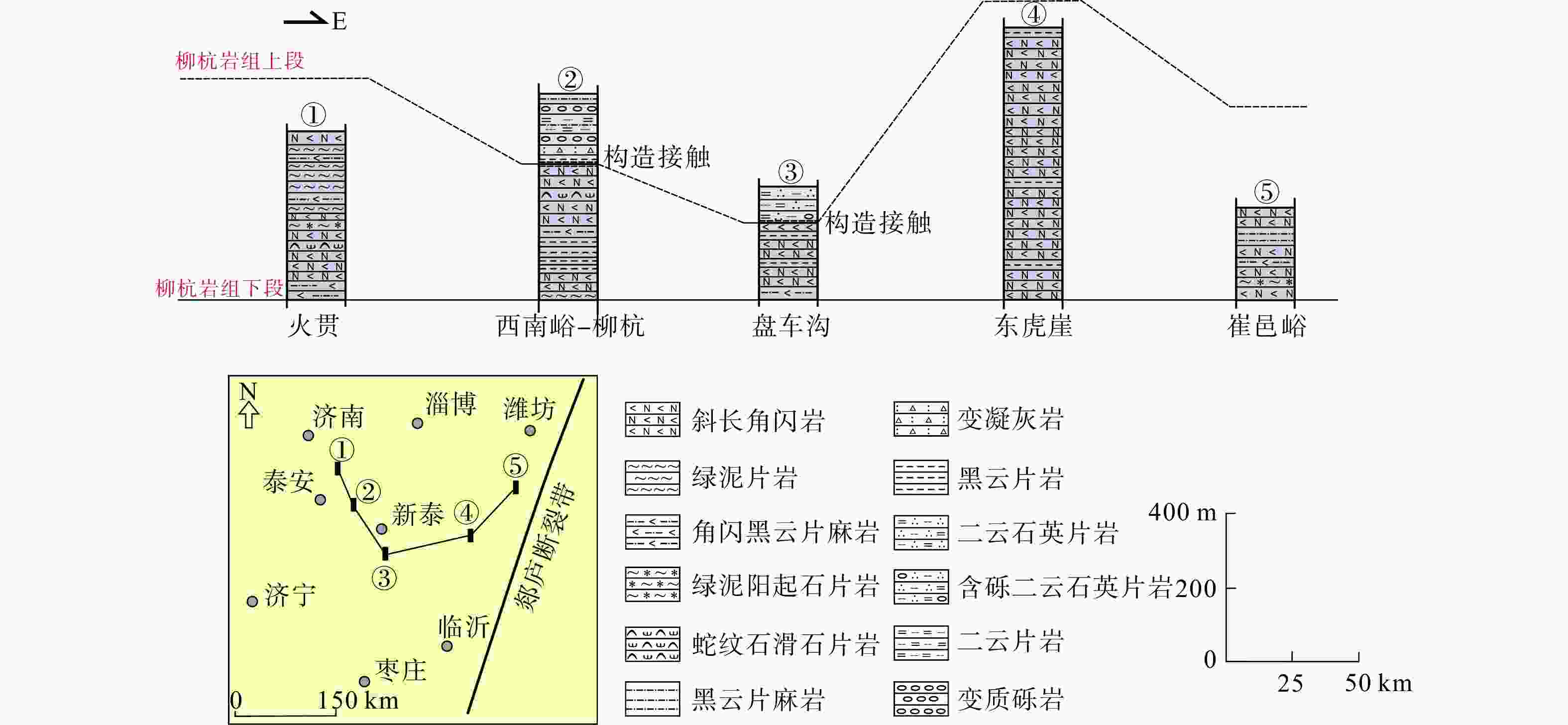
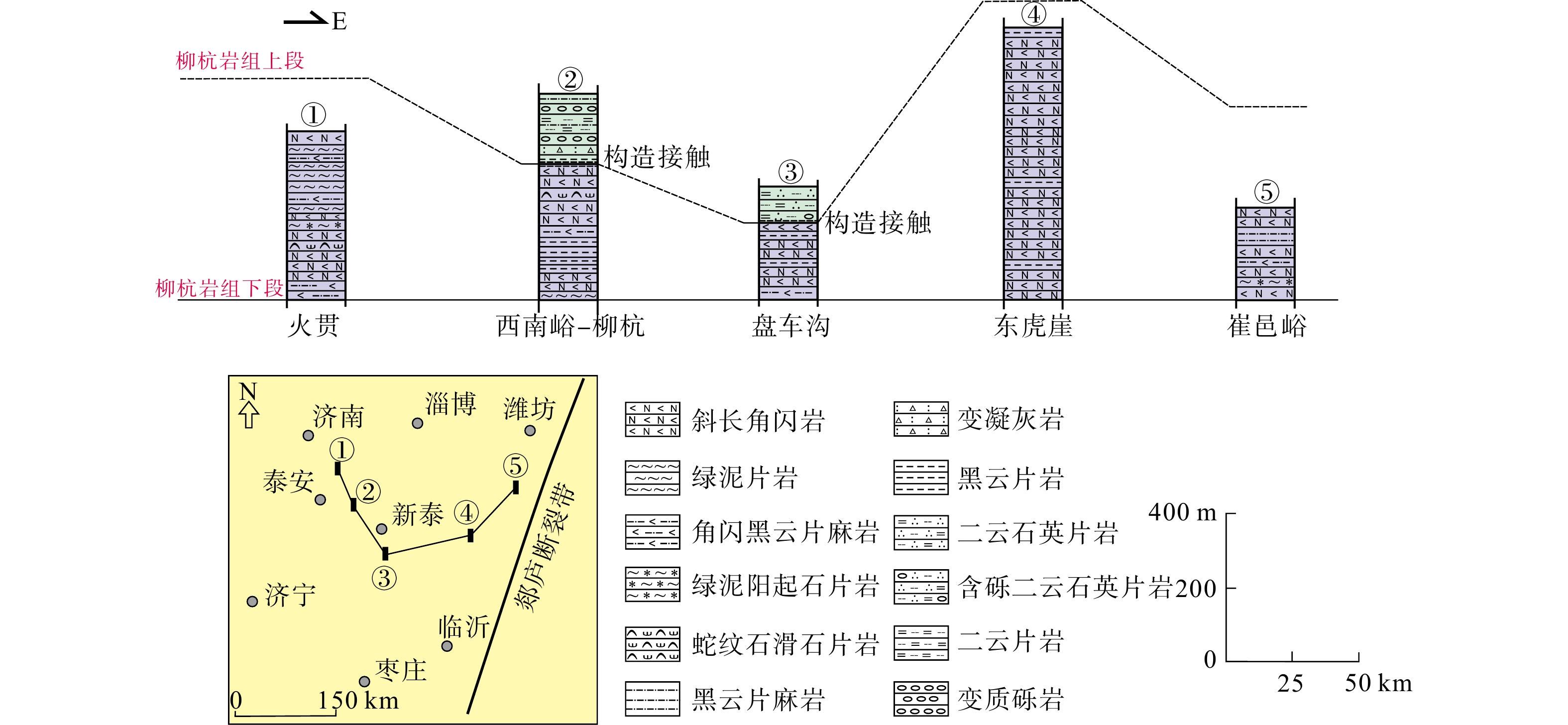
图 10 鲁西地区柳杭岩组地层柱状图
Figure 10. Stratigraphic column of the Liuhang Formation in the Luxi area
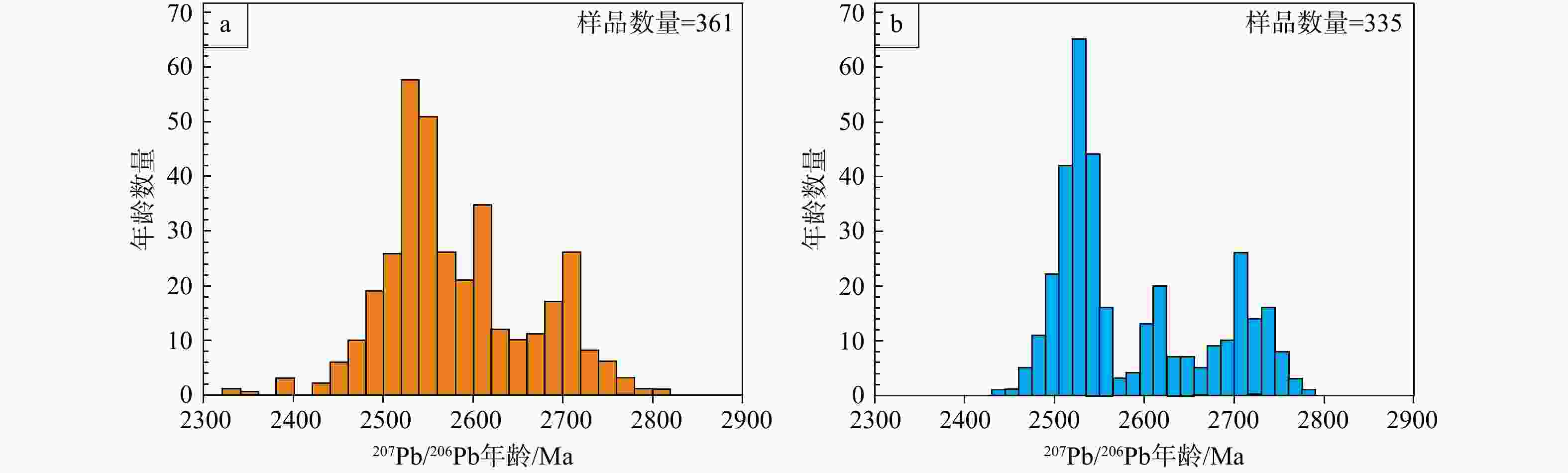
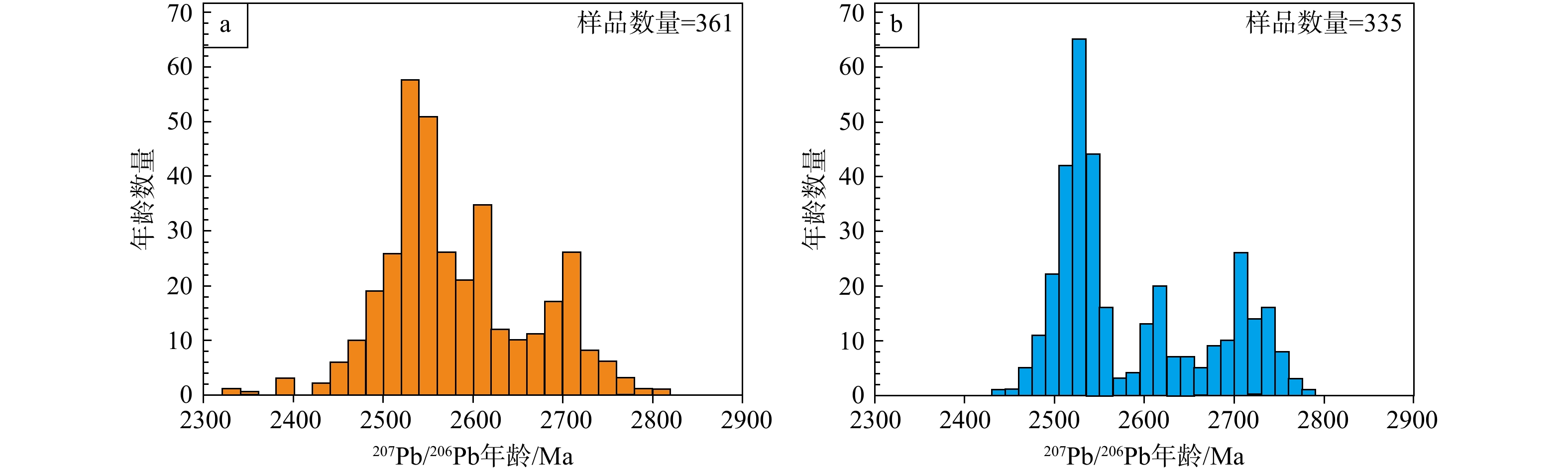
图 11 鲁西地区新太古代晚期表壳岩和侵入岩锆石年龄直方图(Wan et al.,2012a)
a—新太古代晚期表壳岩系岩石(数据主要来自山草峪岩组和柳行岩组上段的变质沉积岩和长英质变质火山岩);b—新太古代深成侵入岩
Figure 11. Histogram of apparent 207Pb /206Pb ages of late Neoarchean supracrustal rocks and intrusive rocks in the Luxi area (Wan et al., 2012a)
(a) Late Neoarchean supracrustal rocks (data mainly from metamorphic sedimentary rocks and felsic metamorphic volcanic rocks of the Shancaoyu Formation and the upper part of the Liuhang Formation; (b) Neoarchean intrusive rocks
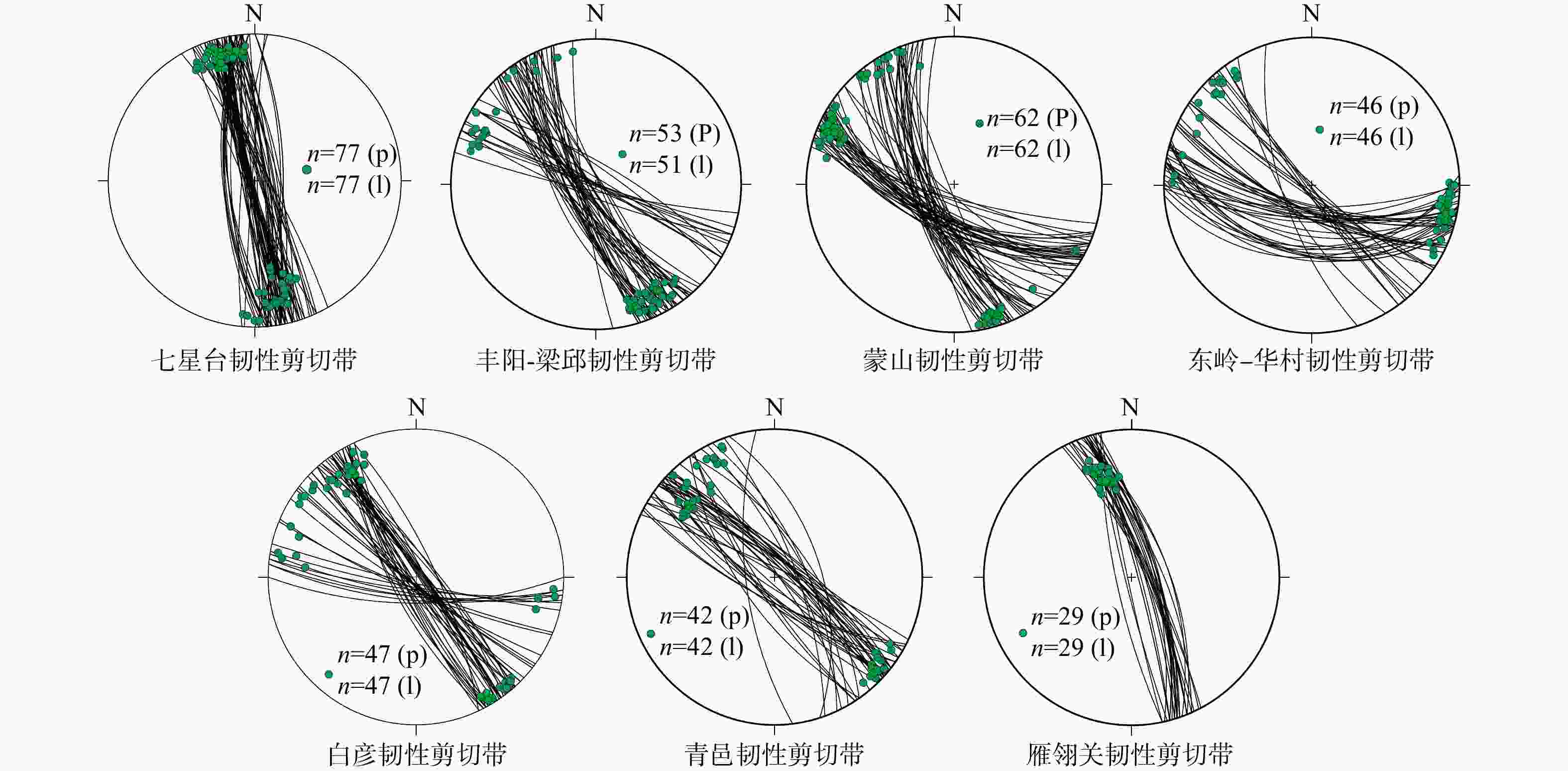
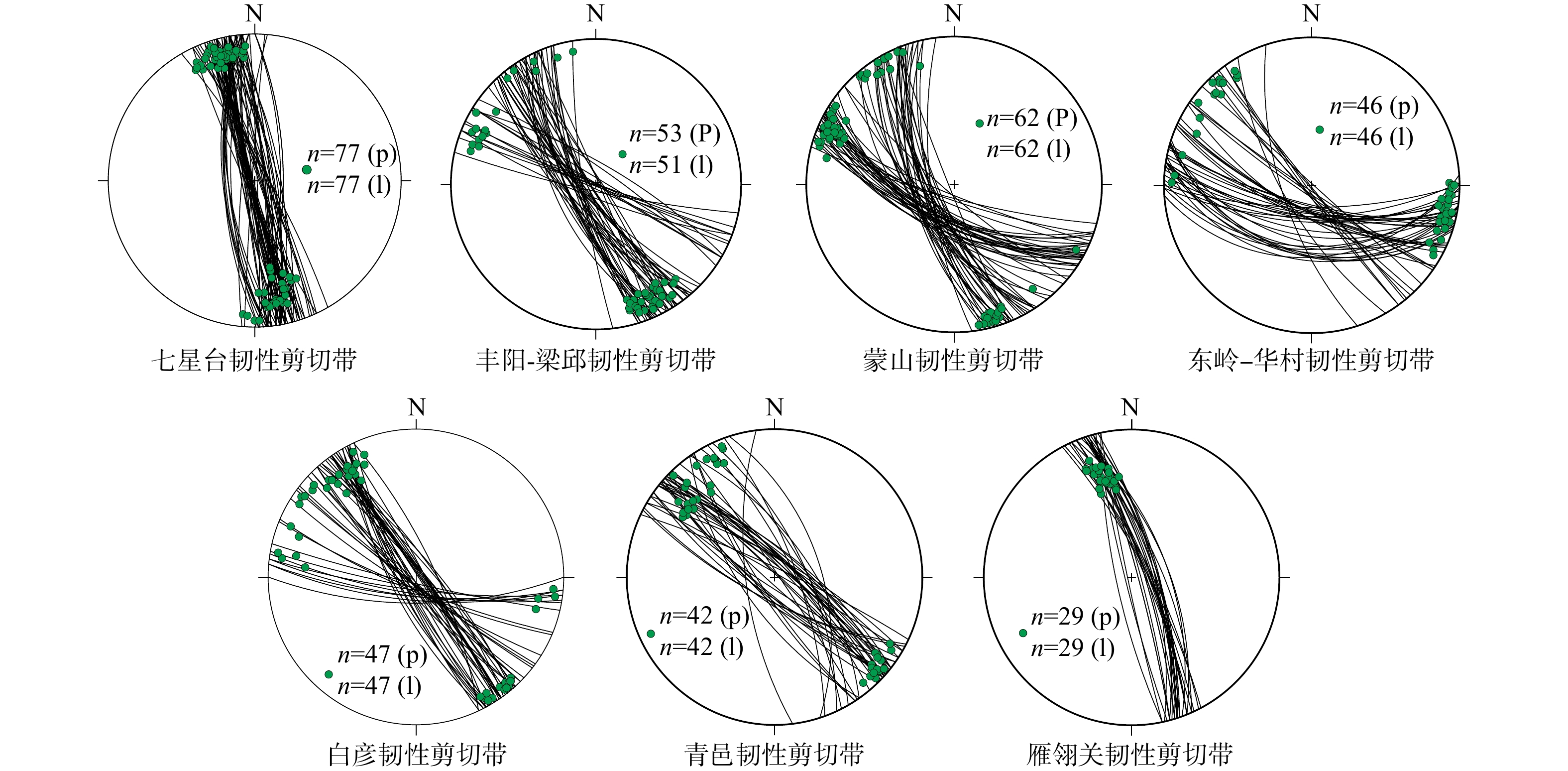
图 12 鲁西地区韧性剪切带构造要素下半球赤平投影
n—构造要素数量;p—面理;l—线理
Figure 12. Lower-hemisphere stereographic projections of structural elements of the main ductile shear zones in the Luxi area
n—number of structural elements; p—foliation; l—lineation
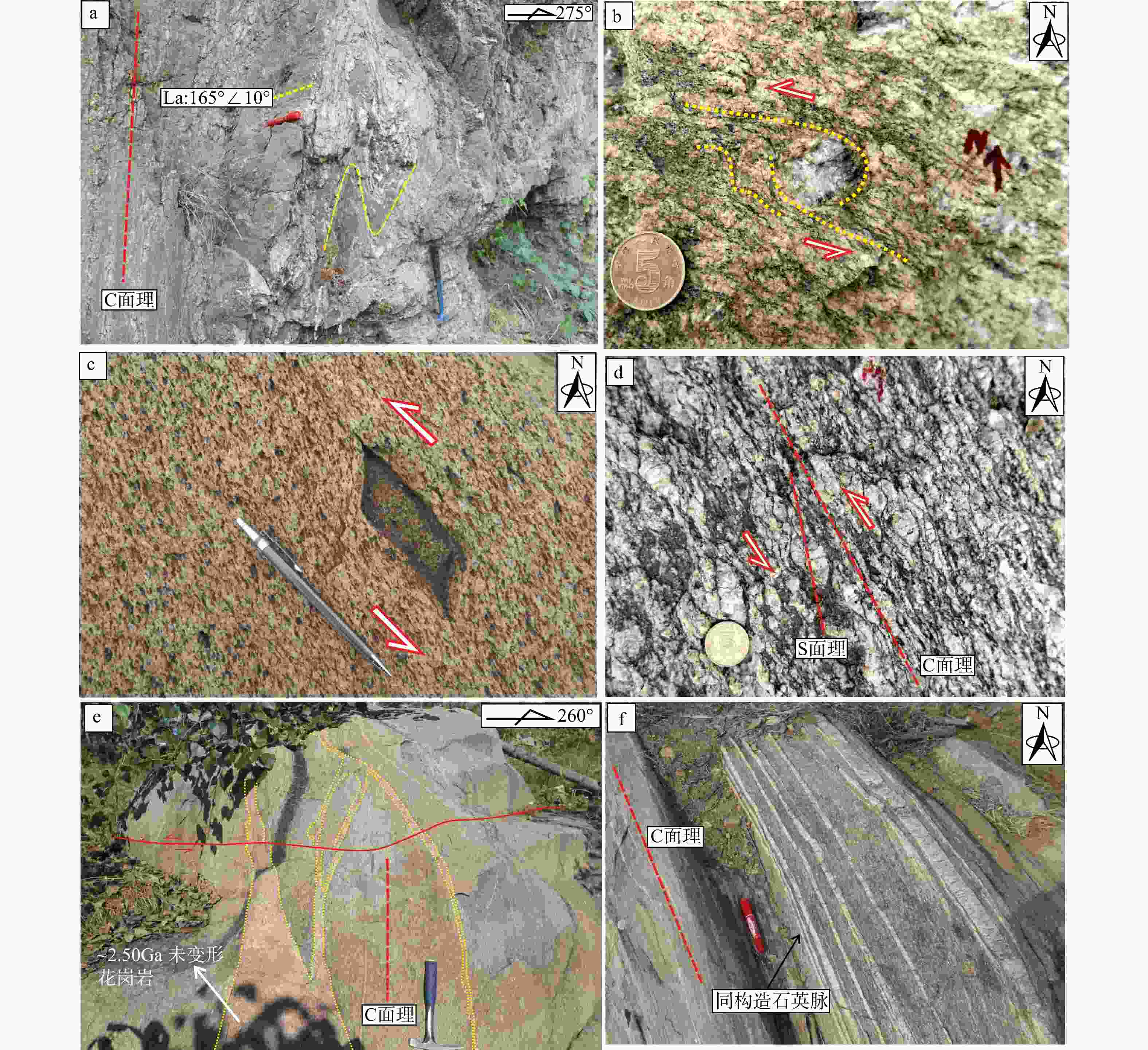
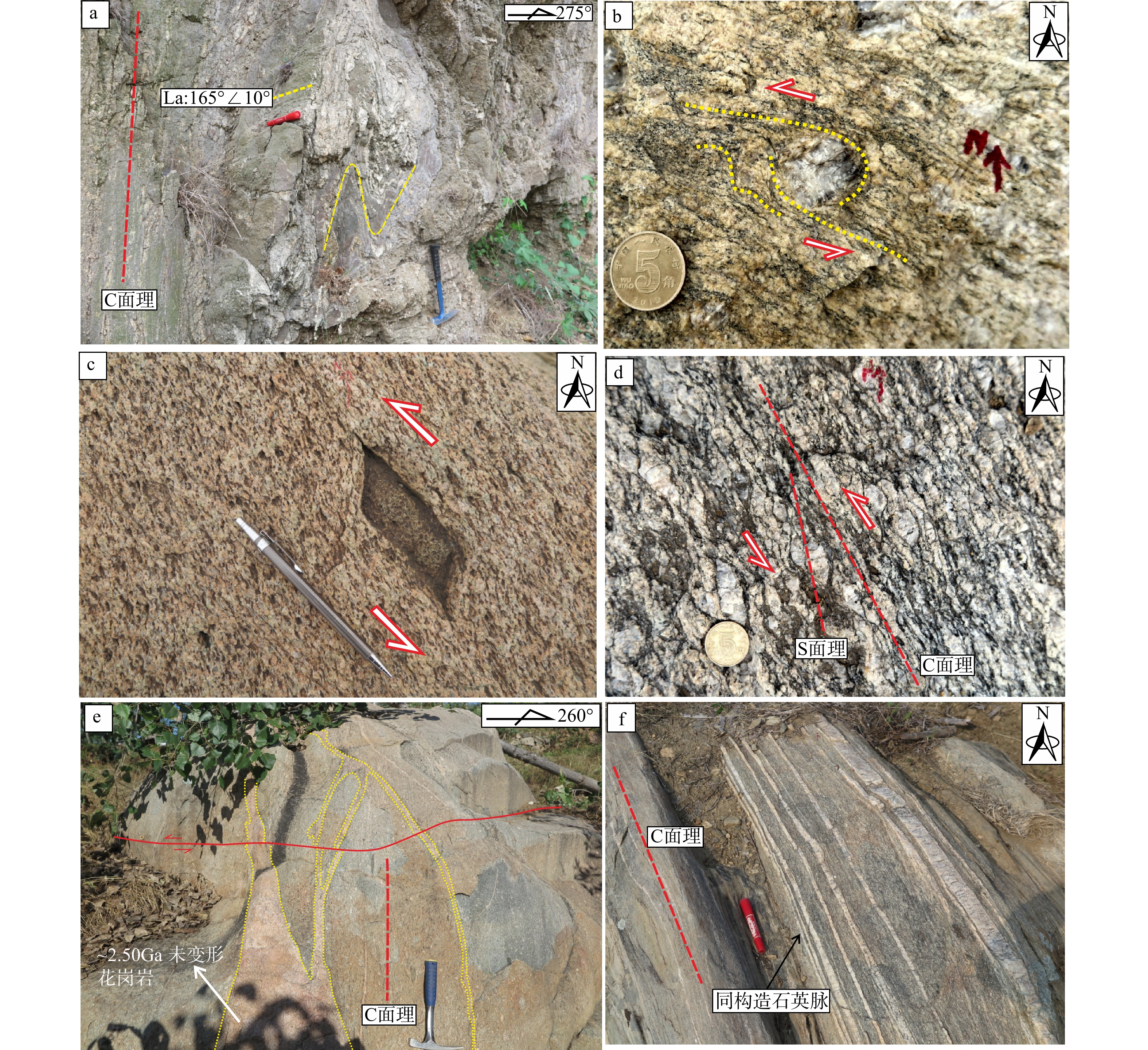
图 13 鲁西地区韧性剪切带宏观变形照片
La—矿物拉伸线理a—七星台韧性剪切带中陡倾面理及近水平矿物拉伸线理,枢纽与线理平行的A型褶皱;b—东岭‒华村韧性剪切带斜长石旋转碎斑指示左行剪切;c—白彦韧性剪切带内斜长角闪岩捕虏体经受变形改造,指示左行剪切;d—蒙山韧性剪切带内S-C组构指示左行剪切;e—侵入青邑韧性剪切带未变形的细粒花岗岩脉,测年数据引自Wang et al.(2024a);f—丰阳‒梁邱韧性剪切带中平行于剪切面理的同构造石英脉
Figure 13. Photos of macroscopic deformation characteristics of the main ductile shear zones in the Luxi area
(a) Steeply dipping foliation and subhorizontal mineral stretching lineation in the Qixingtai ductile shear zone, with an A-type fold whose hinge is parallel to the lineation; (b) Rotated plagioclase porphyroclasts in the Dongling‒Huacun ductile shear zone, indicating sinistral shear; (c) Deformed amphibolite xenolith in the Baiyan ductile shear zone, indicating sinistral shear; (d) S–C fabric in the Mengshan ductile shear zone, indicating sinistral shear; (e) Undeformed fine-grained granite veins intruding the Qingyi ductile shear zone (geochronological data from Wang et al., 2024); (f) Synkinematic quartz veins parallel to the shear foliation in the Fengyang–Liangqiu ductile shear zone
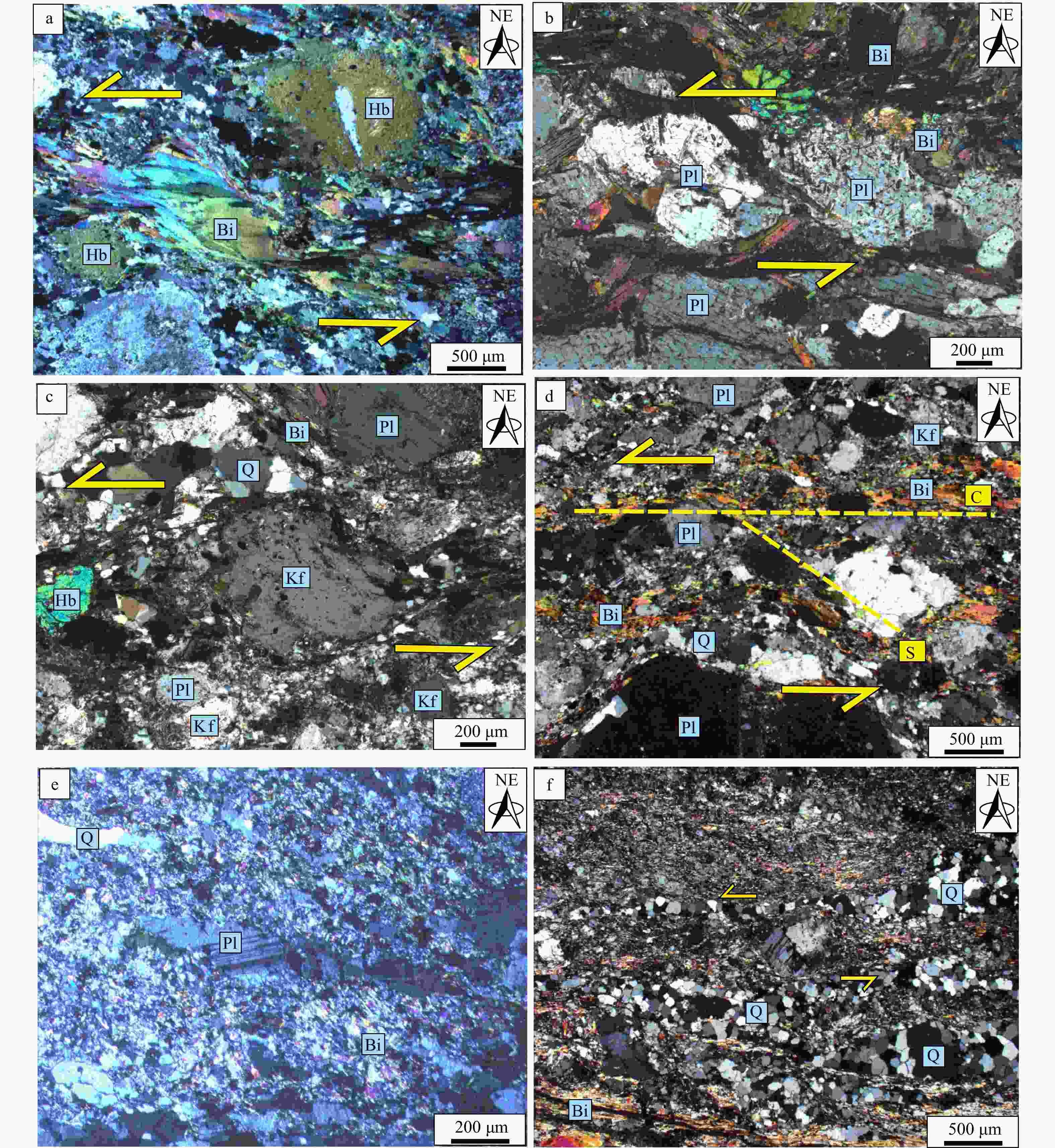
图 14 鲁西地区韧性剪切带显微变形照片
Hb—角闪石;Bi—黑云母;Pl—斜长石;Q—石英;Kf—钾长石a—白彦韧性剪切带内云母鱼、角闪石旋转碎斑指示左行剪切;b—蒙山韧性剪切带斜长石书斜构造;c—丰阳‒梁邱韧性剪切带斜长石旋转碎斑,指示左行剪切;d—七星台韧性剪切带中S-C组构指示左行剪切,C面理由石英多晶条带和黑云母定向排列构成;e—丰阳‒梁邱韧性剪切带内斜长石拉长变形;f—七星台韧性剪切带内多晶石英条带,长石旋转碎斑指示左行剪切
Figure 14. Microphotographs of the main ductile shear zones in the Luxi area
(a) Mica fish and rotated hornblende porphyroclasts in the Baiyan ductile shear zone, indicating sinistral shear; (b) Plagioclase domino structure in the Mengshan ductile shear zone, indicating sinistral strike-slip shear; (c) Rotated plagioclase porphyroclasts in the Fengyang‒Liangqiu ductile shear zone, indicating sinistral shear; (d) S-C fabric in the Qixingtai ductile shear zone, with C-foliation defined by polycrystalline quartz ribbons and oriented biotite, indicating sinistral shear; (e) Elongated plagioclase in the Fengyang‒Liangqiu ductile shear zone; (f) Polycrystalline quartz ribbons and rotated plagioclase porphyroclasts in the Qixingtai ductile shear zone, indicating sinistral shear Hb—hornblende; Bi—biotite; Pl—plagioclase; Q—quartz; Kf—K-feldspar
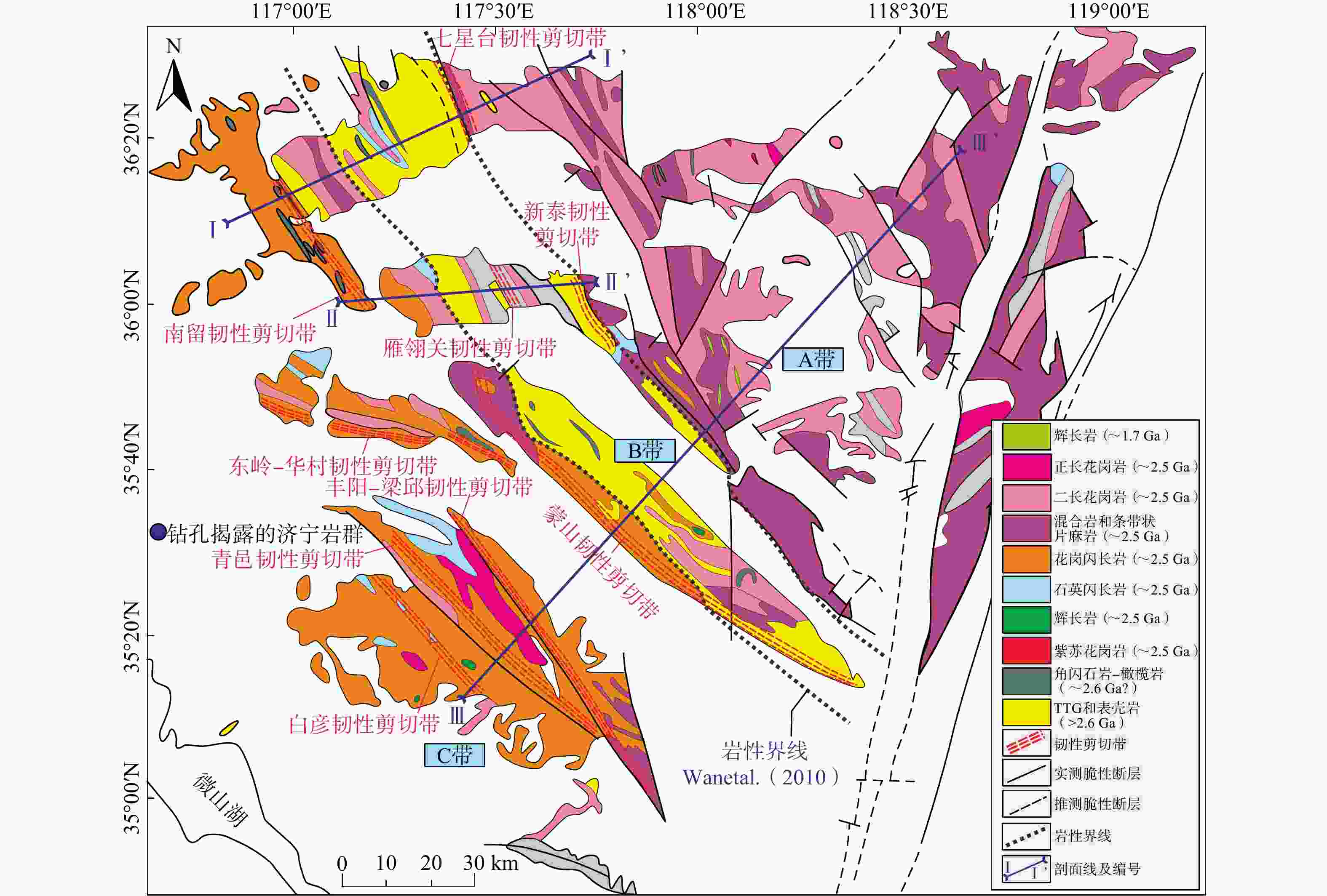
图 15 鲁西地区岩性分带界线与韧性剪切带的空间对应关系
Figure 15. The spatial correspondence between lithologic zonation boundaries and ductile shear zones in the Luxi area
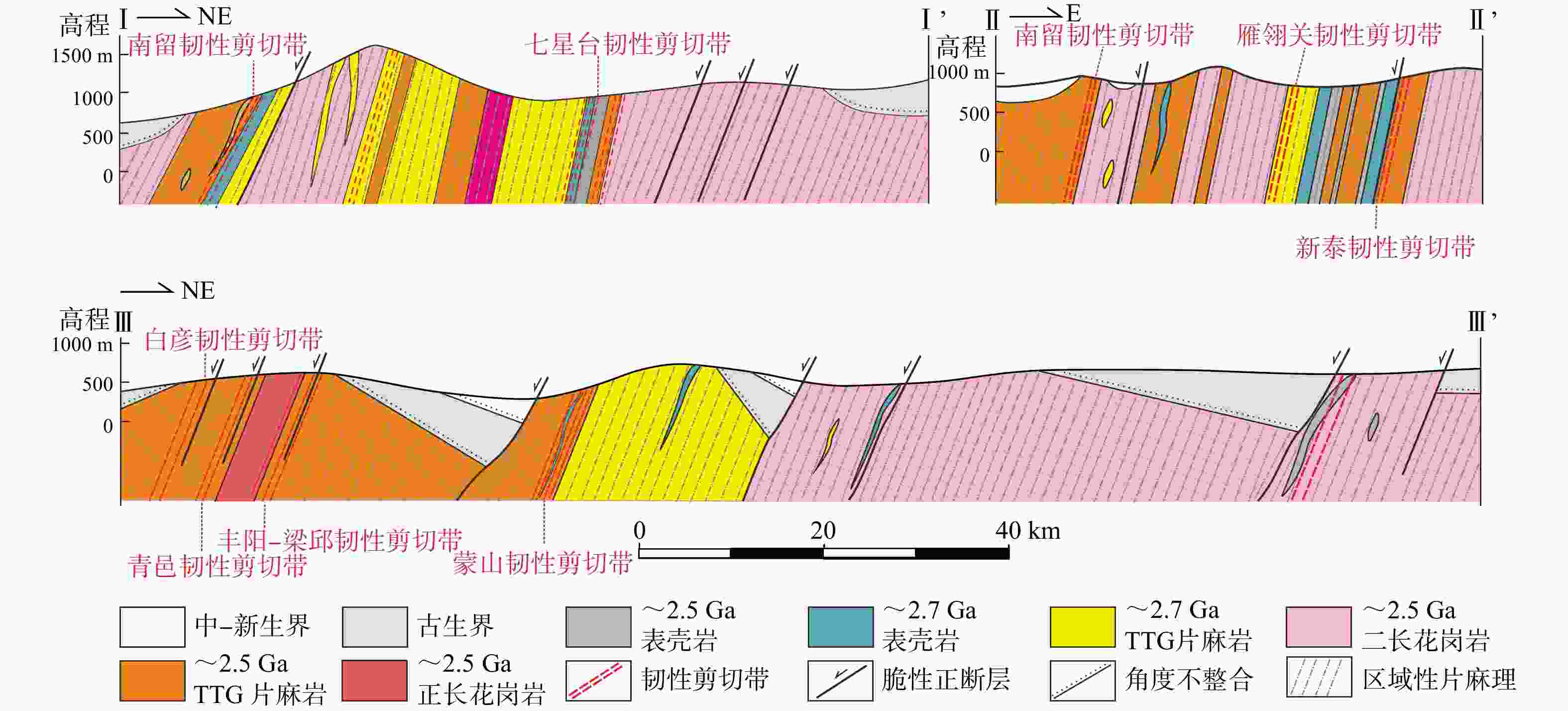
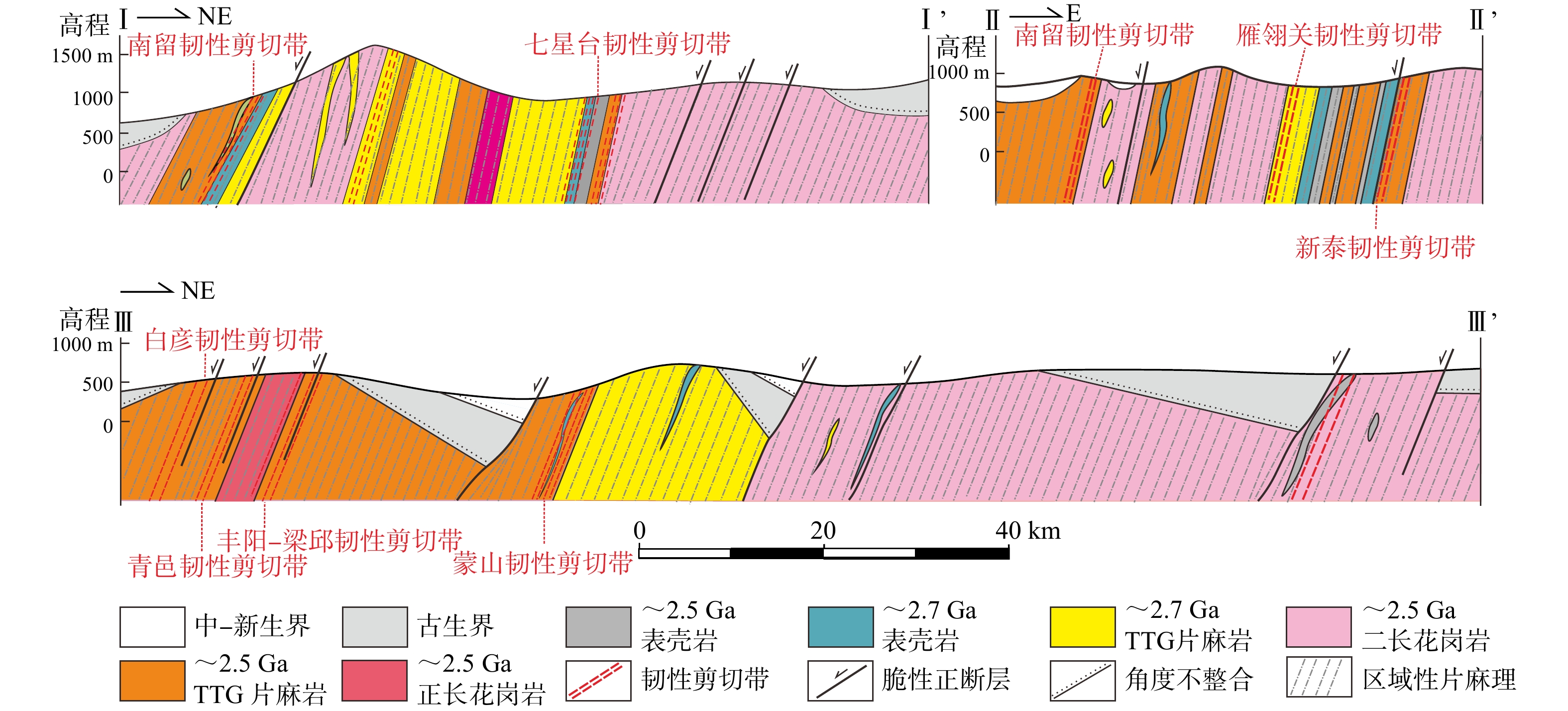
图 16 鲁西地区构造−岩性剖面图(剖面位置见图15)
Figure 16. Structural–lithological cross-sections of the Luxi area
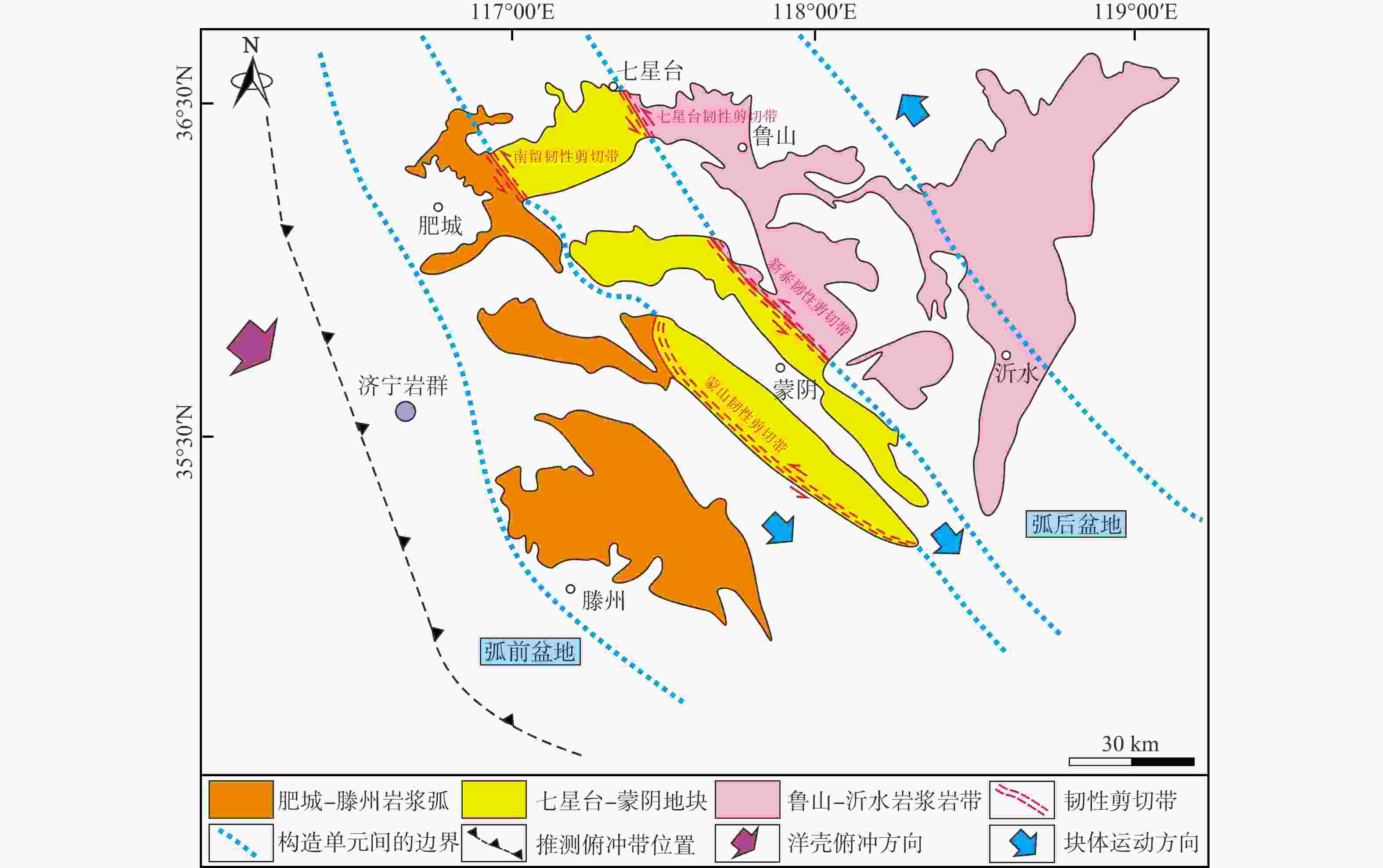
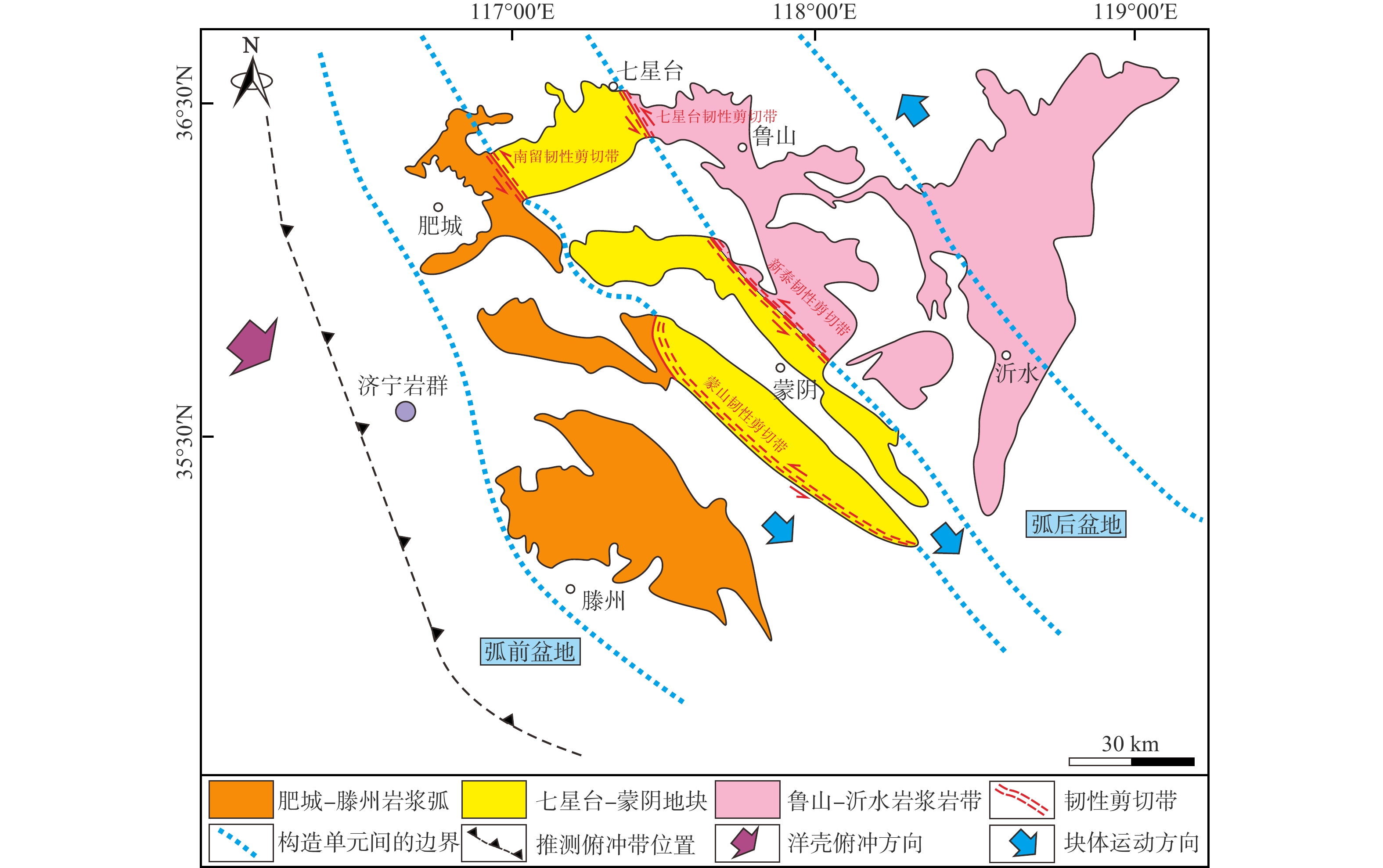
图 17 鲁西增生型造山带构造单元划分及块体拼贴方式示意图
Figure 17. Schematic diagram showing the tectonic subdivision and terrane amalgamation of the Luxi accretionary orogenic belt
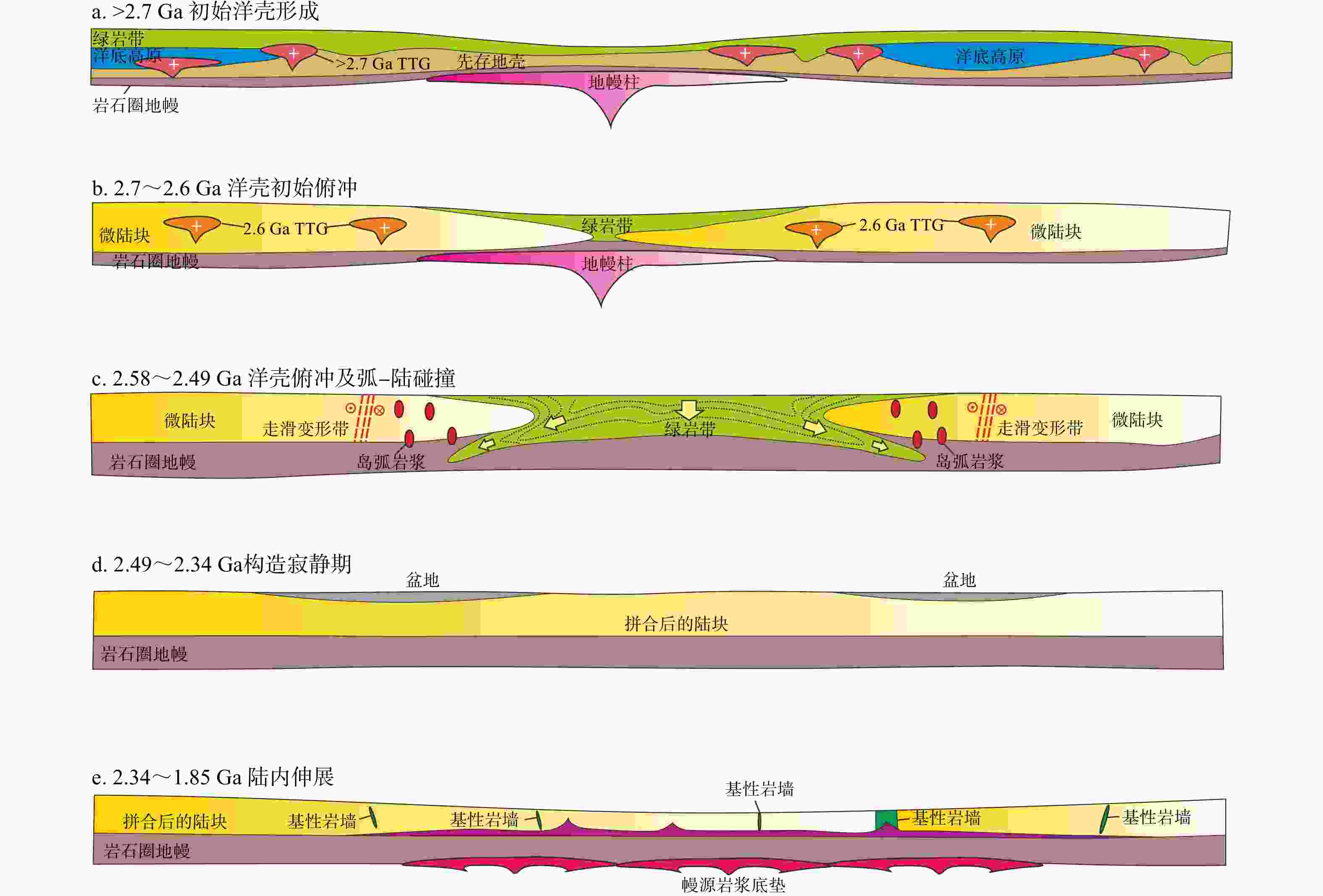
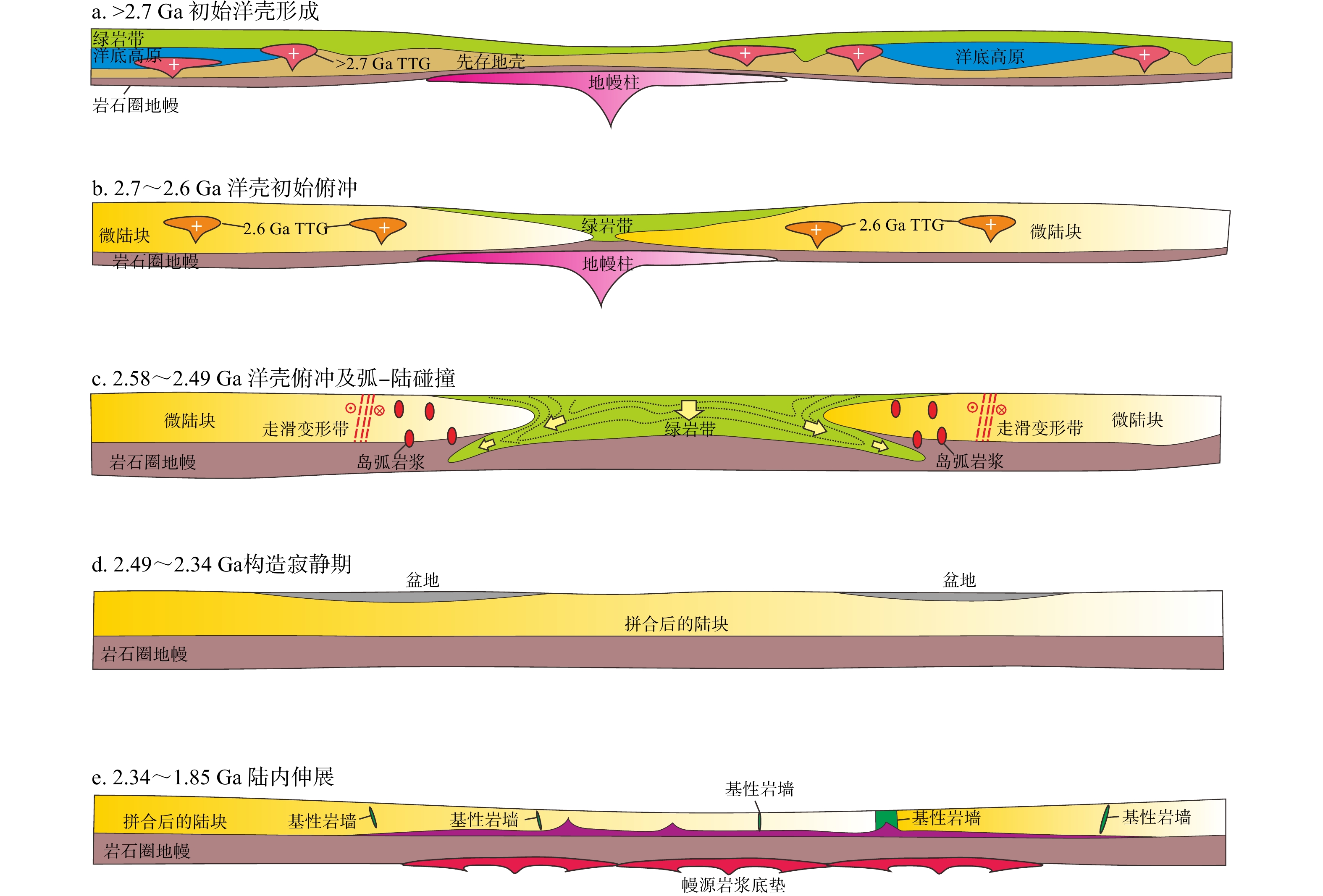
图 18 鲁西增生型造山带构造演化示意图(据翟明国等,2020修改)
Figure 18. Tectonic evolution model of the Luxi accretionary orogenic belt (modified after Zhai et al.,2020)
Cartoon showing tectonic evolution model of the Luxi accretionary orogenic belt (modified after Zhai et al.,2020)(a) Formation of the initial oceanic crust (>2.70 Ga); (b) Initial subduction of the oceanic crust (2.7-2.6 Ga); (c) Oceanic crust subduction and arc-continent collision (2.58-2.49 Ga); (d) Tectonic quiescence period (2.49-2.34 Ga); (e) Intracontinental extension stage (2.34-1.85 Ga)
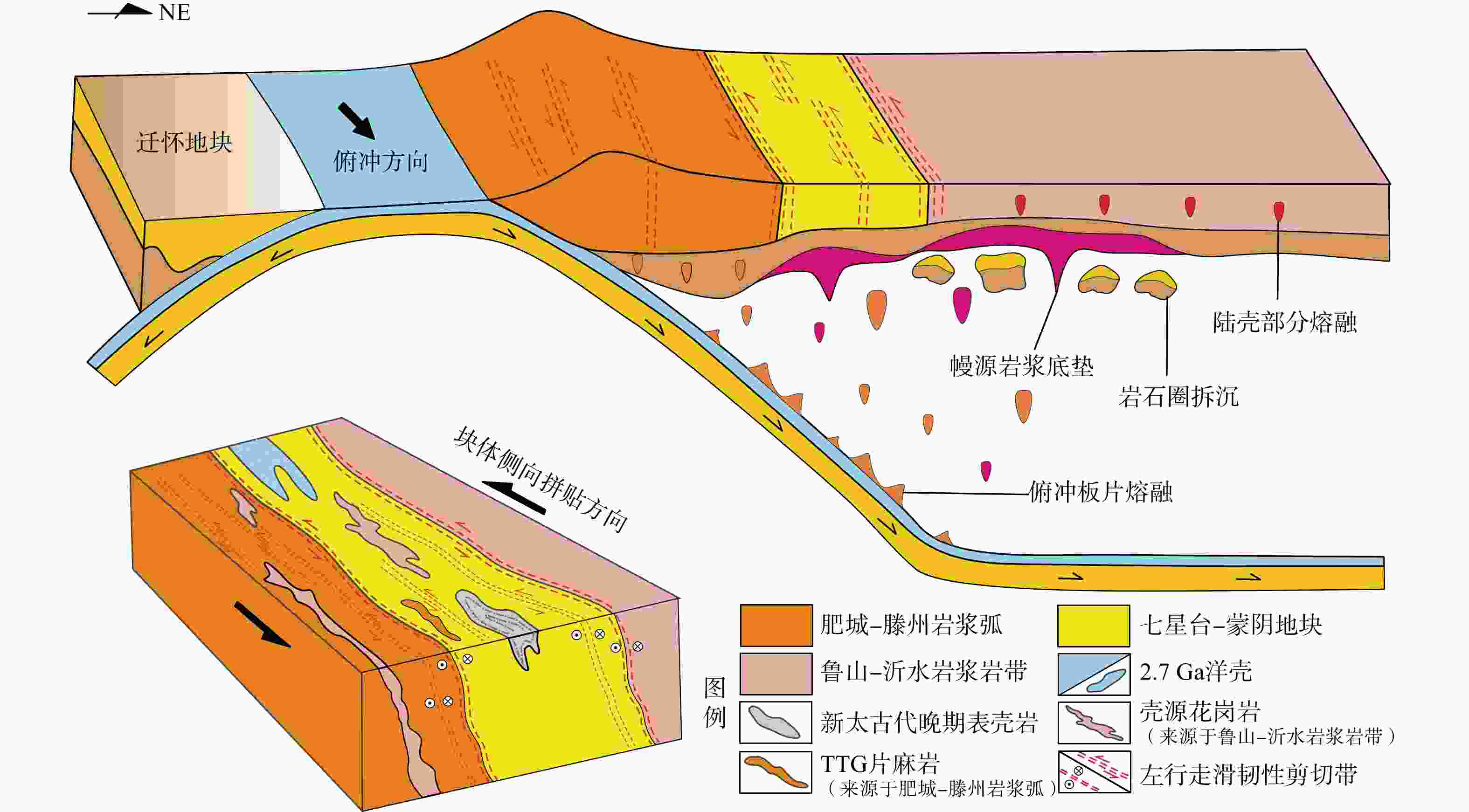
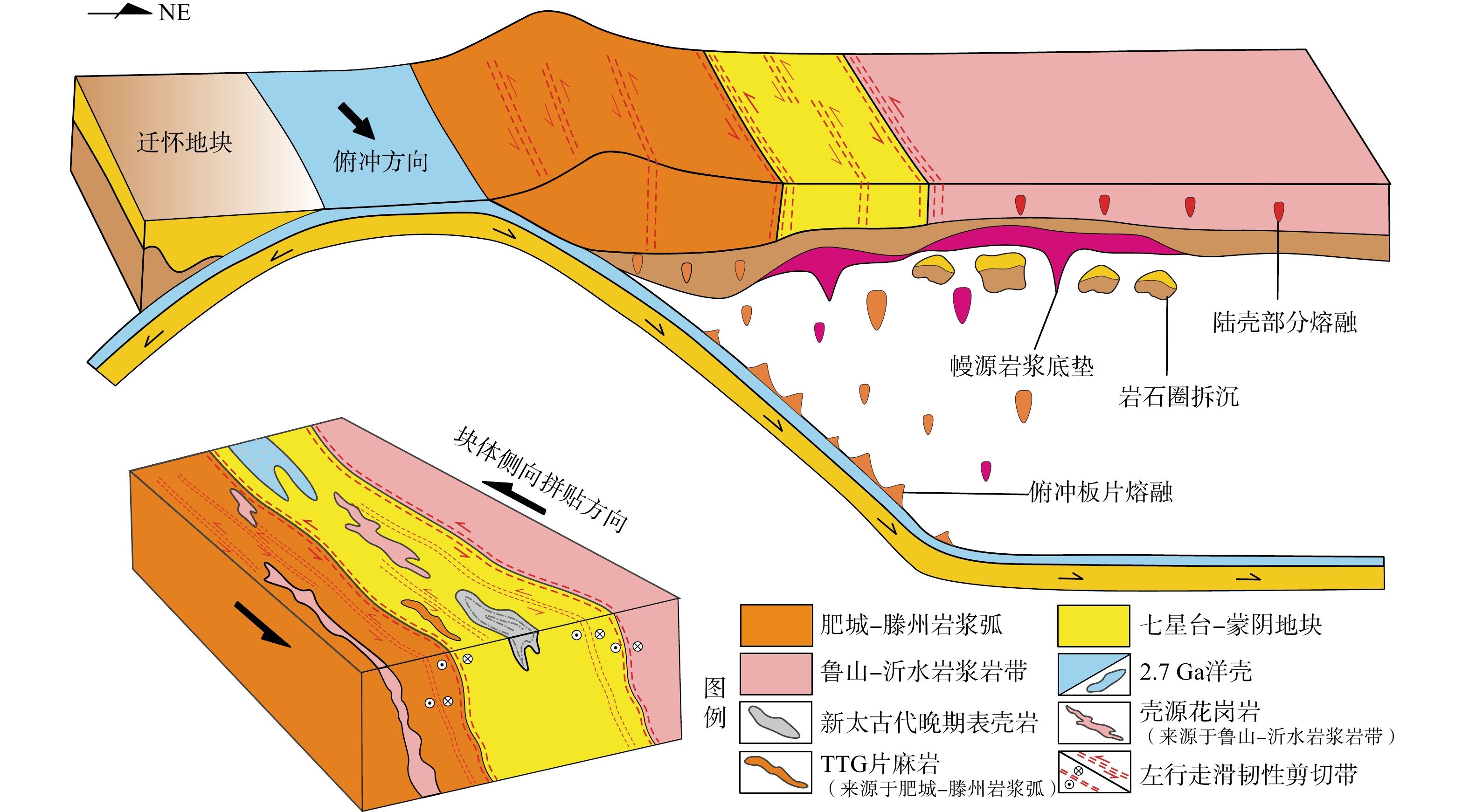
图 19 胶辽地块西缘鲁西地区洋壳俯冲以及块体拼合示意图
Figure 19. Tectonic model showing the subduction of ocean crust and terrane amalgamation in the Luxi area on the western margin of the Jiaoliao Block
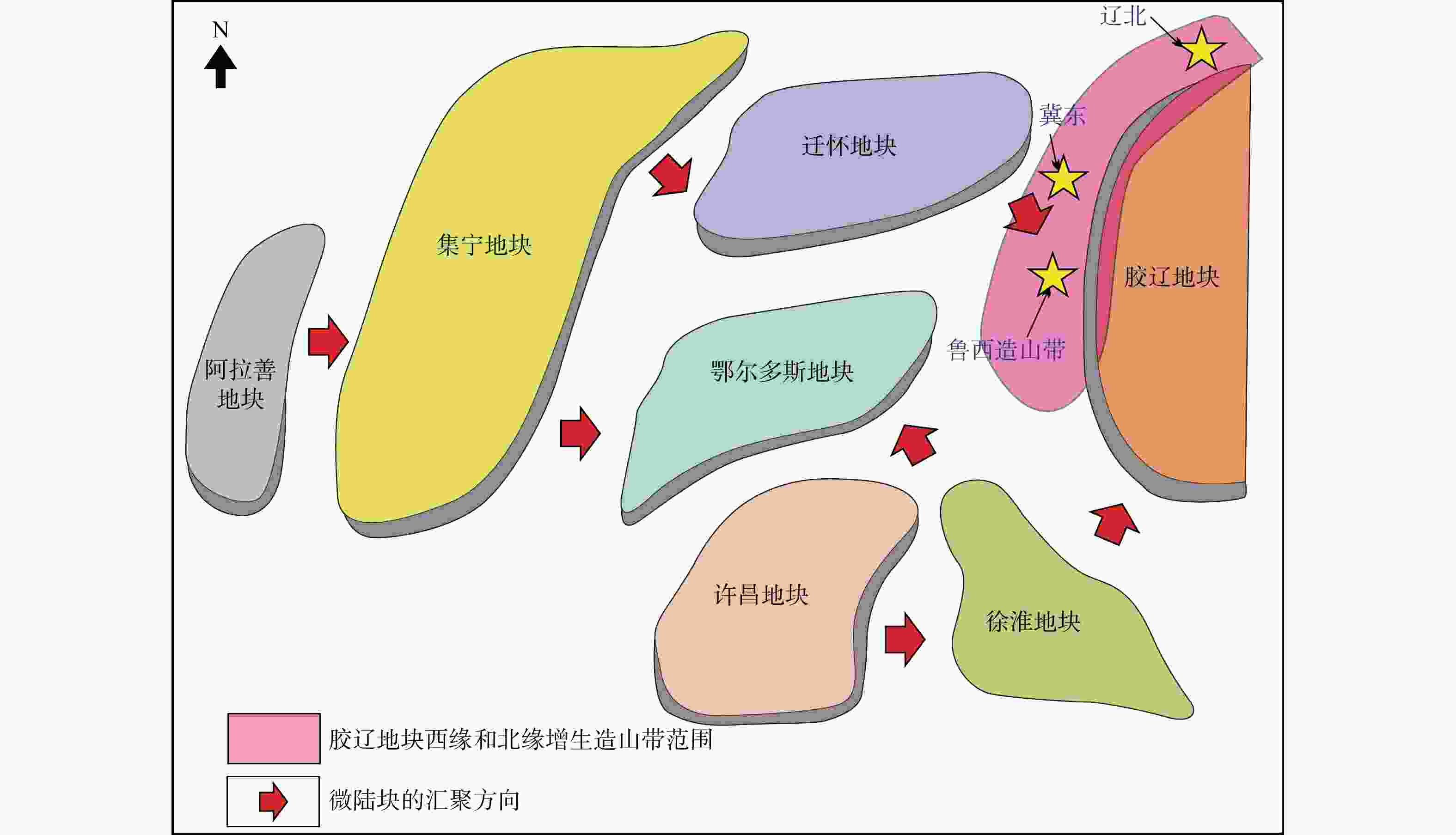
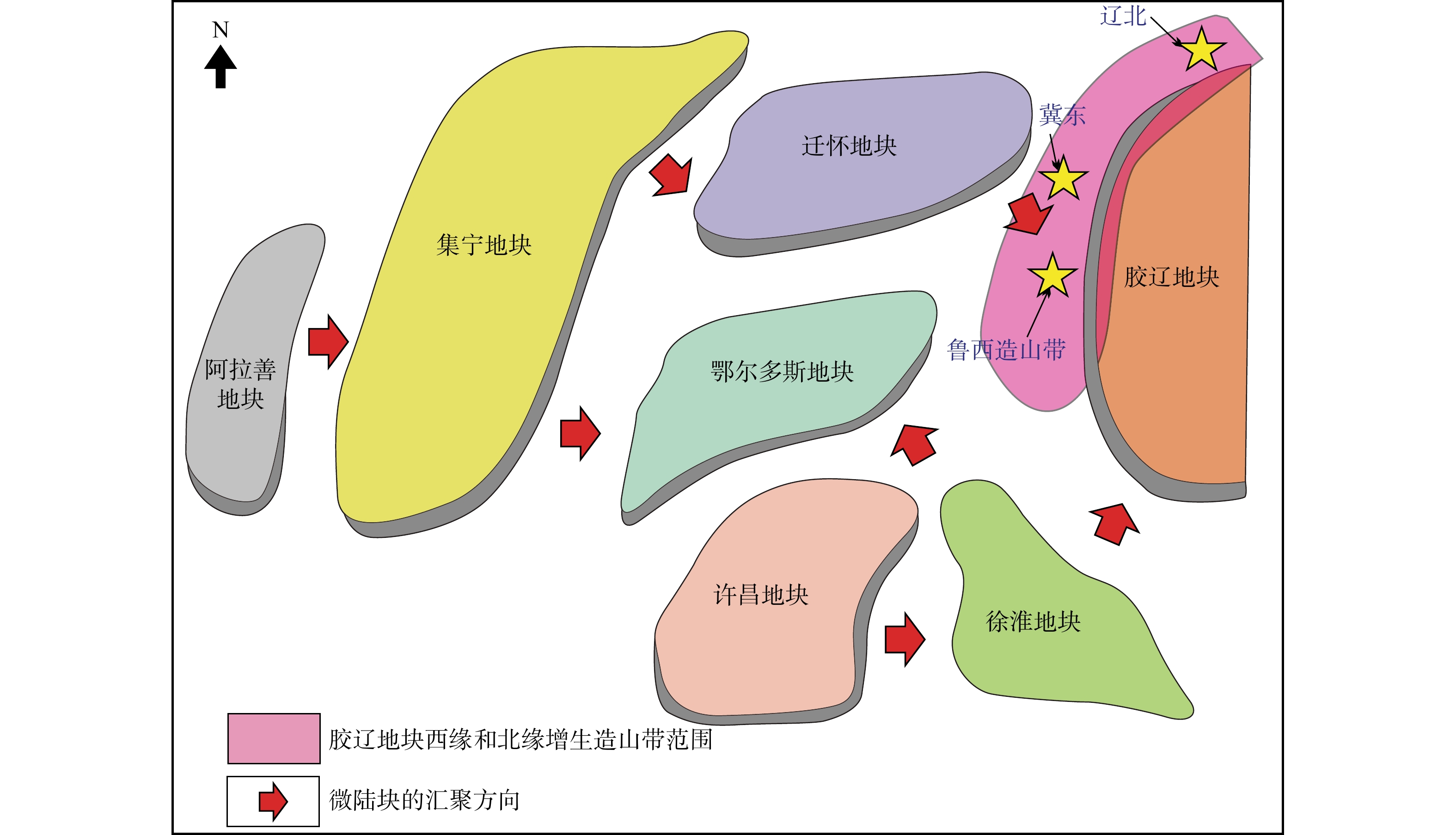
图 20 华北克拉通微陆块拼合方向示意图(据Zhai and Santosh,2011修改)
Figure 20. Schematic diagram showing the convergence direction of micro-blocks in the North China Craton (modified after Zhai and Santosh,2011)
-
[1] ALTHERR R, HOLL A, HEGNER E, et al., 2000. High-potassium, calc-alkaline I-type plutonism in the European Variscides: northern Vosges (France) and northern Schwarzwald (Germany)[J]. Lithos, 50(1-3): 51-73. doi: 10.1016/S0024-4937(99)00052-3 [2] BAO H, LIU S W, WAN Y S, et al., 2022. Neoarchean granitoids and tectonic regime of lateral growth in northeastern North China Craton[J]. Gondwana Research, 107: 176-200. doi: 10.1016/j.gr.2022.02.015 [3] BROWN M, JOHNSON T, GARDINER N J, 2020. Plate tectonics and the Archean Earth[J]. Annual Review of Earth and Planetary Sciences, 48: 291-320. doi: 10.1146/annurev-earth-081619-052705 [4] CAO G Q, 1996. Early Precambrian geology of western Shandong[M]. Beijing: Geological Publishing House: 1-210. (in Chinese) [5] CAWOOD P A, KRÖNER A, COLLINS W J, et al., 2009. Accretionary orogens through Earth history[J]. Geological Society, London, Special Publications, 318(1): 1-36. doi: 10.1144/sp318.1 [6] CAWOOD P A, HAWKESWORTH C J, DHUIME B, 2013. The continental record and the generation of continental crust[J]. GSA Bulletin, 125(1-2): 14-32. doi: 10.1130/B30722.1 [7] CAWOOD P A, HAWKESWORTH C J, PISAREVSKY S A, et al., 2018. Geological archive of the onset of plate tectonics[J]. Philosophical Transactions of the Royal Society A: Mathematical, Physical and Engineering Sciences, 376(2132): 20170405. doi: 10.1098/rsta.2017.0405 [8] CHEN Y P, KONG F M, LI X P, et al., 2025. Multi-mineral dating of Archean granitoids of the Jiaobei Terrane: decoding multiple tectono-thermal events in the eastern North China Craton[J]. Precambrian Research, 427: 107864. doi: 10.1016/j.precamres.2025.107864 [9] CHENG S H, KUSKY T, 2007. Komatiites from west Shandong, North China craton: implications for plume tectonics[J]. Gondwana Research, 12(1-2): 77-83. doi: 10.1016/j.gr.2006.10.015 [10] CONDIE K C, 1981. Archean greenstone belts[M]. Amsterdam: Elsevier Scientific Publishing Company: 1-425. [11] CONDIE K C, 2005. Earth as an evolving planetary system[M]. Amsterdam: Elsevier Academic Press: 1-447. [12] CONDIE K C, 2007. Accretionary orogens in space and time[M]//HATCHER JR R D, CARLSON M P, MCBRIDE J H, et al. 4-D framework of continental crust. Boulder: Geological Society of America: 145-158. [13] DEWEY J F, KISEEVA E S, PEARCE J A, et al., 2021. Precambrian tectonic evolution of Earth: an outline[J]. South African Journal of Geology, 124(1): 141-162. doi: 10.25131/sajg.124.0019 [14] DIWU C, SUN Y, SI B W, et al., 2024. Archean continental crustal growth and reworking of the North China Craton: constraints from zircon U-Pb age and Hf isotopic composition[J]. Earth-Science Reviews, 248: 104624. doi: 10.1016/j.earscirev.2023.104624 [15] DONG C Y, XIE H Q, KRÖNER A, et al., 2017. The complexities of zircon crystllazition and overprinting during metamorphism and anatexis: an example from the late Archean TTG terrane of western Shandong Province, China[J]. Precambrian Research, 300: 181-200. doi: 10.1016/j.precamres.2017.07.034 [16] DONG C Y, BAI W Q, XIE H Q, et al. , 2021. Early Neoarchean oceanic crust in the North China Craton: evidence from geology, geochemistry and geochronology of greenstone belts in western Shandong[J]. Lithos, 380-381: 105888. [17] DONG Z Y, DENG H, KUSKY T, et al., 2024. Growth of the Central Orogenic Belt, North China Craton through accretion of different Neoarchean arc terranes: perspective from the Linshan complex[J]. Precambrian Research, 412: 107555. doi: 10.1016/j.precamres.2024.107555 [18] DU L L, ZHUANG Y X, YANG C H, et al., 2003. Characters of zircons in the Mengjiatun Formation in Xintai of Shandong and their chronological significance[J]. Acta Geologica Sinica, 77(3): 359-366. (in Chinese with English abstract) [19] DU L L, ZHUANG Y X, YANG C H, et al., 2005. SHRIMP U-Pb zircon chronology of fine-grained amphibolite in the Mengjiatun area, western Shandong[J]. Acta Geoscientica Sinica, 26(5): 429-434. (in Chinese with English abstract) [20] FU J H, LIU S W, SUN G Z, et al., 2021. Two contrasting Neoarchean metavolcanic rock suites in eastern Hebei and their geodynamic implications for the northern North China Craton[J]. Gondwana Research, 95: 45-71. doi: 10.1016/j.gr.2021.02.023 [21] GAO L, LIU S W, SUN G Z, et al., 2018. Petrogenesis of late Neoarchean high-K granitoids in the Western Shandong terrane, North China Craton, and their implications for crust-mantle interactions[J]. Precambrian Research, 315: 138-161. doi: 10.1016/j.precamres.2018.07.006 [22] GAO L, LIU S W, ZHANG B, et al., 2019a. A Ca. 2.8-Ga plume-induced intraoceanic arc system in the eastern North China craton[J]. Tectonics, 38(5): 1694-1717. [23] GAO L, LIU S W, SUN G Z, et al., 2019b. Neoarchean crust-mantle interactions in the Yishui Terrane, south-eastern margin of the North China Craton: constraints from geochemistry and zircon U-Pb-Hf isotopes of metavolcanic rocks and high-K granitoids[J]. Gondwana Research, 65: 97-124. doi: 10.1016/j.gr.2018.10.002 [24] GAO L, LIU S W, WANG M J, et al., 2020. Late Neoarchean volcanic rocks in the southern Liaoning Terrane and their tectonic implications for the formation of the eastern North China Craton[J]. Geoscience Frontiers, 11(3): 1053-1068. doi: 10.1016/j.gsf.2019.11.003 [25] GAO M, ZHANG Z J, CHENG Q M, et al., 2021. Zircon U-Pb and Lu-Hf isotopes of Huai'an complex granites, North China Craton: implications for crustal growth, reworking and tectonic evolution[J]. Gondwana Research, 90: 118-134. doi: 10.1016/j.gr.2020.10.015 [26] GENG Y S, LIU F L, YANG C H, 2006. Magmatic event at the end of the Archean in eastern Hebei province and its geological implication[J]. Acta Geologica Sinica (English Edition), 80(6): 819-833. doi: 10.1111/j.1755-6724.2006.tb00305.x [27] GHOSH S, D’SOUZA J, GOUD B R, et al., 2022. A review of the Precambrian tectonic evolution of the Aravalli Craton, northwestern India: structural, metamorphic and geochronological perspectives from the basement complexes and supracrustal sequences[J]. Earth-Science Reviews, 232: 104098. doi: 10.1016/j.earscirev.2022.104098 [28] GUO B R, LIU S W, SANTOSH M, et al., 2017a. Neoarchean arc magmatism and crustal growth in the north-eastern North China Craton: evidence from granitoid gneisses in the Southern Jilin Province[J]. Precambrian Research, 303: 30-53. doi: 10.1016/j.precamres.2016.12.009 [29] GUO M J, ZHANG J, QIAN J H, et al. , 2024. Ultrahigh-temperature metamorphism of the felsic granulites in the eastern North China Craton and their implications on the Neoarchean tectonic regime[J]. Lithos, 468-469: 107516. [30] GUO P, SANTOSH M, LI S R, et al., 2014. Crustal evolution in the central part of eastern NCC: zircon U-Pb ages from multiple magmatic pulses in the Luxi area and implications for gold mineralization[J]. Ore Geology Reviews, 60: 126-145. doi: 10.1016/j.oregeorev.2014.01.002 [31] GUO R R, LIU S W, GONG E P, et al., 2017b. Arc-generated metavolcanic rocks in the Anshan-Benxi greenstone belt, North China Craton: constraints from geochemistry and zircon U-Pb-Hf isotopic systematics[J]. Precambrian Research, 303: 228-250. doi: 10.1016/j.precamres.2017.03.028 [32] GUO R R, LI Z H, LIU S W, et al., 2022. Late Neoarchean geodynamic regime of the northeastern North China Craton: constraints from metamorphosed volcanic rocks of the Anshan-Benxi greenstone belt[J]. Precambrian Research, 371: 106583. doi: 10.1016/j.precamres.2022.106583 [33] GUO R R, XIAO Y, WEI C M, et al., 2025. New geochronological evidences and diverse arc-related meta-volcanic rock suits from the Northern Liaoning terrane, North China Craton[J]. Precambrian Research, 422: 107755. doi: 10.1016/j.precamres.2025.107755 [34] HE X, WANG W, SANTOSH M, et al., 2021. Late Neoarchean crustal growth under paired continental arc-back arc system in the North China Craton[J]. Geoscience Frontiers, 12(3): 101120. doi: 10.1016/j.gsf.2020.12.003 [35] HOU G T, LIU Y L, LI J H, 2006. Evidence for ~1.8 Ga extension of the Eastern Block of the North China Craton from SHRIMP U–Pb dating of mafic dyke swarms in Shandong Province[J]. Journal of Asian Earth Sciences, 27(4): 392-401. doi: 10.1016/j.jseaes.2005.05.001 [36] HU Y L, LIU S W, GAO L, et al. , 2019b. Diverse middle Neoarchean granitoids and the delamination of thickened crust in the Western Shandong Terrane, North China Craton[J]. Lithos, 348-349: 105178. [37] HU Y L, LIU S W, SUN G Z, et al., 2019a. Petrogenesis of the Neoarchean granitoids and crustal oxidation states in the Western Shandong Province, North China Craton[J]. Precambrian Research, 334: 105446. doi: 10.1016/j.precamres.2019.105446 [38] JAHN B M, AUVRAY B, SHEN Q H, et al., 1988. Archean crustal evolution in China: the Taishan complex, and evidence for juvenile crustal addition from long-term depleted mantle[J]. Precambrian Research, 38(4): 381-403. [39] KANG J L, PENG P, WANG H C, et al., 2024. Continental subduction in Paleoproterozoic: insights from ~ 1.9 Ga nepheline syenite in the North China craton[J]. Precambrian Research, 404: 107346. [40] KEMP A I S, HAWKESWORTH C J, COLLINS W J, et al., 2009. Isotopic evidence for rapid continental growth in an extensional accretionary orogen: the Tasmanides, eastern Australia[J]. Earth and Planetary Science Letters, 284(3-4): 455-466. doi: 10.1016/j.epsl.2009.05.011 [41] KORSCH R J, KOSITCIN N, CHAMPION D C, 2011. Australian island arcs through time: geodynamic implications for the Archean and Proterozoic[J]. Gondwana Research, 19(3): 716-734. doi: 10.1016/j.gr.2010.11.018 [42] KUSKY T M, ZHAI M G, 2012. The neoarchean ophiolite in the North China craton: early Precambrian plate tectonics and scientific debate[J]. Journal of Earth Science, 23(3): 277-284. doi: 10.1007/s12583-012-0253-6 [43] KUSKY T M, WINDLEY B F, POLAT A, 2018. Geological evidence for the operation of plate tectonics throughout the Archean: records from Archean paleo-plate boundaries[J]. Journal of Earth Science, 29(6): 1291-1303. doi: 10.1007/s12583-018-0999-6 [44] LAURENT O, DOUCELANCE R, MARTIN H, et al., 2013. Differentiation of the late-Archaean sanukitoid series and some implications for crustal growth: insights from geochemical modelling on the Bulai pluton, Central Limpopo Belt, South Africa[J]. Precambrian Research, 227: 186-203. doi: 10.1016/j.precamres.2012.07.004 [45] LI S S, SANTOSH M, CEN K, et al., 2016. Neoarchean convergent margin tectonics associated with microblock amalgamation in the North China Craton: evidence from the Yishui Complex[J]. Gondwana Research, 38: 113-131. doi: 10.1016/j.gr.2015.11.004 [46] LI Z, WEI C J, CHEN B, et al., 2021. U–Pb–Hf–O–Nd isotopic and geochemical constraints on the origin of Archean TTG gneisses from the North China Craton: implications for crustal growth[J]. Precambrian Research, 354: 106078. doi: 10.1016/j.precamres.2020.106078 [47] LI Z S, SHAN X L, LIU J, et al., 2023. Late Neoarchean TTG and monzogranite in the northeastern North China Craton: implications for partial melting of a thickened lower crust[J]. Gondwana Research, 115: 201-223. doi: 10.1016/j.gr.2022.10.008 [48] LIOU P, GUO J H, PENG P, et al., 2022. Crustal growth of the North China Craton at ca. 2.5 Ga[J]. Science Bulletin, 67(15): 1553-1555. doi: 10.1016/j.scib.2022.06.002 [49] LIU B, MA J X, LI P F, et al., 2025. First boron isotopes in the southern Jilin TTG series uncover a Neoarchean oceanic arc in the eastern North China Craton[J]. Gondwana Research, 139: 243-259. doi: 10.1016/j.gr.2024.11.008 [50] LIU D Y, NUTMAN A P, COMPSTON W, et al., 1992. Remnants of ≥3800 Ma crust in the Chinese part of the Sino-Korean craton[J]. Geology, 20(4): 339-342. doi: 10.1130/0091-7613(1992)020<0339:romcit>2.3.co;2 [51] LIU G, LU J S, ZHAI M G, et al., 2022. Clockwise P−T−t paths of late Neoarchean high-pressure pelitic granulites from the Qingyuan terrane, eastern North China Craton[J]. Precambrian Research, 381: 106874. doi: 10.1016/j.precamres.2022.106874 [52] LIU J H, LIU F L, DING Z J, et al., 2024a. Mesoarchean–Neoarchean coupled crust–mantle differentiation followed by gravity-driven lithospheric delamination and subduction initiation in the North China Craton[J]. Precambrian Research, 404: 107349. doi: 10.1016/j.precamres.2024.107349 [53] LIU S, FENG C X, SANTOSH M, et al., 2019. Origin and geodynamics of Neoarchean mafic dikes in Western Shandong, Northeastern North China Craton: geochronological, geochemical, and Nd-Hf isotopic evidence[J]. The Journal of Geology, 127(1): 61-79. doi: 10.1086/700407 [54] LIU S W, BAO H, GAO L, et al., 2021. Late Neoarchean metavolcanics and geodynamics regime in central and eastern North China Craton[J]. Acta Petrologica Sinica, 37(1): 113-128. (in Chinese with English abstract) doi: 10.18654/1000-0569/2021.01.08 [55] LIU T, WEI C J, JOHNSON T E, 2024b. Archean UHT metamorphism with counterclockwise P–T path: insights from pelitic granulites from East Hebei, North China Craton[J]. Gondwana Research, 133: 108-128. doi: 10.1016/j.gr.2024.06.007 [56] LU C S, QIAN J H, YIN C Q, et al., 2023. Characterising early Precambrian collisional orogens: a metamorphic perspective from the Lüliang Complex and the Trans-North China Orogen[J]. Earth-Science Reviews, 245: 104566. [57] LU S N, CHEN Z H, XIANG Z Q, 2008. Geochronological framework of ancient intrusions in Taishan Geopark[M]. Beijing: Geological Publishing House: 1-90. (in Chinese) [58] MANIAR P D, PICCOLI P M, 1989. Tectonic discrimination of granitoids[J]. GSA Bulletin, 101(5): 635-643. doi: 10.1130/0016-7606(1989)101<0635:tdog>2.3.co;2 [59] MARTIN H, SMITHIES R H, RAPP R, et al., 2005. An overview of adakite, tonalite–trondhjemite–granodiorite (TTG), and sanukitoid: relationships and some implications for crustal evolution[J]. Lithos, 79(1-2): 1-24. doi: 10.1016/j.lithos.2004.04.048 [60] MARTIN H, MOYEN J F, RAPP R, 2009. The sanukitoid series: magmatism at the Archaean–Proterozoic transition[J]. Earth and Environmental Science Transactions of the Royal Society of Edinburgh, 100(1-2): 15-33. doi: 10.1130/2010.2472(02) [61] MCDONOUGH W F, 2003. Compositional model for the earth's core[J]. Treatise on Geochemistry, 2: 547-568. doi: 10.1016/b978-0-08-095975-7.00215-1 [62] MOYEN J F, MARTIN H, JAYANANDA M, et al., 2003. Late Archaean granites: a typology based on the Dharwar Craton (India)[J]. Precambrian Research, 127(1-3): 103-123. doi: 10.1016/S0301-9268(03)00183-9 [63] MU M S, YANG D B, YANG H T, et al., 2022. Petrogenesis and tectonic implications of the Paleoproterozoic Gaoliduntai plagiogranites in the Jiao–Liao–Ji Belt, North China Craton[J]. Precambrian Research, 368: 106465. doi: 10.1016/j.precamres.2021.106465 [64] O’CONNOR J T, 1965. A classification for quartz-rich igneous rocks based on feldspar ratios[J]. US Geological Survey, Professional Papers, 525B: B79-B84. [65] OLIVEIRA E P, SOUZA Z S, MCNAUGHTON N J, et al., 2011. The Rio Capim volcanic-plutonic-sedimentary belt, São Francisco Craton, Brazil: geological, geochemical and isotopic evidence for oceanic arc accretion during Palaeoproterozoic continental collision[J]. Gondwana Research, 19(3): 735-750. doi: 10.1016/j.gr.2010.06.005 [66] OUYANG D J, JIAO S J, COLLINS W J, et al. , 2024. Evolution of A-type granites during the Late Paleoproterozoic orogenic cycle of North China craton: implications for post-collisional magmatism[J]. Lithos, 474-475: 107584. [67] PALIN R M, SANTOSH M, CAO W T, et al., 2020. Secular change and the onset of plate tectonics on Earth[J]. Earth-Science Reviews, 207: 103172. [68] PEARCE J A, 1983. Role of the sub-continental lithosphere in magma genesis at active continental margins[M]//HAWKESWORTH C J, NORRY M J. Continental basalts and mantle xenoliths. Nantwich: Shiva Publishing: 158-185. [69] PENG T P, FAN W M, PENG B X, 2012. Geochronology and geochemistry of late Archean adakitic plutons from the Taishan granite-greenstone Terrain: implications for tectonic evolution of the eastern North China Craton[J]. Precambrian Research, 208-211: 53-71. [70] PENG T P, WILDE S A, FAN W M, et al., 2013. Neoarchean siliceous high-Mg basalt (SHMB) from the Taishan granite-greenstone terrane, Eastern North China Craton: petrogenesis and tectonic implications[J]. Precambrian Research, 228: 233-249. doi: 10.1016/j.precamres.2013.01.017 [71] PERCHUK A L, SAFONOV O G, SMIT C A, et al., 2018. Precambrian ultra-hot orogenic factory: making and reworking of continental crust[J]. Tectonophysics, 746: 572-586. doi: 10.1016/j.tecto.2016.11.041 [72] POLAT A, HERZBERG C, MÜNKER C, et al., 2006. Geochemical and petrological evidence for a suprasubduction zone origin of Neoarchean (ca. 2.5 Ga) peridotites, central orogenic belt, North China craton[J]. GSA Bulletin, 118(7-8): 771-784. doi: 10.1130/B25845.1 [73] REN P, XIE H Q, WANG S J, et al., 2016. A ca. 2.60 Ga tectono-thermal event in Western Shandong Province, North China Craton from zircon U–Pb–O isotopic evidence: plume or convergent plate boundary process[J]. Precambrian Research, 281: 236-252. doi: 10.1016/j.precamres.2016.05.016 [74] ROJAS-AGRAMONTE Y, KRÖNER A, DEMOUX A, et al., 2011. Detrital and xenocrystic zircon ages from Neoproterozoic to Palaeozoic arc terranes of Mongolia: significance for the origin of crustal fragments in the Central Asian Orogenic Belt[J]. Gondwana Research, 19(3): 751-763. doi: 10.1016/j.gr.2010.10.004 [75] SAFONOVA I, 2017. Juvenile versus recycled crust in the Central Asian Orogenic Belt: implications from ocean plate stratigraphy, blueschist belts and intra-oceanic arcs[J]. Gondwana Research, 47: 6-27. doi: 10.1016/j.gr.2016.09.003 [76] SAFONOVA I Y, SANTOSH M, 2014. Accretionary complexes in the Asia-Pacific region: tracing archives of ocean plate stratigraphy and tracking mantle plumes[J]. Gondwana Research, 25(1): 126-158. doi: 10.1016/j.gr.2012.10.008 [77] SANTOSH M, MARUYAMA S, KOMIYA T, et al., 2010. Orogens in the evolving Earth: from surface continents to ‘lost continents’ at the core-mantle boundary[J]. Geological Society, London, Special Publications, 338(1): 77-116. doi: 10.1144/SP338.5 [78] SANTOSH M, LIU D Y, SHI Y R, et al., 2013. Paleoproterozoic accretionary orogenesis in the North China Craton: a SHRIMP zircon study[J]. Precambrian Research, 227: 29-54. doi: 10.1016/j.precamres.2011.11.004 [79] SANTOSH M, TENG X M, HE X F, et al., 2016. Discovery of Neoarchean suprasubduction zone ophiolite suite from Yishui Complex in the North China Craton[J]. Gondwana Research, 38: 1-27. doi: 10.1016/j.gr.2015.10.017 [80] SANTOSH M, GAO P, YU B, et al., 2020. Neoarchean suprasubduction zone ophiolite discovered from the Miyun Complex: implications for Archean–Paleoproterozoic Wilson cycle in the North China Craton[J]. Precambrian Research, 342: 105710. doi: 10.1016/j.precamres.2020.105710 [81] Shandong Institute of Geological Survey, 2021. Regional geology of China, Shandong Province[M]. Beijing: Geological Publishing House. (in Chinese) [82] SHI K X, WANG C M, SANTOSH M, et al., 2019. New insights into Neoarchean–Paleoproterozoic crustal evolution in the North China Craton: evidence from zircon U-Pb geochronology, Lu–Hf isotopes and geochemistry of TTGs and greenstones from the Luxi Terrane[J]. Precambrian Research, 327: 232-254. doi: 10.1016/j.precamres.2019.04.010 [83] SHU L S, YAO J L, WANG B, et al., 2021. Neoproterozoic plate tectonic process and Phanerozoic geodynamic evolution of the South China Block[J]. Earth-Science Reviews, 216: 103596. doi: 10.1016/j.earscirev.2021.103596 [84] SONG M C, JIAO X M, SONG Y X, et al., 2011. Geochemical characteristics and sedimentary environment of Precambrian Jining Group in Western Shandong Province[J]. Geotectonica et Metallogenia, 35(4): 543-551. (in Chinese with English abstract) [85] STERN R J, TSUJIMORI T, HARLOW G, et al., 2013. Plate tectonic gemstones[J]. Geology, 41(7): 723-726. doi: 10.1130/G34204.1 [86] SUN G Z, LIU S W, GAO L, et al., 2019a. Neoarchean sanukitoids and associated rocks from the Tengzhou-Pingyi intrusive complex, North China Craton: insights into petrogenesis and crust-mantle interactions[J]. Gondwana Research, 68: 50-68. doi: 10.1016/j.gr.2018.11.005 [87] SUN G Z, LIU S W, SANTOSH M, et al., 2019b. Thickness and geothermal gradient of Neoarchean continental crust: inference from the southeastern North China Craton[J]. Gondwana Research, 73: 16-31. doi: 10.1016/j.gr.2019.02.001 [88] SUN G Z, LIU S W, GAO L, et al., 2020. Origin of late Neoarchean granitoid diversity in the Western Shandong province, North China Craton[J]. Precambrian Research, 339: 105620. doi: 10.1016/j.precamres.2020.105620 [89] SUN G Z, LIU S W, CAWOOD P A, et al., 2021. Thermal state and evolving geodynamic regimes of the Meso-to Neoarchean North China Craton[J]. Nature Communications, 12(1): 3888. doi: 10.1038/s41467-021-24139-z [90] SUN G Z, LIU S W, WANG L T, et al., 2025. Late Neoarchean sanukitoids in the North China Craton: a geodynamic perspective[J]. Geosystems and Geoenvironment, 4(4): 100426. doi: 10.1016/j.geogeo.2025.100426 [91] TIAN Z H, NUTMAN A P, 2022. Structural restoration of an Eo-Mesoarchean (3.8-2.9 Ga) terrane, Eastern China, dissected by the Tanlu fault zone[J]. Journal of Structural Geology, 161: 104629. doi: 10.1016/j.jsg.2022.104629 [92] WAN Y S, LIU D Y, WANG S J, et al., 2010. Juvenile magmatism and crustal recycling at the end of the Neoarchean in Western Shandong Province, North China Craton: evidence from SHRIMP zircon dating[J]. American Journal of Science, 310(10): 1503-1552. doi: 10.2475/10.2010.11 [93] WAN Y S, LIU D Y, WANG S J, et al., 2011. 2.7 Ga juvenile crust formation in the North China Craton (Taishan-Xintai area, western Shandong Province): further evidence of an understated event from U–Pb dating and Hf isotopic composition of zircon[J]. Precambrian Research, 186(1-4): 169-180. doi: 10.1016/j.precamres.2011.01.015 [94] WAN Y S, WANG S J, LIU D Y, et al., 2012a. Redefinition of depositional ages of Neoarchean supracrustal rocks in western Shandong Province, China: SHRIMP U-Pb zircon dating[J]. Gondwana Research, 21(4): 768-784. doi: 10.1016/j.gr.2011.05.017 [95] WAN Y S, DONG C Y, LIU D Y, et al. , 2012b. Zircon ages and geochemistry of late Neoarchean syenogranites in the North China Craton: a review[J]. Precambrian Research, 222-223: 265-289. [96] WAN Y S, XIE S W, YANG C H, et al., 2014a. Early Neoarchean (~2.7Ga) tectono–thermal events in the North China Craton: a synthesis[J]. Precambrian Research, 247: 45-63. [97] WAN Y S, DONG C Y, WANG S J, et al., 2014b. Middle Neoarchean magmatism in western Shandong, North China Craton: SHRIMP zircon dating and LA-ICP-MS Hf isotope analysis[J]. Precambrian Research, 255: 865-884. doi: 10.1016/j.precamres.2014.07.016 [98] WAN Y S, MA M Z, DONG C Y, et al., 2015. Widespread late Neoarchean reworking of Meso-to Paleoarchean continental crust in the Anshan-Benxi area, North China Craton, as documented by U-Pb-Nd-Hf-O isotopes[J]. American Journal of Science, 315(7): 620-670. doi: 10.2475/07.2015.02 [99] WAN Y S, GUO R P, TIAN J X, et al. , 2019. Discovery of Mesoarchean-early Neoarchean TTG Rocks in Laizhou Area in Eastern Shandong of North China Craton: SHRIMP U-Pb zircon dating[J]. Shandong Land and Resources, 35(4): 1-16, 37. (in Chinese with English abstract) [100] WAN Y S, DONG C Y, XIE H Q, et al., 2023. Hadean to early Mesoarchean rocks and zircons in the North China Craton: a review[J]. Earth-Science Reviews, 243: 104489 doi: 10.1016/j.earscirev.2023.104489 [101] WANG A D, LIU Y C, 2012. Neoarchean (2.5-2.8 Ga) crustal growth of the North China Craton revealed by zircon Hf isotope: a synthesis[J]. Geoscience Frontiers, 3(2): 147-173. doi: 10.1016/j.gsf.2011.10.006 [102] WANG D M, HU J M, ZHAO Y F, et al., 2024a. Kinematics and geochronology of the ductile shear zones in the western Shandong granite-greenstone belt: implications for the Neoarchean plate tectonics of the North China Craton[J]. Precambrian Research, 411: 107509. doi: 10.1016/j.precamres.2024.107509 [103] WANG J P, KUSKY T, POLAT A, et al., 2013a. A late Archean tectonic mélange in the Central orogenic belt, North China Craton[J]. Tectonophysics, 608: 929-946. doi: 10.1016/j.tecto.2013.07.025 [104] WANG K, LIU S W, WANG M J, et al., 2017a. Geochemistry and zircon U-Pb-Hf isotopes of the late Neoarchean granodiorite-monzogranite-quartz syenite intrusions in the Northern Liaoning Block, North China Craton: petrogenesis and implications for geodynamic processes[J]. Precambrian Research, 295: 151-171. doi: 10.1016/j.precamres.2017.04.021 [105] WANG W, WANG S J, DONG C Y, et al., 2010. SHRIMP U-Pb dating of zircons from Neoarchean crustal derived granites in the Lushan area, Shandong, China[J]. Geological Bulletin of China, 29(7): 993-1000. (in Chinese with English abstract) [106] WANG W, YANG E X, ZHAI M G, et al., 2013b. Geochemistry of~ 2.7 Ga basalts from Taishan area: constraints on the evolution of early Neoarchean granite-greenstone belt in western Shandong Province, China[J]. Precambrian Research, 224: 94-109. doi: 10.1016/j.precamres.2012.09.009 [107] WANG W, ZHAI M G, WANG S J, et al., 2013c. Crustal reworking in the North China Craton at ~ 2.5 Ga: evidence from zircon U–Pb age, Hf isotope and whole rock geochemistry of the felsic volcano-sedimentary rocks from the western Shandong Province[J]. Geological Journal, 48(5): 406-428. doi: 10.1002/gj.2493 [108] WANG W, ZHAI M G, TAO Y B, et al., 2014. Late Neoarchean crustal evolution of the eastern North China Craton: a study on the provenance and metamorphism of paragneiss from the Western Shandong Province[J]. Precambrian Research, 255: 583-602. doi: 10.1016/j.precamres.2014.08.020 [109] WANG W, LIU S W, SANTOSH M, et al., 2015. Neoarchean intra-oceanic arc system in the Western Liaoning Province: implications for Early Precambrian crustal evolution in the Eastern Block of the North China Craton[J]. Earth-Science Reviews, 150: 329-364. doi: 10.1016/j.earscirev.2015.08.002 [110] WANG W, ZHAI M G, SANTOSH M, 2016. The genesis of Archean supracrustal rocks in the western Shandong Province of North China Craton: constraints on regional crustal evolution[J]. Science China Earth Sciences, 59(8): 1583-1596. doi: 10.1007/s11430-016-5300-1 [111] WANG W, ZHAI M G, WANG S J, et al., 2016a. Neoarchean crustal evolution in western Shandong Province of the North China Craton: the role of 2.7-2.6 Ga magmatism[J]. Precambrian Research, 285: 170-185. doi: 10.1016/j.precamres.2016.09.010 [112] WANG W, LIU S W, CAWOOD P A, et al., 2016b. Late Neoarchean subduction-related crustal growth in the Northern Liaoning region of the North China Craton: evidence from~ 2.55 to 2.50 Ga granitoid gneisses[J]. Precambrian Research, 281: 200-223. doi: 10.1016/j.precamres.2016.05.018 [113] WANG W, ZHANG X, WANG S J, et al., 2017b. Geochronology and geochemistry of Neoarchean granitoids from the western Shandong Province, North China Craton, implications for crustal evolution and cratonization[J]. Precambrian Research, 303: 749-763. doi: 10.1016/j.precamres.2017.10.007 [114] WANG W, CAWOOD P A, LIU S W, et al., 2017c. Cyclic formation and stabilization of Archean lithosphere by accretionary orogenesis: constraints from TTG and potassic granitoids, North China Craton[J]. Tectonics, 36(9): 1724-1742. doi: 10.1002/2017TC004600 [115] WANG W, LIU S W, CAWOOD P A, et al., 2024b. Early Neoarchean alternation of plate subduction and deep mantle upwelling[J]. Precambrian Research, 402: 107303. doi: 10.1016/j.precamres.2024.107303 [116] WANG X, ZHU W B, ZHENG Y F, 2022. Geochemical constraints on the nature of Late Archean basaltic-andesitic magmatism in the North China Craton[J]. Earth-Science Reviews, 230: 104065. doi: 10.1016/j.earscirev.2022.104065 [117] WANG X, GE R F, ZHENG Y F, et al., 2024c. Successful subduction of oceanic plate after failed attempts in the Late Archean: petrological and geochemical constraints[J]. Earth and Planetary Science Letters, 644: 118944. doi: 10.1016/j.epsl.2024.118944 [118] WANG X S, ZHUANG Y X, XU H F, et al., 1999. The implication of terminal Archean ductile shearing in continental crustal evolution of the Taishan Mountain region[J]. Regional Geology of China, 18(2): 168-174. (in Chinese with English abstract) [119] WANG Y J, ZHAO G C, FAN W M, et al., 2007. LA-ICP-MS U–Pb zircon geochronology and geochemistry of Paleoproterozoic mafic dykes from western Shandong Province: implications for back-arc basin magmatism in the Eastern Block, North China Craton[J]. Precambrian Research, 154(1-2): 107-124. doi: 10.1016/j.precamres.2006.12.010 [120] WANG Y J, ZHANG Y Z, ZHAO G C, et al., 2009. Zircon U-Pb geochronological and geochemical constraints on the petrogenesis of the Taishan sanukitoids (Shandong): implications for Neoarchean subduction in the Eastern Block, North China Craton[J]. Precambrian Research, 174(3-4): 273-286. doi: 10.1016/j.precamres.2009.08.005 [121] WANG Y Q, DONG C Y, WILDE S A, et al., 2025. The Neoarchean granitoids in the Yanlingguan area, western Shandong, North China Craton record the transition from TTG to K-rich granitoids[J]. Precambrian Research, 417: 107633. doi: 10.1016/j.precamres.2024.107633 [122] WANG Z H, 2009. Tectonic evolution of the Hengshan-Wutai-Fuping complexes and its implication for the Trans-North China Orogen[J]. Precambrian Research, 170(1-2): 73-87. doi: 10.1016/j.precamres.2008.11.003 [123] WEI C M, YAO Y Z, FU J F, et al., 2025. Diverse provenances and tectonic setting of late Neoarchean metasedimentary rocks from the Anshan-Benxi greenstone belt, North China Craton: constraints from whole-rock geochemistry and zircon U–Pb–Lu–Hf isotopes[J]. Journal of Asian Earth Sciences, 279: 106443. doi: 10.1016/j.jseaes.2024.106443 [124] WU M L, LIN S F, WAN Y S, et al., 2021. Episodic Archean crustal accretion in the North China Craton: insights from integrated zircon U-Pb-Hf-O isotopes of the Southern Jilin Complex, northeast China[J]. Precambrian Research, 358: 106150. doi: 10.1016/j.precamres.2021.106150 [125] WU M L, ZHAO G C, SUN M, et al. , 2013. Zircon U-Pb geochronology and Hf isotopes of major lithologies from the Yishui Terrane: implications for the crustal evolution of the Eastern Block, North China Craton[J]. Lithos, 170-171: 164-178. [126] XIAO W J, SANTOSH M, 2014. The western Central Asian Orogenic Belt: a window to accretionary orogenesis and continental growth[J]. Gondwana Research, 25(4): 1429-1444. doi: 10.1016/j.gr.2014.01.008 [127] XIAO W J, LI J L, SONG D F, et al., 2019. Structural analyses and spatio-temporal constraints of Accretionary Orogens[J]. Earth Science, 44(5): 1661-1687. (in Chinese with English abstract) [128] YAKYMCHUK C, ZHAO W R, WAN Y S, et al. , 2019. Fluid-present anatexis of Neoarchean tonalite and amphibolite in the Western Shandong Province[J]. Lithos, 326-327: 110-124. [129] YANG F, SANTOSH M, KIM S W, et al., 2021. Late Neoarchean to Paleoproterozoic arc magmatism in the Shandong Peninsula, North China Craton and its tectonic implications[J]. Precambrian Research, 358: 106188. doi: 10.1016/j.precamres.2021.106188 [130] YANG J, WU F, WILDE S, et al., 2008. Petrogenesis and geodynamics of late Archean magmatism in Eastern Hebei, eastern North China Craton: geochronological, geochemical and Nd–Hf isotopic evidence[J]. Precambrian Research, 167(1-2): 125-149. doi: 10.1016/j.precamres.2008.07.004 [131] YANG L H, HOU G T, LIU S W, et al., 2019. 2.09 Ga mafic dykes from Western Shandong, Eastern block of North China Craton, and their tectonic implications[J]. Precambrian Research, 325: 39-54. doi: 10.1016/j.precamres.2019.02.007 [132] YANG L H, HOU G T, GAO L, et al., 2020. Neoarchaean subduction tectonics in Western Shandong Province, China: evidence from geochemistry and zircon U–Pb–Hf isotopes of metabasalts[J]. Geological Journal, 55(5): 3575-3600. doi: 10.1002/gj.3605 [133] YANG Q Y, SANTOSH M, COLLINS A S, et al., 2016a. Microblock amalgamation in the North China Craton: evidence from Neoarchaean magmatic suite in the western margin of the Jiaoliao Block[J]. Gondwana Research, 31: 96-123. doi: 10.1016/j.gr.2015.04.002 [134] YANG Q Y, SANTOSH M, TSUNOGAE T, 2016b. High-grade metamorphism during Archean–Paleoproterozoic transition associated with microblock amalgamation in the North China Craton: mineral phase equilibria and zircon geochronology[J]. Lithos, 263: 101-121. doi: 10.1016/j.lithos.2015.11.018 [135] YANG Q Y, SANTOSH M, 2017. The building of an Archean microcontinent: evidence from the North China Craton[J]. Gondwana Research, 50: 3-37. doi: 10.1016/j.gr.2017.01.003 [136] YU Y, LI D P, CHEN Y L, et al. , 2019. Late Neoarchean slab rollback in the Jiaoliao microblock, North China craton: constraints from zircon U-Pb geochronology and geochemistry of the Yishui complex, Western Shandong province[J]. Lithos, 342-343: 315-332. [137] YU Y, LI D P, CHEN Y L, et al., 2021. Mantle cooling and cratonization of Archean lithosphere by continuous plate subduction: constraints from TTGs, sanukitoids, and high-K granites, eastern North China Craton[J]. Precambrian Research, 353: 106042. doi: 10.1016/j.precamres.2020.106042 [138] YU Y, LI D P, CHEN Y L, et al., 2022. Mesoarchean trondhjemitic continental nucleus and pre-plate tectonic crustal-mantle interactions of the Western Shandong Complex, North China Craton[J]. Precambrian Research, 369: 106517. doi: 10.1016/j.precamres.2021.106517 [139] ZHAI M G, GUO J H, LIU W J, 2005. Neoarchean to Paleoproterozoic continental evolution and tectonic history of the North China Craton: a review[J]. Journal of Asian Earth Sciences, 24(5): 547-561. doi: 10.1016/j.jseaes.2004.01.018 [140] ZHAI M G, SANTOSH M, 2011. The early Precambrian odyssey of the North China Craton: a synoptic overview[J]. Gondwana Research, 20(1): 6-25. doi: 10.1016/j.gr.2011.02.005 [141] ZHAI M G, 2014. Multi-stage crustal growth and cratonization of the North China Craton[J]. Geoscience Frontiers, 5(4): 457-469. doi: 10.1016/j.gsf.2014.01.003 [142] ZHAI M G, ZHAO L, ZHU X Y, et al., 2020. Review and overview for the frontier hotspot: early continents and start of plate tectonics[J]. Acta Petrologica Sinica, 36(8): 2249-2275. (in Chinese with English abstract) doi: 10.18654/1000-0569/2020.08.01 [143] ZHANG H, HOU G T, ZHANG B, et al., 2022. Kinematics, temperature and geochronology of the Qingyi ductile shear zone: tectonic implications for late Neoarchean microblock amalgamation in the Western Shandong Province, North China craton[J]. Journal of Structural Geology, 161: 104645. doi: 10.1016/j.jsg.2022.104645 [144] ZHANG H, HOU G T, TIAN W, 2023. Baddeleyite dating of a 2.34 Ga mafic dyke in the Western Shandong Province, North China Craton, and its tectonic implications[J]. Lithos, 438-439: 107013. [145] ZHANG H T, LI Y L, ZHENG J P, et al., 2024. The Archean crust-mantle interaction in the Jiaoliao microblock, North China Craton: constraints on the Neoarchean subduction regime[J]. Earth-Science Reviews, 255: 104827. doi: 10.1016/j.earscirev.2024.104827 [146] ZHANG S H, ZHOU X Q, 1999. Microstructure study and petrofabric analyses of the ductile shear zones in western Shandong[J]. Contributions to Geology and Mineral Resources Research, 14(1): 39-47. (in Chinese with English abstract) [147] ZHANG S H, ZHANG J, ZHAO C, et al., 2025. Deformational characteristics of the Qixingtai ductile shear zone, western Shandong: implications for the Neoarchean tectonic evolution of the eastern North China Craton[J]. Acta Petrologica Sinica, 41(1): 237-259. (in Chinese with English abstract) [148] ZHANG Y, XIE W, LI D P, et al., 2025b. Depositional age and source material of banded iron formations in the Western Shandong Province, North China Craton: constraints from geochemistry, zircon U–Pb geochronology and Sm–Nd isotope composition[J]. Journal of Geochemical Exploration, 271: 107691. doi: 10.1016/j.gexplo.2025.107691 [149] ZHANG Z Q, YANG E X, LIU R P, et al., 2012. Geological characteristics of Longting Rubby Deposit in Xintai City of Shandong Province[J]. Shandong Land and Resources, 28(1): 1-4. (in Chinese with English abstract) [150] ZHAO G C, KRÖNER A, WILDE S A, et al., 2007. Lithotectonic elements and geological events in the Hengshan–Wutai–Fuping belt: a synthesis and implications for the evolution of the Trans-North China Orogen[J]. Geological Magazine, 144(5): 753-775. doi: 10.1017/s0016756807003561 [151] ZHAO G C, ZHAI M G, 2013. Lithotectonic elements of Precambrian basement in the North China Craton: review and tectonic implications[J]. Gondwana Research, 23(4): 1207-1240. doi: 10.1016/j.gr.2012.08.016 [152] ZHENG Y F, ZHAO G C, 2020. Two styles of plate tectonics in Earth’s history[J]. Science Bulletin, 65(4): 329-334. doi: 10.1016/j.scib.2018.12.029 [153] ZHONG Y T, KUSKY T, WANG L, et al., 2021. Alpine-style nappes thrust over ancient North China continental margin demonstrate large Archean horizontal plate motions[J]. Nature Communications, 12(1): 6172. doi: 10.1038/s41467-021-26474-7 [154] ZUO R, LONG X P, WU B, et al., 2025. Petrogenesis of the > 2.90 Ga komatiite in the Sujiagou region of the North China Craton: implications for Archean mantle source and geodynamic setting[J]. Precambrian Research, 417: 107632. doi: 10.1016/j.precamres.2024.107632 [155] 曹国权, 1996. 鲁西早前寒武纪地质[M]. 北京: 地质出版社: 1-210. [156] 杜利林, 庄育勋, 杨崇辉, 等, 2003. 山东新泰孟家屯岩组锆石特征及其年代学意义[J]. 地质学报, 77(3): 359-366. doi: 10.3321/j.issn:0001-5717.2003.03.007 [157] 杜利林, 庄育勋, 杨崇辉, 等, 2005. 鲁西孟家屯一种细粒斜长角闪岩的锆石SHRIMP年代学[J]. 地球学报, 26(5): 429-434. doi: 10.3321/j.issn:1006-3021.2005.05.006 [158] 刘树文, 包涵, 高磊, 等, 2021. 华北克拉通中东部新太古代晚期变质火山岩及动力学体制[J]. 岩石学报, 37(1): 113-128. doi: 10.18654/1000-0569/2021.01.08 [159] 陆松年, 陈志宏, 相振群, 2008. 泰山世界地质公园古老侵入岩系年代格架[M]. 北京: 地质出版社: 1-90. [160] 山东省地质调查院, 2021. 中国区域地质志: 山东志[M]. 北京: 地质出版社. [161] 宋明春, 焦秀美, 宋英昕, 等, 2011. 鲁西隐伏含铁岩系: 前寒武纪济宁岩群地球化学特征及沉积环境[J]. 大地构造与成矿学, 35(4): 543-551. doi: 10.3969/j.issn.1001-1552.2011.04.008 [162] 万渝生, 郭瑞朋, 田京祥, 等, 2019. 华北克拉通胶东莱州地区中太古代-新太古代早期TTG岩石的发现: 锆石SHRIMP U-Pb定年[J]. 山东国土资源, 35(4): 1-16, 37. [163] 王伟, 王世进, 董春艳, 等, 2010. 山东鲁山地区新太古代壳源花岗岩锆石SHRIMP U-Pb定年[J]. 地质通报, 29(7): 993-1000. doi: 10.3969/j.issn.1671-2552.2010.07.004 [164] 王伟, 翟明国, SANTOSH M, 2016. 鲁西太古宙表壳岩的成因及其对地壳演化的制约[J]. 中国科学: 地球科学, 46(7): 949-962. doi: 10.1360/N072015-00049 [165] 王新社, 庄育勋, 徐惠芬, 等, 1999. 泰山地区太古宙末韧性剪切作用在陆壳演化中的意义[J]. 中国区域地质, 18(2): 168-174. doi: 10.3969/j.issn.1671-2552.1999.02.009 [166] 肖文交, 李继亮, 宋东方, 等, 2019. 增生型造山带结构解析与时空制约[J]. 地球科学, 44(5): 1661-1687. [167] 翟明国, 赵磊, 祝禧艳, 等, 2020. 早期大陆与板块构造启动: 前沿热点介绍与展望[J]. 岩石学报, 36(8): 2249-2275. doi: 10.18654/1000-0569/2020.08.01 [168] 张书慧, 张健, 赵辰, 等, 2025. 鲁西七星台地区韧性剪切带变形特征及样式: 对华北克拉通东部新太古代演化的构造约束[J]. 岩石学报, 41(1): 237-259. [169] 张拴宏, 周显强, 1999. 鲁西地区韧性剪切带显微构造研究及岩组分析[J]. 地质找矿论丛, 14(1): 39-47. [170] 张增奇, 杨恩秀, 刘鹏瑞, 等, 2012. 鲁西地区“泰山红宝石”的发现及其地质特征[J]. 山东国土资源, 28(1): 1-4. doi: 10.3969/j.issn.1672-6979.2012.01.001 -

 下载:
下载:




计量
- 文章访问数: 1121
- HTML全文浏览量: 271
- PDF下载量: 360
- 被引次数: 0
