


Numerical simulation of the influence of normal stress on sub-instability synergy of strike-slip faults
-
摘要: 为揭示走滑断层在不同正应力作用下的协同化规律,通过数值模拟方法系统研究了走滑断层的失稳过程。通过对比分析不同正应力条件下走滑断层剪应变场的时空演化特征,探讨了正应力对剪应变场演化和断层位移的影响,并基于剪应变场和断层位移的变化,对协同化程度进行了定量判定。研究结果表明:在相同条件下,垂直于断层方向的正应变随时间步增长呈递减趋势;而平行于断层方向的剪应变在不同监测点的演化规律相似但均值大小不同,1号监测点剪应变均值为负值,11号监测点剪应变均值为正值,2—10号监测点剪应变均值趋向于0,其中监测点为获取数据变化的监测位置;在亚失稳阶段断层应力累积至临界时,模型的薄弱区域剪应变率先显著增加,剪应变集中区域范围逐渐扩展并贯通,最终形成连续的剪应变连通区域;同震位移、剪应变和剪应变能密度同正应力呈正相关关系;随着正应力的增加,协同化系数逐渐减小,协同化程度增加,在亚失稳阶段协同化系数出现明显的下降趋势。最终得出以下结论:正应力通过调控剪应变能的空间分布与释放过程,显著影响走滑断层亚失稳阶段的协同化程度;正应力增大导致同震位移增加、剪应变能积累增强,并有效提升断层的协同化程度;协同化系数可作为量化断层失稳前协同化程度的关键指标,对识别断层亚失稳状态具有应用价值。这一研究明确了正应力与走滑断层协同化程度之间的正相关关系,为地震预测和防灾减灾提供了重要的科学依据。Abstract:
Objective In order to reveal the synergy law of strike-slip faults under different normal stresses, this study systematically investigates the instability process of strike-slip faults through numerical simulation methods. Methods A numerical model of a strip-slip fault (elastic modulus 22.3 GPa, Poisson's ratio 0.25) is established using FLAC3D software and a frictional-hardening and frictional-softening model. Six normal stress schemes (0.1–3.5 MPa) are set, with a constant loading rate of 0.5 mm/min for all schemes. By comparing the spatiotemporal evolution characteristics of the shear strain field of strike-slip faults under different normal stress conditions, the influence of normal stress on the evolution of the shear strain field and fault displacement is discussed. Based on changes in the shear strain field and fault displacement, the degree of synergy is quantitatively determined. Results Under the same conditions, the normal strain perpendicular to the fault direction decreases with increasing time steps, while the shear strain parallel to the fault direction exhibits similar evolution patterns at different monitoring points, albeit with different mean values. The mean shear strain at monitoring point 1 is negative, that at monitoring point 11 is positive, and the mean values at monitoring points 2 to 10 tend to zero (monitoring points indicate locations where changes are observed). In the sub-instability stage, as fault stress accumulates to the critical point, the shear strain in weak areas increases significantly first. The concentrated shear strain area gradually expands and connects, eventually forming a continuous shear strain connection area. Normal stress is positively correlated with both coseismic displacement and shear strain, and the change in shear strain energy density is also positively correlated with stress. Normal stress has an important influence on displacement in the sub-unstable stage. As normal stress increases, the synergy coefficient gradually decreases, while the degree of synergy increases. In the sub-instability stage, the synergy coefficient shows a significant downward trend. Conclusions Normal stress significantly affects the degree of synergy in the sub-instability stage of strike-slip faults by regulating the spatial distribution and release process of shear strain energy. An increase in normal stress leads to an increase in co-seismic displacement and an accumulation of shear strain energy, which effectively improves the degree of fault synergy. The synergy coefficient can be used as a key indicator to quantify the degree of synergy before fault instability and has application value in identifying the sub-instability state of faults. [ Significance ] This study clarifies the positive correlation between normal stress and the degree of synergy of strike-slip faults, providing an important scientific basis for earthquake prediction, as well as fordisaster prevention and mitigation. -
Key words:
- sub-instability /
- synergy /
- normal stress /
- strike-slip fault /
- numerical simulation
-
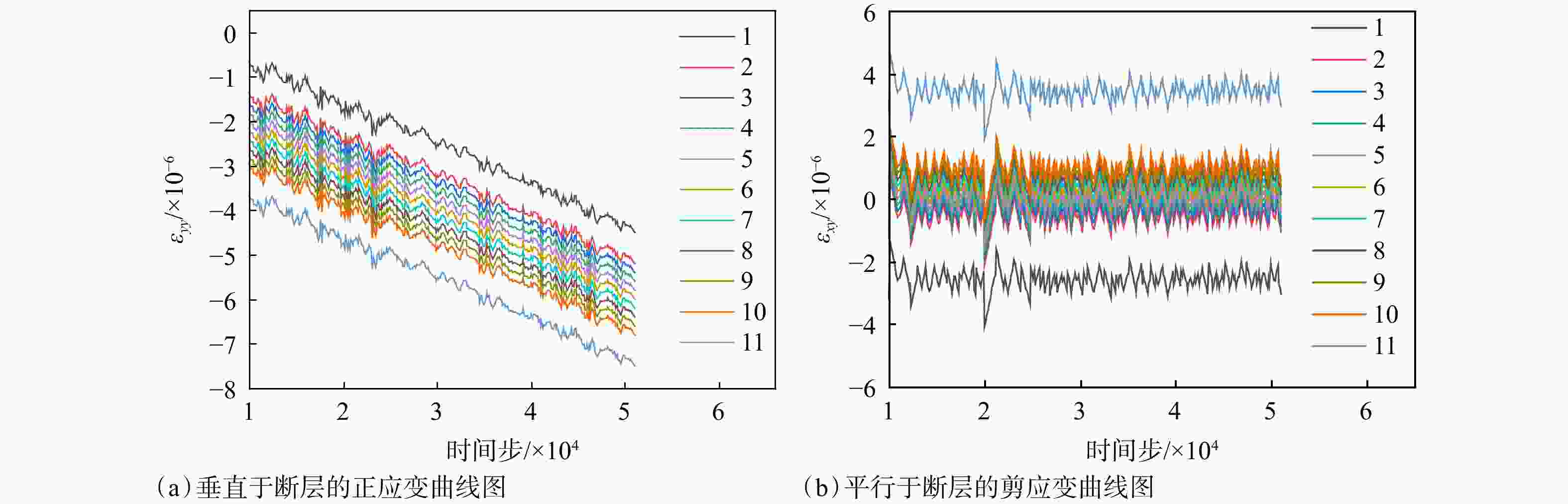
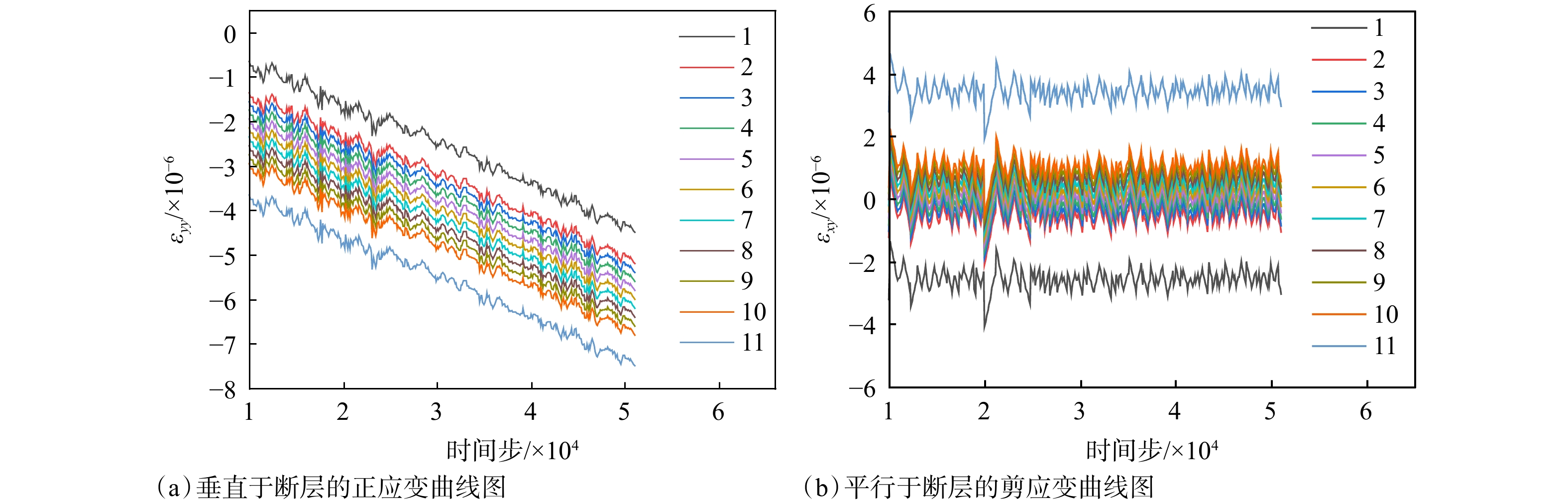
图 3 垂直于断层的正应变曲线图与平行于断层的剪应变曲线图
$ {\varepsilon }_{{yy}} $—垂直于断层方向的正应变;$ {\varepsilon }_{{xy}} $—平行于断层方向的剪应变
Figure 3. Curves of normal strain perpendicular to the fault and shear strain parallel to the fault
(a) The normal strain curve perpendicular to the fault; (b) The shear strain curve parallel to the fault $ {\varepsilon }_{\text{yy}} $—The normal strain perpendicular to the fault; $ {\varepsilon }_{\text{xy}} $—The shear strain parallel to the fault
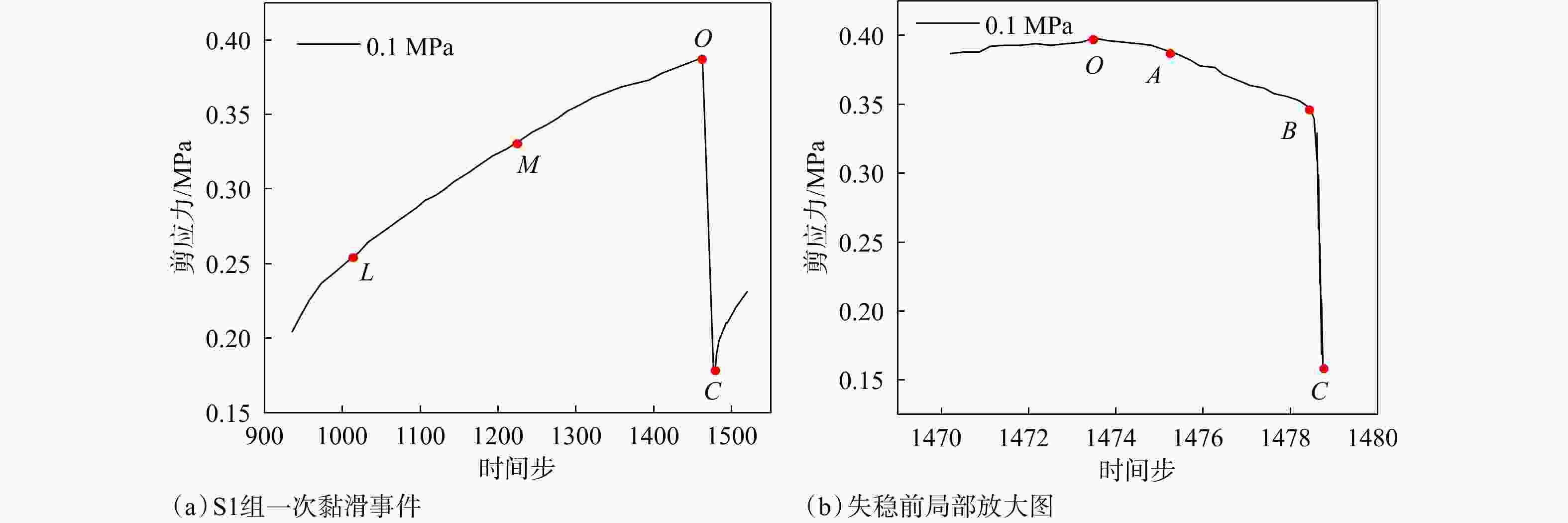
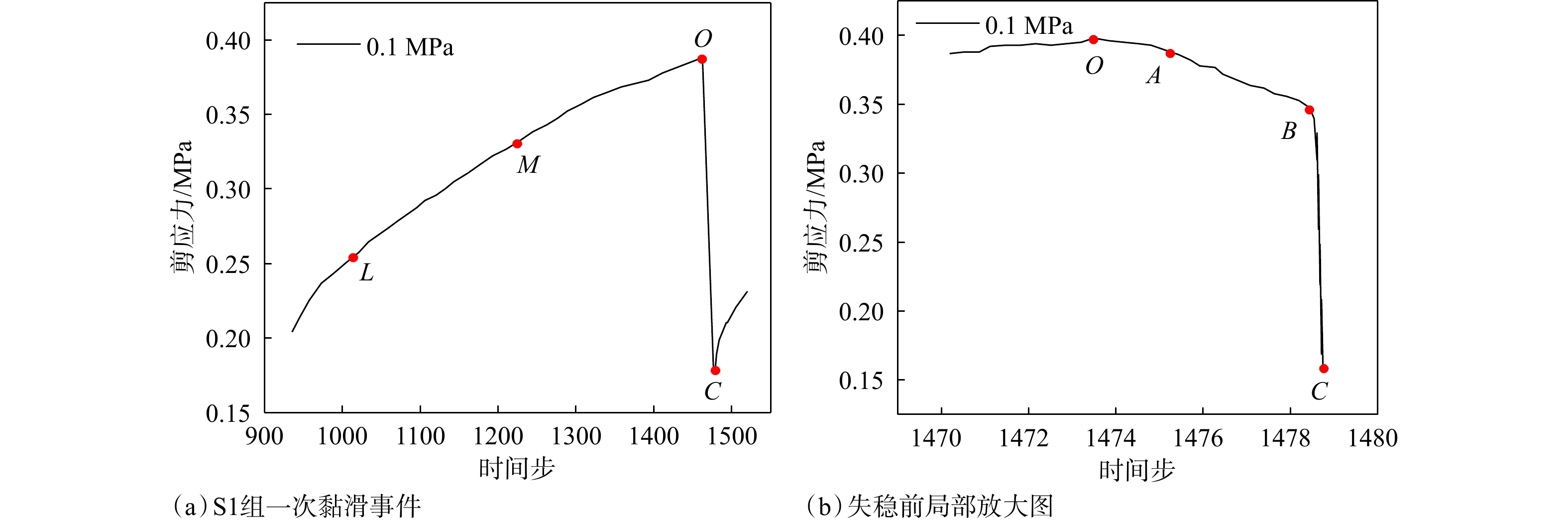
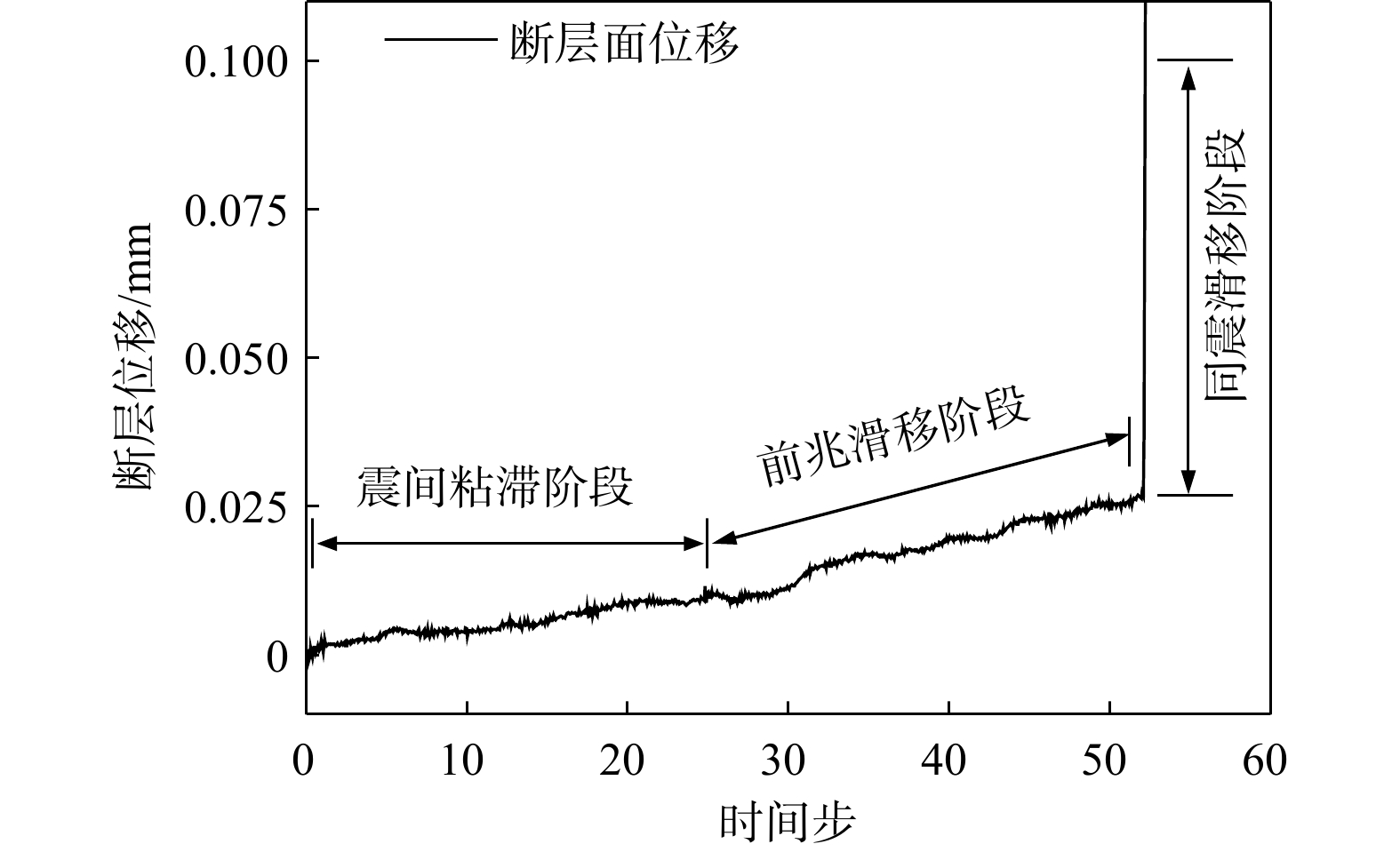
图 4 剪应力−时间步图
Figure 4. Shear stress–time step graph
(a) A stick-slip event in the S1 group; (b) Local enlargement before instability
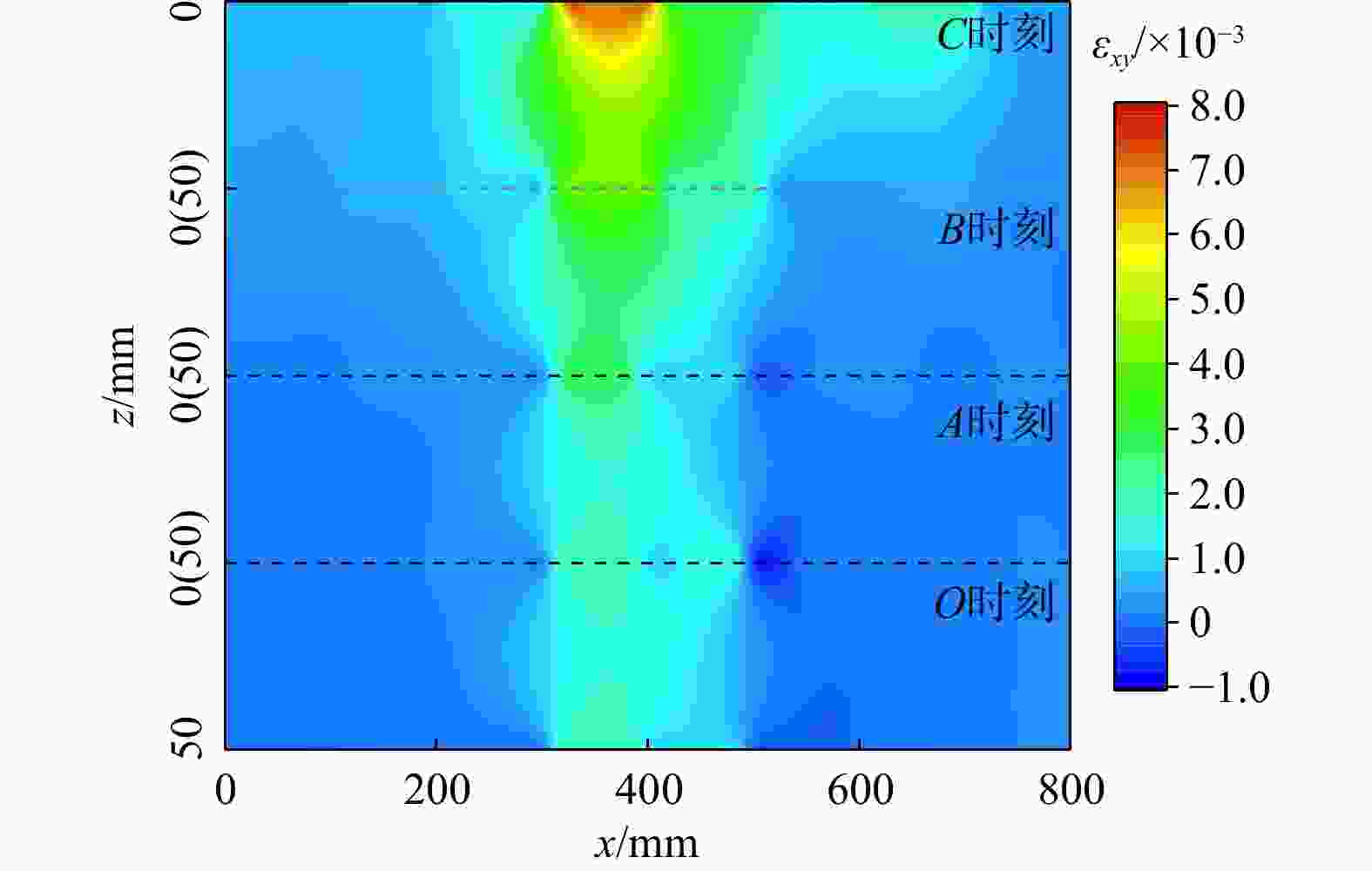
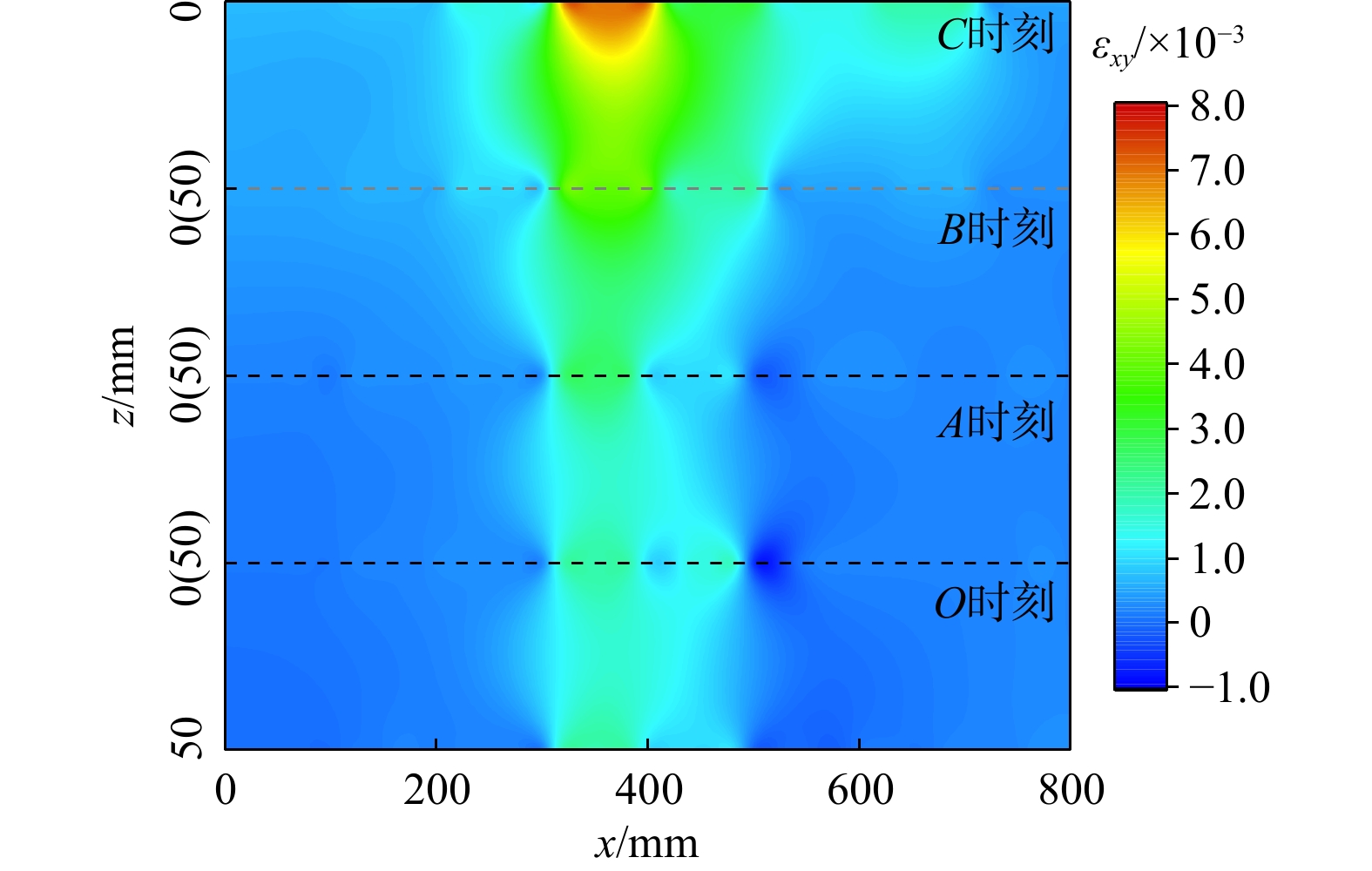
图 6 左盘接触面剪应变云图
$ {\varepsilon }_{{xy}} $—剪应变
Figure 6. Shear strain contour map of the contact surface on the left part
$ {\varepsilon }_{{xy}} $—shear strain
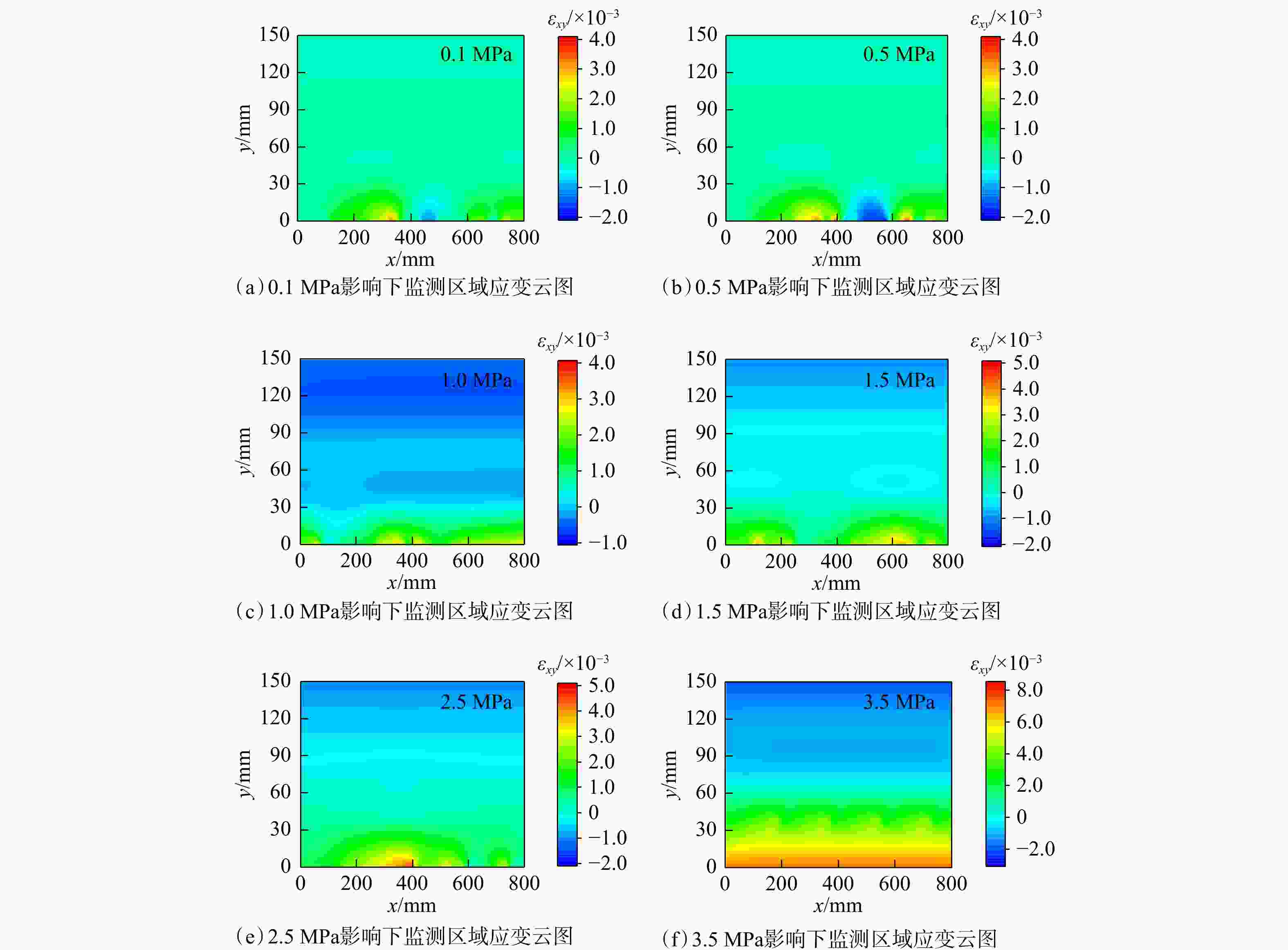
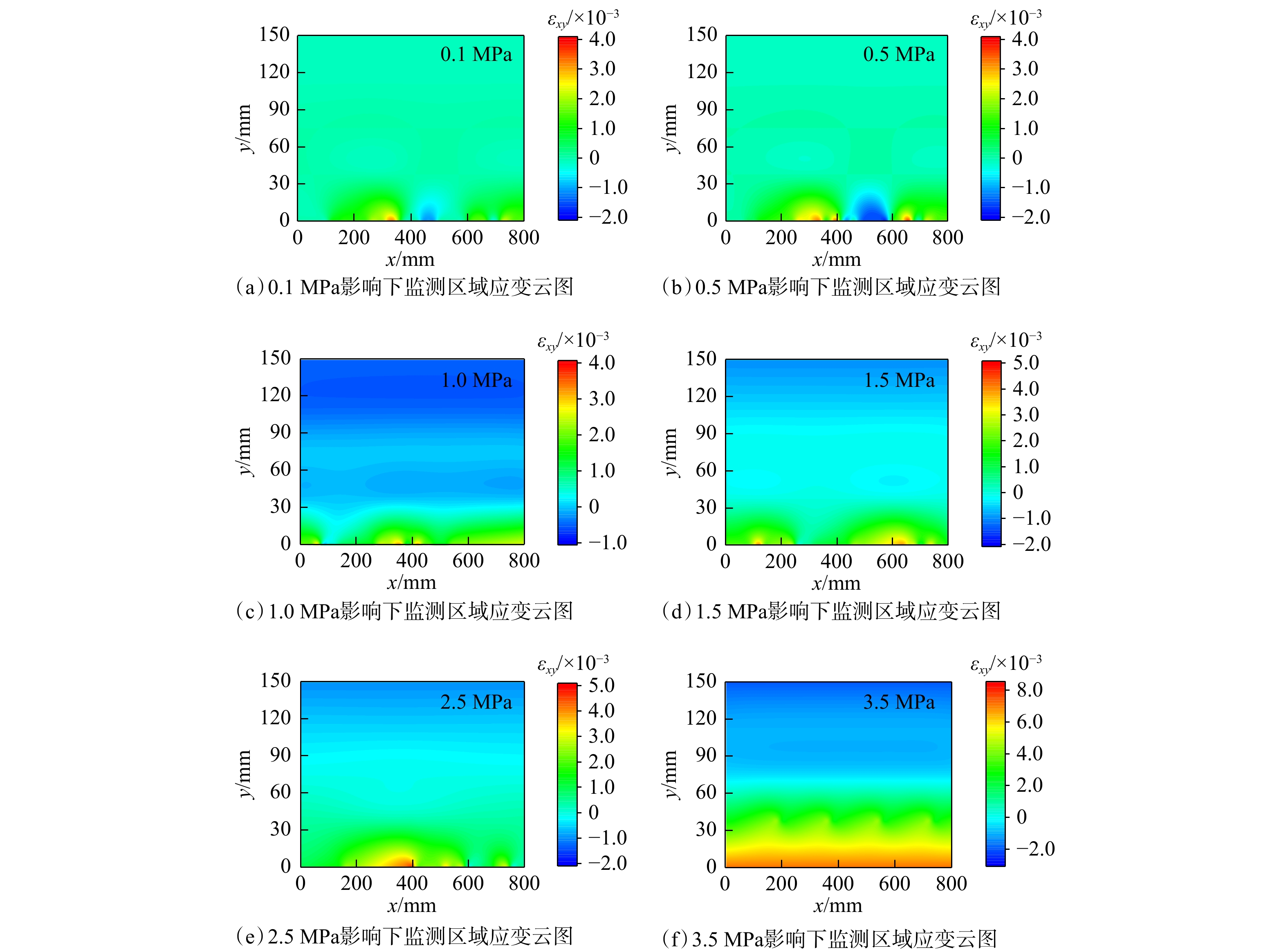
图 7 不同正应力下的剪应变云图
$ {\varepsilon }_{{xy}} $—剪应变
Figure 7. Shear strain contour maps under different normal stresses
(a) Contour map under 0.1 MPa; (b) Contour map under 0.5 MPa; (c) Contour map under 1.0 MPa; (d) Contour map under 1.5 MPa; (e) Contour map under 2.5 MPa; (f) Contour map under 3.5 MPa $ {\varepsilon }_{{xy}} $—shear strain
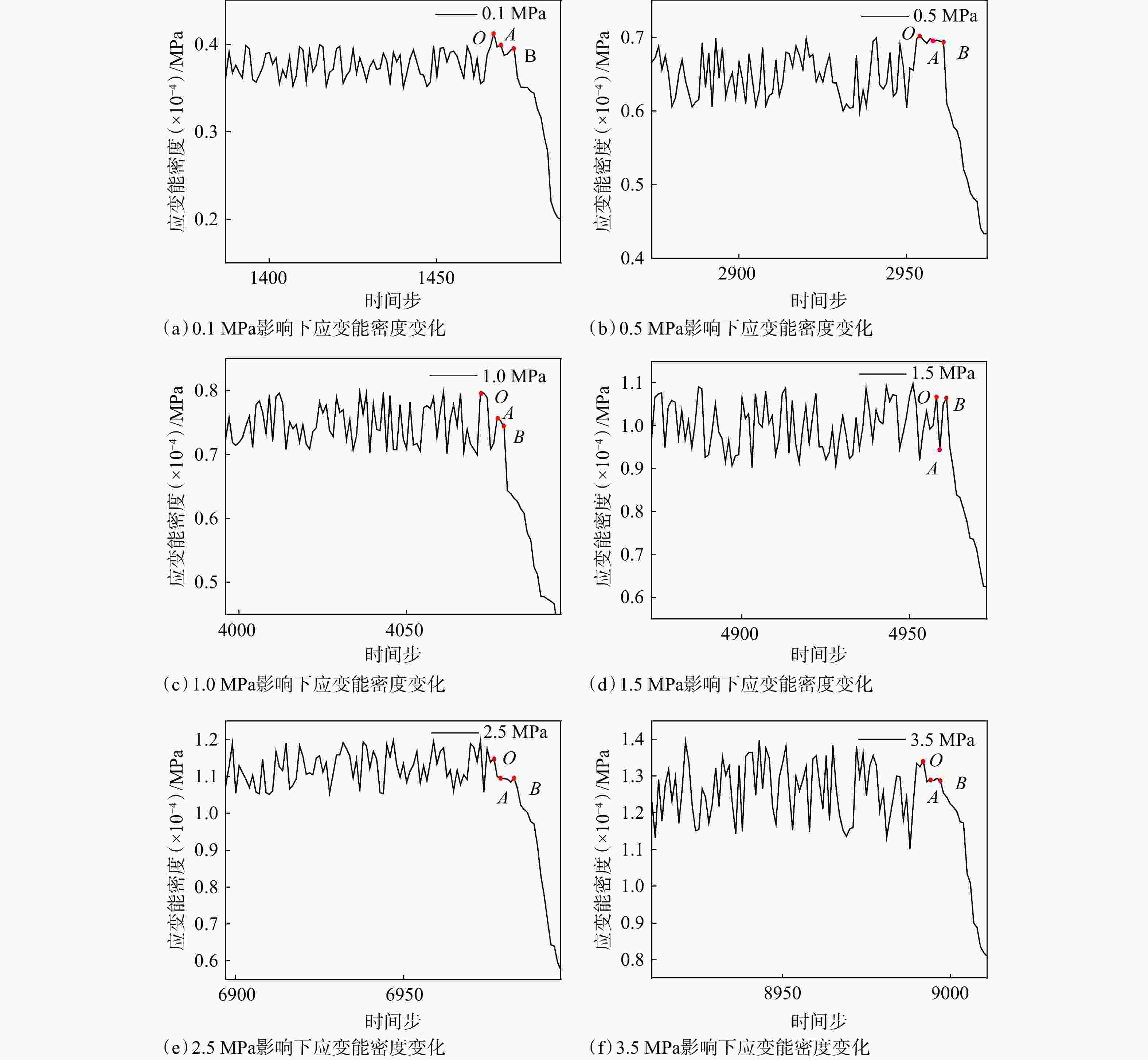
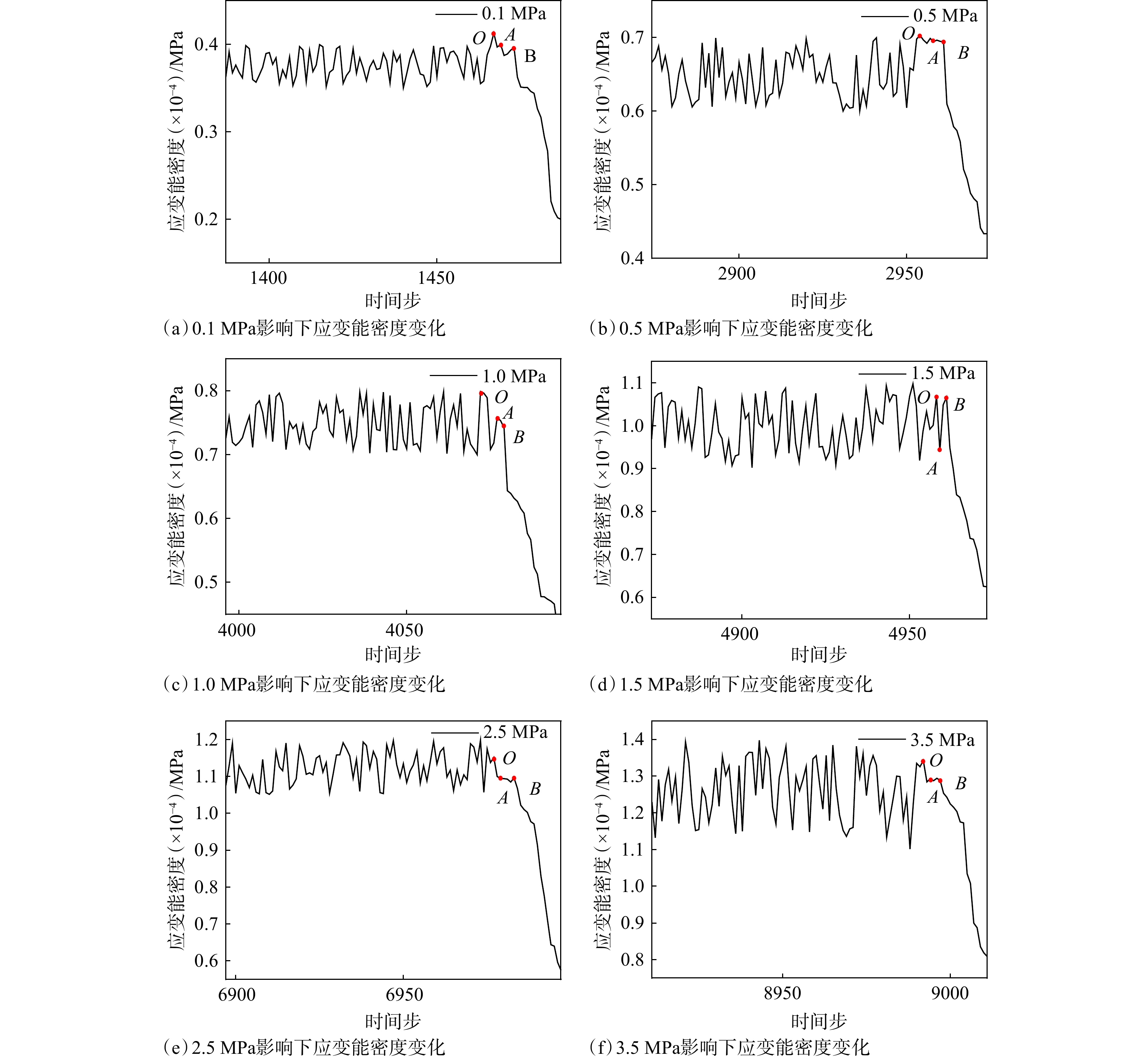
图 8 不同正应力下应变能密度变化图局部放大图
Figure 8. Local magnified diagrams of strain energy density variation under different normal stresses
(a) Variation under 0.1 MPa; (b) Variation under 0.5 MPa; (c) Variation under 1.0 MPa; (d) Variation under 1.5 MPa; (e) Variation under 2.5 MPa; (f) Variation under 3.5 MPa
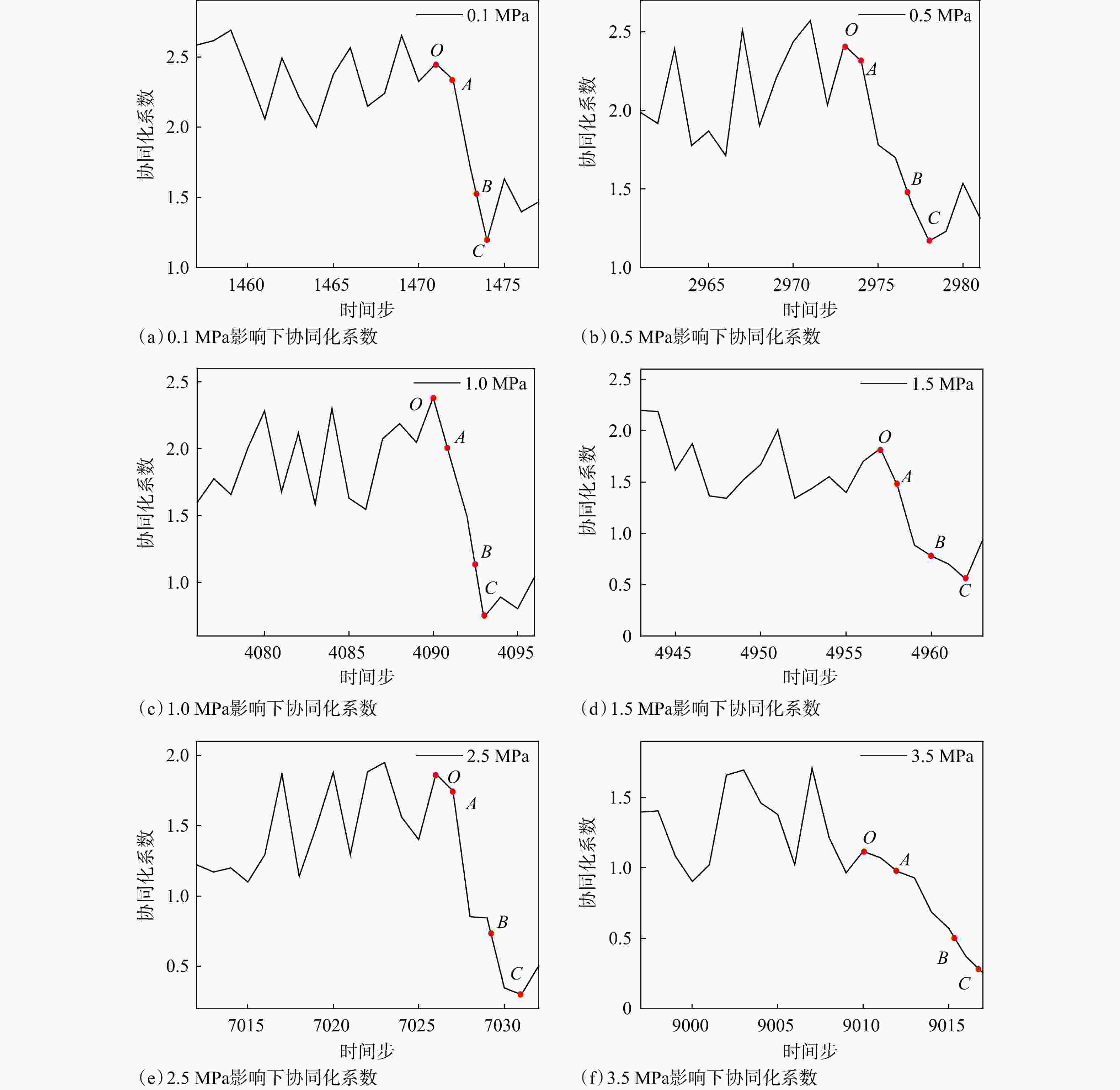
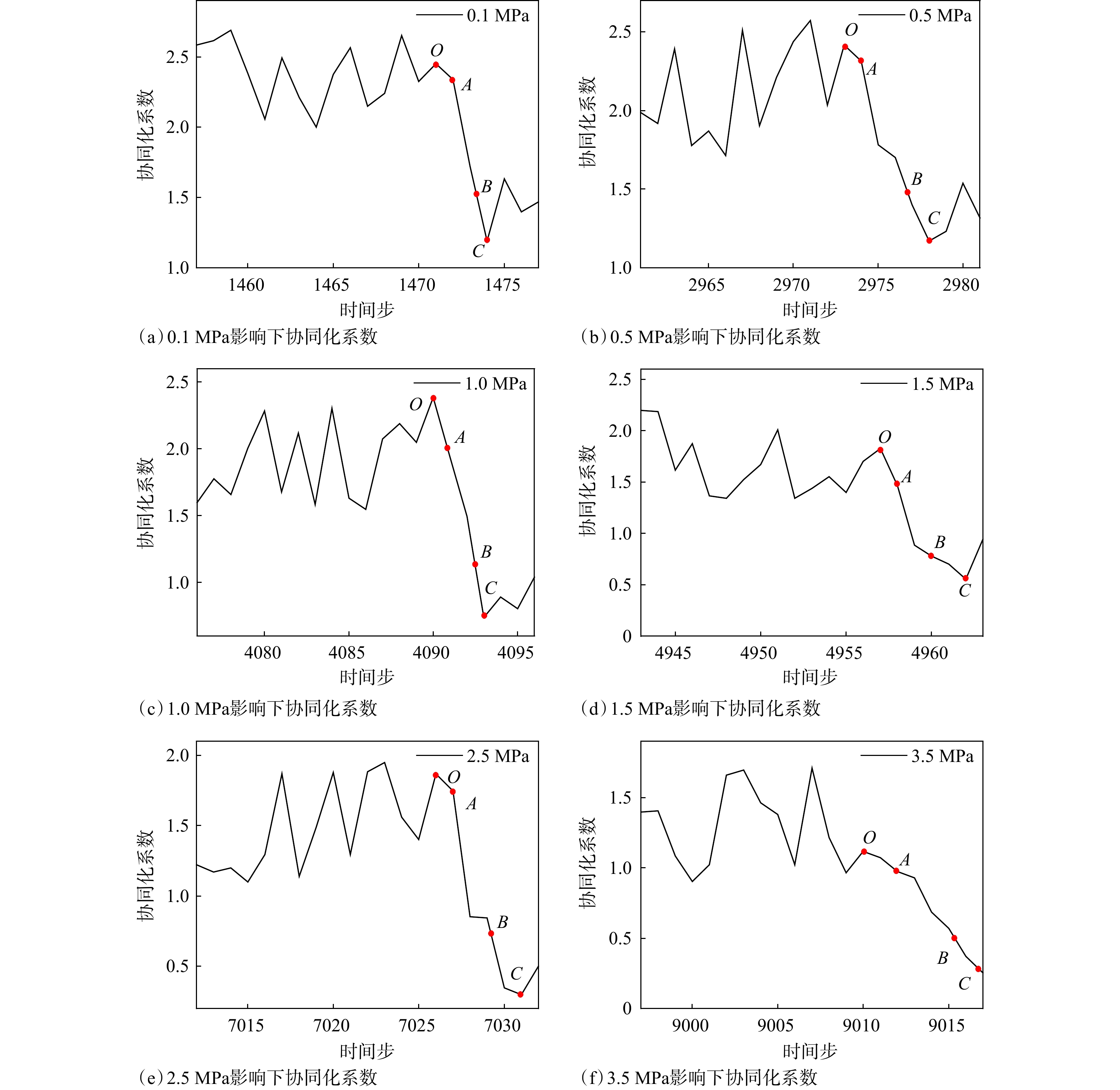
图 11 亚失稳阶段协同化系数
Figure 11. Synergy coefficient of the sub-instability stage
(a) Synergy coefficient under 0.1 MPa; (b) Synergy coefficient under 0.5 MPa; (c) Synergy coefficient under 1.0 MPa; (d) Synergy coefficient under 1.5 MPa; (e) Synergy coefficient under 2.5 MPa; (f) Synergy coefficient under 3.5 MPa
表 1 数值模拟方案
Table 1. Numerical simulation scheme
试验组别 加载速率/(mm/min) 正应力/MPa S1 0.5 0.1 S2 0.5 0.5 S3 0.5 1.0 S4 0.5 1.5 S5 0.5 2.5 S6 0.5 3.5  下载: 导出CSV
-
[1] ANDO R, FUKUSHIMA Y, YOSHIDA K, et al., 2025. Nonplanar 3D fault geometry controls the spatiotemporal distributions of slip and uplift: evidence from the Mw 7.5 2024 Noto Peninsula, Japan, Earthquake[J]. Earth, Planets and Space, 77(1): 53. doi: 10.1186/s40623-025-02187-9 [2] BRACE W F, BYERLEE J D, 1966. Stick-slip as a mechanism for earthquakes[J]. Science, 153(3739): 990-992. doi: 10.1126/science.153.3739.990 [3] BYERLEE J, 1978. Friction of rocks[J]. Pure and Applied Geophysics, 116(4): 615-626. [4] CHENG J H, YANG H S, ALMAKARI M, et al., 2025. FASTDASH: an implementation of 3-D earthquake cycle simulation on complex fault systems using the boundary element method accelerated by H-matrices[J]. Geophysical Journal International, 242(2): ggaf230. doi: 10.1093/gji/ggaf230 [5] DENG L L, 2019. Study on rock friction sliding instability mechanism and acoustic emission evolution characteristics[D]. Beijing: North China University of Technology. (in Chinese with English abstract) [6] FENG X, DING Z, WANG E, et al., 2023. Stick-slip meta-instability of coal under uniaxial loading and AE and EMR response characteristics[J]. Coal Science and Technology, 51(5): 72-81. (in Chinese with English abstract) [7] ELLSWORTH W L, BEROZA G C, 1995. Seismic evidence for an earthquake nucleation phase[J]. Science, 268(5212): 851-855. doi: 10.1126/science.268.5212.851 [8] GUO S S, ZHU Y Q, XU Y M, et al., 2021. Gravity evidence of meta-instable state before the 2008 Wenchuan earthquake[J]. Seismology and Geology, 43(6): 1368-1380. (in Chinese with English abstract) [9] HAN X H, ZHAO Z X, DENG L L, 2017. Study of energy release characteristics of rock fault instability sliding[J]. Coal Technology, 36(6): 131-133. (in Chinese with English abstract) [10] LI S, MA J, JI Y, et al., 2021. The spatio-temporal evolution of the fault defomation during the meta-instability quasi-dynamic phase and the coseismic stage: A view from laboratory[J]. Seismology and Geology, 43(1): 1-19. (in Chinese with English abstract) [11] JI Q J, ZHOU W W, HAN R S, et al., 2024. Characteristics of life-cycle stages and reservoir control in the development of extensional faults in the Dongying Sag[J]. Journal of Geomechanics, 30(4): 595-608. (in Chinese with English abstract) [12] JIANG G Y, XU X W, CHEN G H, et al., 2015. Geodetic imaging of potential seismogenic asperities on the Xianshuihe-Anninghe-Zemuhe fault system, southwest China, with a new 3-D viscoelastic interseismic coupling model[J]. Journal of Geophysical Research: Solid Earth, 120(3): 1855-1873. doi: 10.1002/2014JB011492 [13] LEE J, TSAI V C, HIRTH G, et al., 2024. Fault-network geometry influences earthquake frictional behaviour[J]. Nature, 631(8019): 106-110. doi: 10.1038/s41586-024-07518-6 [14] LI J G, WANG S Z, 1992. Resistance nonuniformity and sudden instability of sliding zone in rocks[J]. Seismology and Geology, 14(1): 79-88. (in Chinese with English abstract) [15] LI L Y, YIN H Q, MA L L, et al., 2023. A retrospective study of two MS7.0 earthquakes in Lijiang and Lushan and discussions on the characteristics of meta-instability[J]. Journal of Seismological Research, 46(4): 461-472. (in Chinese with English abstract) [16] LI Y B, HUANG L Y, YAO R, et al., 2024. Spatiotemporal evolution of interseismic coupling and stress accumulation near an asperity on a vertical strike-slip fault: insights from three-dimensional viscoelastic numerical simulation[J]. Journal of Geomechanics, 30(6): 878-892. (in Chinese with English abstract) [17] LI Y H, LIU J P, ZHAO X D, et al. , 2009. Study on b-value and fractal dimension of acoustic emission during rock failure process[J]. Rock and Soil Mechanics, 30(9): 2559-2563, 2574. (in Chinese with English abstract) [18] LIU C, LAY T, WANG R, et al., 2023. Complex multi-fault rupture and triggering during the 2023 earthquake doublet in southeastern Türkiye[J]. Nature communications, 14(1): 5564. doi: 10.1038/s41467-023-41404-5 [19] LIU Y, RICE J R, 2007. Spontaneous and triggered aseismic deformation transients in a subduction fault model[J]. Journal of Geophysical Research: Solid Earth, 112(B9): B09404. doi: 10.1029/2007jb004930 [20] LU S M, WU Z H, HUANG T, 2025. Characteristics of geological hazard development and disaster-inducing environment of the MS6.2 earthquake in Jishishan, Gansu Province[J]. Journal of Geomechanics, 31(1): 139-155. (in Chinese with English abstract) [21] MA J, SHERMA S I, GUO Y S, 2012. Identification of meta-instable stress state based on experimental study of evolution of the temperature field during stick-slip instability on a 5° bending fault[J]. Science China Earth Sciences, 55(6): 869-881. (in Chinese with English abstract) doi: 10.1007/s11430-012-4423-2 [22] MA J, GUO Y S, 2014. Accelerated Synergism prior to fault instability: evidence from laboratory experiments and an earthquake case[J]. Seismology and Geology, 36(3): 547-561. (in Chinese with English abstract) [23] MA S L, MA J, LIU L Q, 2002. Experimental evidence for seismic nucleation phase[J]. Chinese Science Bulletin, 47(9): 769-773. (in Chinese with English abstract) doi: 10.1360/02tb9174 [24] MA S L, LIU L Q, MA J, et al., 2003. Experimental study on nucleation process of stick-slip instability on homogeneous and non-homogeneous faults[J]. Science in China Series D: Earth Sciences, 46(2): 56-66. (in Chinese with English abstract) [25] MEI J Z, MA G, ZOU Y X, et al., 2022. Review of studies on the stick-slip behavior of granular fault gouge[J]. SCIENTIA SINICA Technologica, 52(7): 984-998. (in Chinese with English abstract) doi: 10.1360/SST-2021-0286 [26] MOU Y, LIANG H, SU N, et al., 2023. Control of pre-existing faults on transtensional and transpressional fault systems: A perspective from analogue modelling[J]. Journal of Asian Earth Sciences, 252: 105689. doi: 10.1016/j.jseaes.2023.105689 [27] REN Y Q, LIU P X, MA J, et al., 2013. Experimental study on evolution of thermal field of en echelon fault during the meta-instability stage[J]. Chinese Journal of Geophysics, 56(7): 2348-2357. (in Chinese with English abstract) [28] SONG C Y, MA J, WANG H T, et al., 2018. Study on meta-instability stage and instable section of the fault before strong earthquake: taking western section of southern Tianshan as an example[J]. Chinese Journal of Geophysics, 61(2): 604-615. (in Chinese with English abstract) [29] SONG Y M, MA S P, YANG X B, et al., 2012. Experimental study on the dynamic displacement evolution of fault in stick-slip process[J]. Chinese Journal of Geophysics, 55(1): 171-179. (in Chinese with English abstract) [30] WANG S Z, SHI L Q, 1985. Asperity of sliding zone and two different kinds of sudden instabilities in rocks[J]. Seismology and Geology, 7(3): 73-80. (in Chinese with English abstract) [31] WANG X B, MA J, PAN Y S, 2013. Numerical simulation of stick-slip behaviours of typical faults in biaxial compression based on a frictional-hardening and frictional-softening model[J]. Geophysical Journal International, 194(2): 1023-1041. doi: 10.1093/gji/ggt143 [32] YAN B Q, REN F H, CAI M F, et al., 2021. Research review of rock mechanics experiment and numerical simulation under THMC multi-field coupling[J]. Chinese Journal of Engineering, 43(01): 47-57. (in Chinese with English abstract) [33] YANG Z, ZHONG N, ZHANG X B, et al., 2025. Avoidance distance and influence range of active faults: a case study of Litang fault[J]. Journal of Geomechanics, 31(1): 124-138. (in Chinese with English abstract) [34] ZHANG S L, WANG X, GUO W F, et al., 2021. Sub-instability phenomena in various geophysical fields observation data[J]. Journal of Jilin University (Earth Science Edition), 51(2): 571-583. (in Chinese with English abstract) [35] ZHANG X, JIA P, LIU X, et al., 2020. Cross-fault short-term and impending anomalies before the Minxian-Zhangxian strong earthquake and the characteristics of meta-instable state[J]. Seismology and Geology, 42(5): 1205-1217. (in Chinese with English abstract) [36] ZHAO D K, HAN B, ZENG Y F, et al., 2025. Permeability evolutionary patterns of fractured rock masses in fault zones under seepage-stress coupling[J]. Coal Geology & Exploration, 53(7): 154-165. (in Chinese with English abstract) [37] ZHAO H B, ZHANG B, ZHANG C, et al., 2025. Mining-induced fault slip: Assessment model and method for determining fault instability ranges[J]. Coal Geology & Exploration, 53(3): 23-33. (in Chinese with English abstract) [38] ZHUO Y Q, GUO Y S, JI Y T, et al., 2013. Slip synergism of planar strike-slip fault during meta-instable state: experimental research based on digital image correlation analysis[J]. Science China Earth Sciences, 56(11): 1881-1887. (in Chinese with English abstract) doi: 10.1007/s11430-013-4623-4 [39] ZOU X B, LI X J, SHAO Y X, et al., 2024. Tectonic deformation and seismic mechanism of the 2021 Aksai MS 5.5 earthquake[J]. Journal of Geomechanics, 30(6): 978-990. (in Chinese with English abstract) [40] 邓琳琳, 2019. 岩石摩擦滑动失稳机制及声发射演化特征研究[D]. 北京: 北方工业大学. [41] 冯小军, 丁增, 王恩元, 等, 2023. 预制裂纹煤体静载黏滑亚失稳及声电信号响应特征[J]. 煤炭科学技术, 2023, 51(5): 72-81. [42] 郭树松, 祝意青, 徐云马, 等, 2021. 汶川地震前失稳过程的重力场观测证据[J]. 地震地质, 43(6): 1368-1380. doi: 10.3969/j.issn.0253-4967.2021.06.002 [43] 韩秀会, 赵泽鑫, 邓琳琳, 2017. 岩石断层失稳滑动能量释放特征分析[J]. 煤炭技术, 36(6): 131-133. [44] 籍庆佳, 周维维, 韩润生, 等, 2024. 东营凹陷张性断层发育的生命演化阶段特征及其控藏作用[J]. 地质力学学报, 30(4): 595-608. doi: 10.12090/j.issn.1006-6616.2023147 [45] 李建国, 王绳祖, 1992. 岩石错动面的非匀阻性与突发失稳[J]. 地震地质, 14(1): 79-88. [46] 李腊月, 尹海权, 马伶俐, 等, 2023. 丽江与芦山两次MS7.0地震震例回溯研究及亚失稳特征探讨[J]. 地震研究, 46(4): 461-472. doi: 10.20015/j.cnki.ISSN1000-0666.2023.0061 [47] 李世念, 马瑾, 2021. 亚失稳准动态及同震过程变形场时空演化特征: 实验与分析[J]. 地震地质, 43(01): 1-19. doi: 10.3969/j.issn.0253-4967.2021.01.001 [48] 李烨波, 黄禄渊, 姚瑞, 等, 2024. 直立走滑断层凹凸体附近闭锁程度和应力积累的时空演化: 来自三维黏弹性数值模拟的视角[J]. 地质力学学报, 30(6): 878-892. doi: 10.12090/j.issn.1006-6616.2023134 [49] 李元辉, 刘建坡, 赵兴东, 等, 2009. 岩石破裂过程中的声发射b值及分形特征研究[J]. 岩土力学, 30(9): 2559-2563, 2574. doi: 10.3969/j.issn.1000-7598.2009.09.003 [50] 陆诗铭, 吴中海, 黄婷, 2025. 甘肃积石山MS6.2地震地质灾害发育特征及孕灾环境分析[J]. 地质力学学报, 31(1): 139-155. doi: 10.12090/j.issn.1006-6616.2024069 [51] 马瑾, SHERMAN S I, 郭彦双, 2012. 地震前亚失稳应力状态的识别: 以5°拐折断层变形温度场演化的实验为例[J]. 中国科学: 地球科学, 42(5): 633-645. doi: 10.1007/s11430-012-4423-2 [52] 马瑾, 郭彦双, 2014. 失稳前断层加速协同化的实验室证据和地震实例[J]. 地震地质, 36(3): 547-561. doi: 10.3969/j.issn.0253-4967.2014.03.001 [53] 马胜利, 马瑾, 刘力强, 2002. 地震成核相的实验证据[J]. 科学通报, 47(5): 387-391. doi: 10.3321/j.issn:0023-074X.2002.05.016 [54] 马胜利, 刘力强, 马瑾, 等, 2003. 均匀和非均匀断层滑动失稳成核过程的实验研究[J]. 中国科学(D辑: 地球科学), 33(S1): 45-52. doi: 10.3969/j.issn.1674-7240.2003.z1.005 [55] 梅江洲, 马刚, 邹宇雄, 等, 2022. 颗粒断层泥黏滑运动的研究进展[J]. 中国科学: 技术科学, 52(7): 984-998. doi: 10.1360/SST-2021-0286 [56] 任雅琼, 刘培洵, 马瑾, 等, 2013. 亚失稳阶段雁列断层热场演化的实验研究[J]. 地球物理学报, 56(7): 2348-2357. doi: 10.6038/cjg20130721 [57] 宋春燕, 马瑾, 王海涛, 等, 2018. 强震前断裂亚失稳阶段及失稳部位的特征研究: 以新疆南天山西段为例[J]. 地球物理学报, 61(2): 604-615. doi: 10.6038/cjg2018K0259 [58] 宋义敏, 马少鹏, 杨小彬, 等, 2012. 断层黏滑动态变形过程的实验研究[J]. 地球物理学报, 55(1): 171-179. doi: 10.6038/j.issn.0001-5733.2012.01.016 [59] 王绳祖, 施良骐, 1985. 岩石错动面的凹凸不平及两种突发失稳[J]. 地震地质, 7(3): 73-80. [60] 颜丙乾, 任奋华, 蔡美峰, 等, 2021. THMC多场耦合作用下岩石力学实验与数值模拟研究进展[J]. 工程科学学报, 43(01): 47-57. doi: 10.13374/j.issn2095-9389.2019.07.29.005 [61] 杨镇, 钟宁, 张献兵, 等, 2025. 活动断层的避让距离与影响范围: 以理塘断裂为例[J]. 地质力学学报, 31(1): 124-138. doi: 10.12090/j.issn.1006-6616.2023085 [62] 张淑亮, 王霞, 郭文峰, 等, 2021. 多种地球物理场观测数据中亚失稳现象[J]. 吉林大学学报(地球科学版), 51(2): 571-583. doi: 10.13278/j.cnki.jjuese.20200032 [63] 张希, 贾鹏, 刘峡, 等, 2020. 岷县漳县强震前的跨断层短临异常及亚失稳状态特征[J]. 地震地质, 42(5): 1205-1217. [64] 赵德康, 韩冰, 曾一凡, 等, 2025. 渗流−应力耦合下断层带裂隙岩体渗透演化规律[J]. 煤田地质与勘探, 53(7): 154-165 [65] 赵洪宝, 张博, 张驰, 等. 采动诱发断层滑移评估模型及失稳范围确定方法[J]. 煤田地质与勘探, 2025, 53(3): 23-33. [66] 卓燕群, 郭彦双, 汲云涛, 等, 2013. 平直走滑断层亚失稳状态的位移协同化特征: 基于数字图像相关方法的实验研究[J]. 中国科学: 地球科学, 43(10): 1643-1650. [67] 邹小波, 李兴坚, 邵延秀, 等, 2024. 2021年阿克塞MS 5.5地震区形变特征及发震机制研究[J]. 地质力学学报, 30(6): 978-990. doi: 10.12090/j.issn.1006-6616.2023125 -

 下载:
下载:

计量
- 文章访问数: 836
- HTML全文浏览量: 296
- PDF下载量: 111
- 被引次数: 0
