


Progress and perspectives in research on crustal stress and earthquakes
-
摘要: 地应力是理解岩石圈动力学过程、揭示地震孕育机制及评估区域地震危险性的核心物理参数,同时可为地下能源资源开发与重大岩土工程的优化设计、安全施工和运营提供基础数据。文章系统梳理该领域的研究脉络,明确当前研究进展与挑战,可为未来研究提供方向。通过系统回顾与综合分析法,从地应力信息获取、应力场分析与建模、地震应力过程3个维度出发,总结了技术方法体系与发展范式演进:在信息获取方面,观测技术实现了从浅部向深部、单点向网络化的跨越,传统方法持续优化,非弹性应变恢复(ASR)、差应变曲线分析(DSCA)等深井原位测量技术将观测深度推进至5 km以深,多学科数据融合成为显著特征;在应力场分析和建模方面,研究方法从解析法、数值模拟演进至“机理+数据+知识”的智能分析新范式,数值模型从二维弹性发展为三维黏弹塑性,实现了区域四维应力场的动态刻画;在地震应力过程方面,实测应力、库仑应力模型与物理−数值实验共同揭示了地震孕育的“平静−积累−释放−调整”循环特征、应力触发与影区效应以及断层失稳成核的物理机制。当前研究仍面临深部数据匮乏、多源数据融合困难、初始应力场不确定性高难挑战。未来应重点发展多手段智能化深部应力观测技术、构建物理约束的机器学习反演与四维动态应力场模型、深化“热−化−力”耦合流变研究,并推动建立“应力机理−海量数据−专家知识”协同的地震预测新范式,为地震风险评估与防灾减灾提供更坚实的科学支撑。通过梳理地应力与地震研究进展及对其展望,为地震应力过程的观测与分析、地震动力学预测方法研究提供了参考与借鉴。Abstract:
Objective The crustal stress state is a key physical parameter for understanding lithospheric dynamics, elucidating earthquake preparation mechanisms, and assessing regional seismic hazards. It also provides essential data for the optimal design, safe construction, and operation of major underground energy and geotechnical engineering projects. Systematically reviewing the research context in this field and clarifying the current progress and challenges can provide guidance for future research. Methods Through a systematic review and synthesis, we summarize the technical methodologies and the evolution of development paradigms in three interconnected domains: acquisition of crustal stress data, analysis and modeling of stress fields, and stress processes associated with earthquakes. Results (1) Progress in stress information acquisition: Observation techniques have advanced from shallow to deep levels and from single-site measurements to network-based monitoring. Traditional methods have been continuously refined, while deep borehole in-situ techniques, such as elastic strain recovery (ASR) and differential strain curve analysis (DSCA), have extended observation depths beyond 5 km. The integration of multidisciplinary data has become a prominent trend. (2) Advances in stress field analysis and modeling: Methodologies have evolved from analytical and numerical approaches to an intelligent framework that integrates mechanisms, data, and knowledge. Numerical models have developed from two-dimensional elastic formulations to three-dimensional visco-elastoplastic representations, enabling the dynamic characterization of regional four-dimensional stress fields. (3) Developments in earthquake-related stress processes: In-situ stress measurements, Coulomb stress modeling, and combined physical–numerical experiments jointly reveal the cyclic pattern of “quiescence–accumulation–release–adjustment” during earthquake initiation, as well as stress triggering and shadow effects, and the physical mechanisms underlying fault instability nucleation. Conclusion Current research still faces challenges such as the scarcity of deep stress data, the complexity of integrating multi-source data, and the high uncertainty in determining the initial stress field. Future studies should focus on (1) developing intelligent, multi-method technologies for deep stress observation; (2) constructing machine learning–based inversion and four-dimensional dynamic stress field models constrained by physical principles; (3) advancing research on thermo–chemical–mechanical coupling rheology; and (4) promoting a new paradigm for seismic prediction that integrates stress mechanisms, big data, and expert knowledge. Thereby, future studies will provide a more robust scientific foundation for seismic risk assessment and disaster prevention and mitigation. [ Significance ] This review of advancements and prospects in crustal stress and earthquake research provides references and insights for the observation and analysis of seismic stress processes and for the research on seismic dynamic prediction methods. -
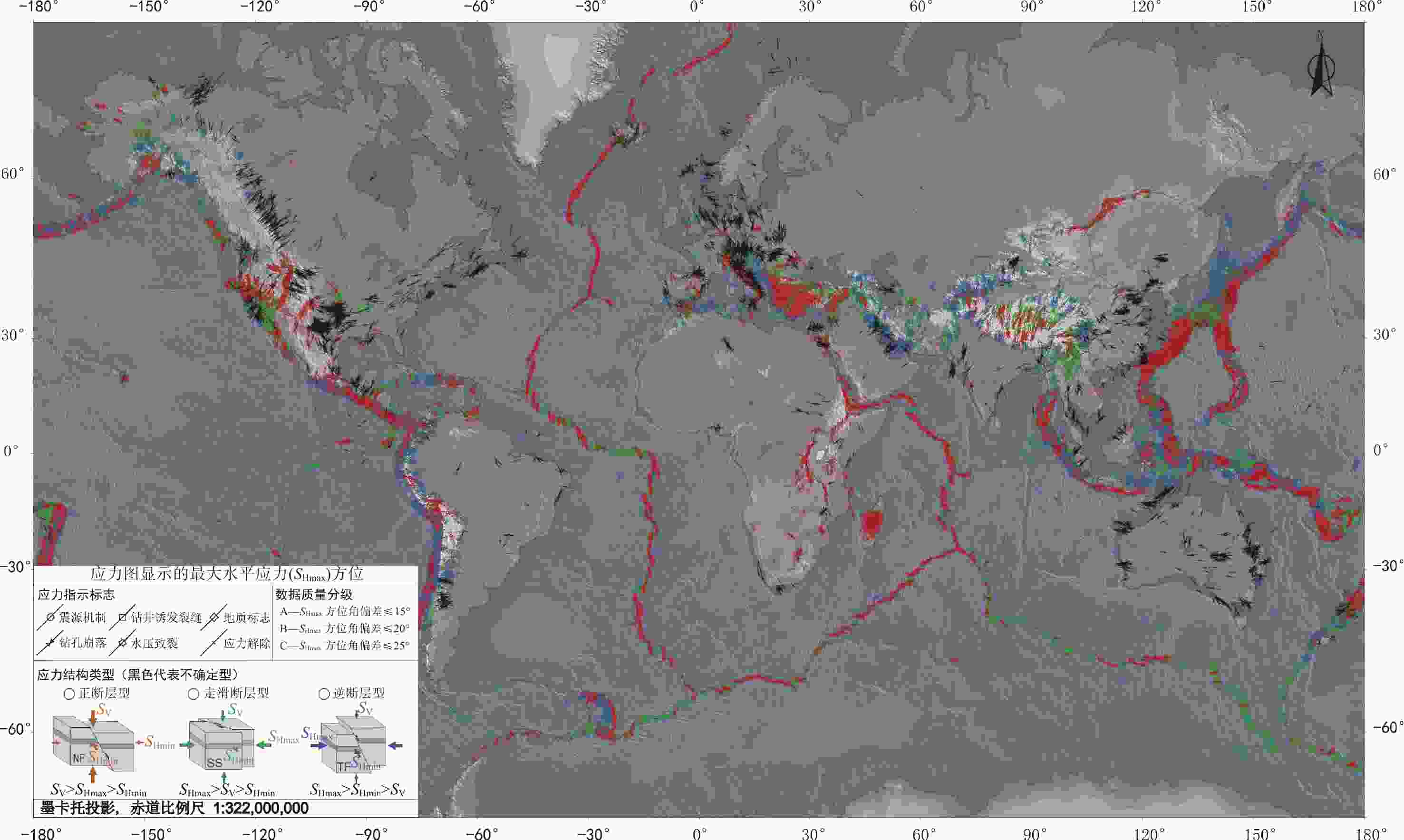
图 1 2025版世界应力图 (据Heidbach et al.,2025修改)
Figure 1. World stress map 2025 ( modified from Heidbach et al., 2025)
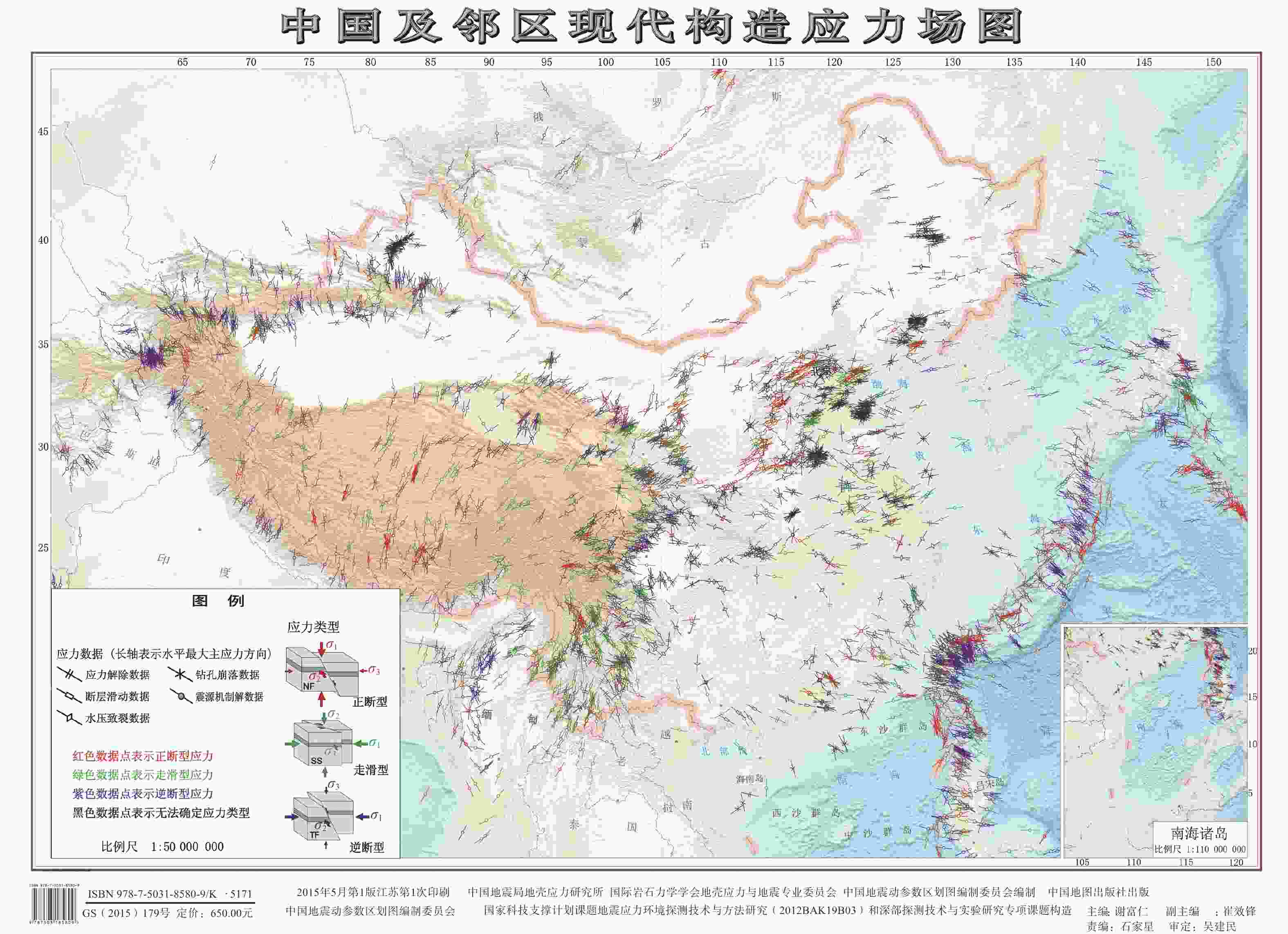
图 2 中国及邻区现代构造应力场图(谢富仁和崔效锋,2015)
Figure 2. Map of the modern tectonic stress field of China and adjacent areas (Xie and Cui, 2015)
-
[1] ANDERSON E M, 1905. The dynamics of faulting[J]. Transactions of the Edinburgh Geological Society, 8(3): 387-402. doi: 10.1144/transed.8.3.387 [2] BAYART E, SVETLIZKY I, FINEBERG J, 2016. Fracture mechanics determine the lengths of interface ruptures that mediate frictional motion[J]. Nature Physics, 12(2): 166-170. doi: 10.1038/nphys3539 [3] BIRD P, 1999. Thin-plate and thin-shell finite-element programs for forward dynamic modeling of plate deformation and faulting[J]. Computers & Geosciences, 25(4): 383-394. [4] BIRD P, 2017. Stress field models from Maxwell stress functions: southern California[J]. Geophysical Journal International, 210(2): 951-963. doi: 10.1093/gji/ggx207 [5] BIRGISDÓTTIR Á G, 2023. Coulomb stress changes on the Reykjanes Peninsula from 1998-2022 and earthquake triggering[D]. Reykjavik: University of Iceland: 1-82. [6] BOTT M H P, 1959. The mechanics of oblique slip faulting[J]. Geological Magazine, 96(2): 109-117. doi: 10.1017/S0016756800059987 [7] BRUDY M, ZOBACK M D, FUCHS K, et al., 1997. Estimation of the complete stress tensor to 8 km depth in the KTB scientific drill holes: implications for crustal strength[J]. Journal of Geophysical Research: Solid Earth, 102(B8): 18453-18475. doi: 10.1029/96JB02942 [8] BURRIDGE R, KNOPOFF L, 1967. Model and theoretical seismicity[J]. Bulletin of the Seismological Society of America, 57(3): 341-371. doi: 10.1785/BSSA0570030341 [9] BYERLEE J, 1978. Friction of rocks[J]. Pure and Applied Geophysics, 116(4-5): 615-626. doi: 10.1007/BF00876528 [10] CAI M F, 1993. Review of principles and methods for rock stress measurement[J]. Chinese Journal of Rock Mechanics and Engineering, 12(3): 275-283. (in Chinese with English abstract) [11] CAO Z B, LIU L J, 2024. Driving forces of continental lithospheric deformation[J]. Science China Earth Sciences, 67(12): 3950-3956. doi: 10.1007/s11430-024-1458-y [12] CHEN L W, LU Y Z, GUO R M, et al., 2001. Evolution of 3D tectonic stress field and fault movement in North China[J]. Acta Seismologica Sinica, 23(4): 349-361. (in Chinese with English abstract) [13] CHEN W Z, WU G J, YANG J P, et al. , 2012. Stability analysis of fractured rock masses in underground engineering: theory and engineering applications[M]. Beijing: Science Press. (in Chinese) [14] CHI S L, CHI Y, DENG T, et al. , 2009. The necessity of building national strain-observation network from the strain abnormality before Wenchuan earthquake[J]. Recent Developments in World Seismology(1): 1-13. (in Chinese with English abstract) [15] “China Seismic Experimental Site: Scientific Challenges” Editorial Team, 2019. China seismic experimental site: scientific challenges[M]. Beijing: Standards Press of China. (in Chinese) [16] COBLENTZ D D, ZHOU S H, HILLIS R R, et al., 1998. Topography, boundary forces, and the Indo-Australian intraplate stress field[J]. Journal of Geophysical Research: Solid Earth, 103(B1): 919-931. doi: 10.1029/97JB02381 [17] CUI J W, LIN W R, WANG L J, et al. , 2014. Determination of three-dimensional in situ stresses by anelastic strain recovery in Wenchuan Earthquake Fault Scientific Drilling Project Hole-1 (WFSD-1)[J]. Tectonophysics, 619-620: 123-132. [18] CUI X F, XIE F R, 1999. Preliminary research to determine stress districts from focal mechanism solutions in southwest China and its adjacent area[J]. Acta Seismologica Sinica, 21(5): 513-522. (in Chinese with English abstract) [19] DAHM T, HAINZL S, 2022. A coulomb stress response model for time-dependent earthquake forecasts[J]. Journal of Geophysical Research: Solid Earth, 127(9): e2022JB024443. doi: 10.1029/2022JB024443 [20] DIAO F Q, WANG R J, XIONG X, et al., 2021. Overlapped postseismic deformation caused by afterslip and viscoelastic relaxation following the 2015 Mw 7.8 Gorkha (Nepal) earthquake[J]. Journal of Geophysical Research: Solid Earth, 126(3): e2020JB020378. doi: 10.1029/2020JB020378 [21] DIETERICH J, 1994. A constitutive law for rate of earthquake production and its application to earthquake clustering[J]. Journal of Geophysical Research: Solid Earth, 99(B2): 2601-2618. doi: 10.1029/93JB02581 [22] DOBSON P, TSANG C F, KNEAFSEY T, et al. , 2016. Deep borehole field test research activities at LBNL[R]. Berkeley: Lawrence Berkeley National Laboratory: LBNL-106044. [23] DONG P, XIA K W, 2022. Laboratory investigations probing earthquake source process[J]. Chinese Science Bulletin, 67(13): 1378-1389. (in Chinese with English abstract) doi: 10.1360/TB-2021-1061 [24] DONG P Y, CHENG H H, SHI Y L, et al., 2019. Numerical inversion of regional initial tectonic stress based on Monte Carlo method: a case study of Bayan Har block[J]. Chinese Journal of Geophysics, 62(8): 2858-2870. (in Chinese with English abstract) [25] ELLIOTT J R, WALTERS R J, WRIGHT T J, 2016. The role of space-based observation in understanding and responding to active tectonics and earthquakes[J]. Nature Communications, 7(1): 13844. doi: 10.1038/ncomms13844 [26] FENG C J, ZHANG P, MENG J, et al., 2017. In situ stress measurement at deep boreholes along the Tanlu fault zone and its seismological and geological significance[J]. Progress in Geophysics, 32(3): 946-967. (in Chinese with English abstract) [27] FENG Y S, XIONG X, SHAN B, et al., 2022. Coulomb stress changes due to the 2021 MS7.4 Maduo Earthquake and expected seismicity rate changes in the surroundings[J]. Science China Earth Sciences, 65(4): 675-686. doi: 10.1007/s11430-021-9882-8 [28] GAO Y, WU J, 2008. Compressive stress field in the crust deduced from shear-wave anisotropy: an example in capital area of China[J]. Chinese Science Bulletin, 53(18): 2840-2848. doi: 10.1007/s11434-008-0310-9 [29] GAO Y, SHI Y T, CHEN A G, 2018. Crustal seismic anisotropy and compressive stress in the eastern margin of the Tibetan Plateau and the influence of the MS8.0 Wenchuan earthquake[J]. Chinese Science Bulletin, 63(19): 1934-1948. (in Chinese with English abstract) doi: 10.1360/N972018-00317 [30] GAY N C, 1975. In-situ stress measurements in Southern Africa[J]. Tectonophysics, 29(1-4): 447-459. doi: 10.1016/0040-1951(75)90173-0 [31] GENG L M, ZHANG G M, SHI Y L, 1993. Preliminary research on the relations between field and source in earthquake preparation[J]. Earthquake Research in China, 9(4): 310-319. (in Chinese with English abstract) [32] GOETZE C, EVANS B, 1979. Stress and temperature in the bending lithosphere as constrained by experimental rock mechanics[J]. Geophysical Journal International, 59(3): 463-478. doi: 10.1111/j.1365-246X.1979.tb02567.x [33] GONG W C, SUN Y Q, QIU X P, et al., 2023. Coulomb stress evolution and seismic hazards along major faults in the northeastern margin of the Tibetan Plateau[J]. China Earthquake Engineering Journal, 45(3): 585-597. (in Chinese with English abstract) [34] GUO Q L, WANG C H, MA H S, et al., 2009. In-situ hydro-fracture stress measurement before and after the Wenchuan MS8.0 earthquake of China[J]. Chinese Journal of Geophysics, 52(5): 1395-1401. (in Chinese with English abstract) [35] HARDEBECK J L, MICHAEL A J, 2004. Stress orientations at intermediate angles to the San Andreas Fault, California[J]. Journal of Geophysical Research: Solid Earth, 109(B11): B11303. [36] HEIDBACH O, TINGAY M, BARTH A, et al., 2010. Global crustal stress pattern based on the World Stress Map database release 2008[J]. Tectonophysics, 482(1-4): 3-15. doi: 10.1016/j.tecto.2009.07.023 [37] HEIDBACH O, RAJABI M, DI GIACOMO D, et al. , 2025. World Stress Map 2025. GFZ Data Services, doi: 10.5880/WSM.2025.002. [38] HEIM A, 1878. Untersuchungen über den Mechanismus der Gebirgsbildung, im Anschluss an die geologische Monographie der Tödi-Windgällen-Gruppe[M]. Basel: Benno Schwabe. [39] HERGERT T, HEIDBACH O, 2011. Geomechanical model of the Marmara Sea region: II. 3-D contemporary background stress field[J]. Geophysical Journal International, 185(3): 1090-1102. doi: 10.1111/j.1365-246X.2011.04992.x [40] HU X P, ZANG A, HEIDBACH O, et al., 2017. Crustal stress pattern in China and its adjacent areas[J]. Journal of Asian Earth Sciences, 149: 20-28. doi: 10.1016/j.jseaes.2017.07.005 [41] HU X P, 2018. Crustal stress pattern across different scales in China[D]. Hefei: University of science and technology of China. (in Chinese with English abstract) [42] HUANG L Y, ZHANG B, QU W L, et al., 2017. The co-seismic effects of 2010 Maule earthquake[J]. Chinese Journal of Geophysics, 60(3): 972-984. (in Chinese with English abstract) [43] HUANG Y, MENG G J, CHENG X, et al., 2023. Present-day crustal deformation in the southeastern Tibetan Plateau: insights from three-dimensional finite-element modeling[J]. Tectonophysics, 863: 229983. doi: 10.1016/j.tecto.2023.229983 [44] JIA K, ZHOU S Y, 2018. Triggering relationship in strong earthquake sequence around the Bayan Har block and its tectonic significance based on Coulomb stress changes and seismicity[J]. Acta Seismologica Sinica, 40(3): 291-303. (in Chinese with English abstract) [45] JOHNSTON M J S, BORCHERDT R D, LINDE A T, et al., 2006. Continuous borehole strain and pore pressure in the near field of the 28 September 2004 M 6.0 Parkfield, California, earthquake: implications for nucleation, fault response, earthquake prediction, and tremor[J]. Bulletin of the Seismological Society of America, 96(4B): S56-S72. doi: 10.1785/0120050822 [46] KARL T, RICHART JR F E, 1952. Stresses in rock about cavities[J]. Géotechnique, 3(2): 57-90. [47] KING G C P, STEIN R S, LIN J, 1994. Static stress changes and the triggering of earthquakes[J]. Bulletin of the Seismological Society of America, 84(3): 935-953. [48] KONG W L, HUANG L Y, YAO R, et al., 2021. Review of stress field studies in Sichuan-Yunnan region[J]. Progress in Geophysics, 36(5): 1853-1864. (in Chinese with English abstract) [49] KREEMER C, BLEWITT G, KLEIN E C, 2014. A geodetic plate motion and Global Strain Rate Model[J]. Geochemistry, Geophysics, Geosystems, 15(10): 3849-3889. doi: 10.1002/2014GC005407 [50] LAPUSTA N, RICE J R, BEN-ZION Y, et al., 2000. Elastodynamic analysis for slow tectonic loading with spontaneous rupture episodes on faults with rate- and state-dependent friction[J]. Journal of Geophysical Research: Solid Earth, 105(B10): 23765-23789. doi: 10.1029/2000JB900250 [51] LEE S G, 1947. Fundamentals and methods of geomechanics[M]. Shanghai: Zhonghua Book Company. (in Chinese) [52] LEE S G, 1977. On earthquakes[M]. Beijing: Geological Press: 1-173. (in Chinese) [53] LEI Q H, LATHAM J P, TSANG C F, 2017. The use of discrete fracture networks for modelling coupled geomechanical and hydrological behaviour of fractured rocks[J]. Computers and Geotechnics, 85: 151-176. doi: 10.1016/j.compgeo.2016.12.024 [54] LI F, ZHOU J X, WANG J A, 2019. Back-analysis and reconstruction method of in-situ stress field based on limited sample data[J]. Journal of China Coal Society, 44(5): 1421-1431. (in Chinese with English abstract) [55] LI F Q, 1983. Application of in-situ stress measurement in earthquake geology research[J]. North China Earthquake Sciences, 1(2): 71-76. (in Chinese) [56] LI F Q, LIU G X, 1986. The present state of stress in China and related problems[J]. Acta Seismologica Sinica, 8(2): 156-171. (in Chinese with English abstract) [57] LI H T, QI Q X, DU W S, et al., 2024. Digital rock mechanics solutions for underground engineering problems such as coal mining[J]. Coal Science and Technology, 52(9): 150-161. (in Chinese with English abstract) [58] LI X R, HERGERT T, HENK A, et al., 2022. Contemporary background stress field in the eastern Tibetan Plateau: insights from 3D geomechanical modeling[J]. Tectonophysics, 822: 229177. doi: 10.1016/j.tecto.2021.229177 [59] LI Y H, SONG S W, HAO M, et al., 2023. Present-day crustal deformation across the Daliang Shan, southeastern Tibetan Plateau constrained by a dense GPS network[J]. Geophysical Journal International, 232(3): 1619-1638. [60] LI Y J, LIU M, LI Y H, et al., 2019. Active crustal deformation in southeastern Tibetan Plateau: the kinematics and dynamics[J]. Earth and Planetary Science Letters, 523: 115708. doi: 10.1016/j.jpgl.2019.07.010 [61] LI Y J, SHI F Q, ZHANG H, et al., 2020. Coulomb stress change on active faults in Sichuan-Yunnan region and its implications for seismic hazard[J]. Seismology and Geology, 42(2): 526-546. (in Chinese with English abstract) [62] LI Y J, HUANG L Y, DING R, et al., 2021. Coulomb stress changes associated with the M7.3 Maduo earthquake and implications for seismic hazards[J]. Natural Hazards Research, 1(2): 95-101 doi: 10.1016/j.nhres.2021.06.003 [63] LIAO C T, ZHANG C S, WU M L, et al., 2003. Stress change near the Kunlun fault before and after the Ms 8.1 Kunlun earthquake[J]. Geophysical Research Letters, 30(20): SDE3. [64] LIEURANCE R S, 1933. Stresses in foundation at Boulder (Hoover) Dam[R]. Denver: U. S. Bureau of Reclamation Technical Memorandum: 346. [65] LIN W, SAKAI Y, KAMIYA N, et al. , 2024. A review of the anelastic strain recovery (ASR) technique for in-situ stress measurements: a suggested test protocol and further challenges[C]//58th U. S. rock mechanics/geomechanics symposium. Golden: ARMA: ARMA-2024-0161. [66] LIU C J, JI L Y, ZHU L Y, et al., 2024. Kilometer-resolution three-dimensional crustal deformation of Tibetan Plateau from InSAR and GNSS[J]. Science China Earth Sciences, 67(6): 1818-1835. doi: 10.1007/s11430-023-1289-4 [67] LIU H Q, LI Y J, CHEN L W, 2023. Mechanisms of the different senses of fault slip in the north and south segments of the Huya Fault zone, eastern Tibetan Plateau: constraints from numerical modeling[J]. Chinese Journal of Geophysics, 66(7): 2757-2771. (in Chinese with English abstract) [68] LIU Y F, GONG B X, LUO C W, et al., 1993. Geostress survey in deep borehole and analysis of geostress field and its application[J]. Journal of Yangtze River Scientific Research Institute, 10(2): 41-49. (in Chinese with English abstract) [69] LUO G, LIU M, 2018. Stressing rates and seismicity on the major faults in eastern Tibetan Plateau[J]. Journal of Geophysical Research: Solid Earth, 123(12): 10968-10986. [70] LUTTRELL K, SANDWELL D, 2012. Constraints on 3-D stress in the crust from support of mid-ocean ridge topography[J]. Journal of Geophysical Research: Solid Earth, 117(B4): B04402. [71] MA J, SHERMAN S I, GUO Y S, 2012. Identification of meta-instable stress state based on experimental study of evolution of the temperature field during stick-slip instability on a 5° bending fault[J]. Science China Earth Sciences, 55(6): 869-881. doi: 10.1007/s11430-012-4423-2 [72] MA S L, JIANG H K, HU X Y, et al., 2004. A discussion on mechanism for seismic quiescence before large earthquakes based on experimental results of acoustic emission[J]. Seismology and Geology, 26(3): 426-435. (in Chinese with English abstract) [73] MA X Y, 2004. Analytical tectonics[M]. Beijing: Geological Publishing House. (in Chinese) [74] MENG Q, GAO K, CHEN Q Z, et al., 2021. Seismogenic, coseismic and postseismic deformation and stress evolution of the 2008 Wenchuan earthquake: numerical simulation analysis[J]. Journal of Geomechanics, 27(4): 614-627. (in Chinese with English abstract) [75] MENG W, CHEN Q C, ZHAO Z, et al., 2015. Characteristics and implications of the stress state in the Longmen Shan fault zone, eastern margin of the Tibetan Plateau[J]. Tectonophysics, 656: 1-19. doi: 10.1016/j.tecto.2015.04.010 [76] MENG W, TIAN T, SUN D S, et al., 2022. Research on stress state in deep shale reservoirs based on in-situ stress measurement and rheological model[J]. Journal of Geomechanics, 28(4): 537-549. (in Chinese with English abstract) [77] MENG W, LIN W R, CHEN Q C, et al., 2023. Spatial and temporal stress variations before and after the 2008 Wenchuan MW 7.9 earthquake and its implications: a study based on borehole stress data[J]. Acta Geologica Sinica (English Edition), 97(1): 226-242. doi: 10.1111/1755-6724.14965 [78] MIAO M, ZHU S B, 2012. A study of the impact of static Coulomb stress changes of megathrust earthquakes along subduction zone on the following aftershocks[J]. Chinese Journal of Geophysics, 55(9): 2982-2993. (in Chinese with English abstract) [79] MILDON Z K, ROBERTS G P, FAURE WALKER J P, et al., 2019. Coulomb pre-stress and fault bends are ignored yet vital factors for earthquake triggering and hazard[J]. Nature Communications, 10(1): 2744. doi: 10.1038/s41467-019-10520-6 [80] MOEIN M J A, LANGENBRUCH C, SCHULTZ R, et al., 2023. The physical mechanisms of induced earthquakes[J]. Nature Reviews Earth & Environment, 4(12): 847-863. [81] MOUSAVI S M, ELLSWORTH W L, ZHU W Q, et al., 2020. Earthquake transformer: an attentive deep-learning model for simultaneous earthquake detection and phase picking[J]. Nature Communications, 11(1): 3952. doi: 10.1038/s41467-020-17591-w [82] NIU P F, HAN Z J, GUO P, et al., 2025. The coulomb stress triggering effect of 2016 MW5.9 and 2022 MW6.7 earthquakes in Menyuan, Qinghai and their influence on the surrounding seismogenic faults[J]. Seismology and Geology, 47(1): 325-344. (in Chinese with English abstract) [83] OTSUKI K, 1985. Plate tectonics of eastern Eurasia in the light of fault systems[J]. Tohoku University, Science Report 2nd Series (Geology), 55(2): 141-251. [84] PANG Y J, WU Y Q, LI Y J, et al., 2023. The mechanism of the present-day crustal deformation in southeast Tibet: from numerical modelling and geodetic observations[J]. Geophysical Journal International, 235(1): 12-23. doi: 10.1093/gji/ggad200 [85] Public Relations Committee, Earthquake Research Institute, the University of Tokyo, 2003. Earthquake Research Institute Annual Report (2003–2004) [R]. Tokyo: Earthquake Research Institute, the University of Tokyo. (in Japanese) [86] RAJABI M, TINGAY M, KING R, et al., 2017. Present-day stress orientation in the Clarence-Moreton Basin of New South Wales, Australia: a new high density dataset reveals local stress rotations[J]. Basin Research, 29(S1): 622-640. doi: 10.1111/bre.12175 [87] SHEN Z K, WAN Y G, GAN W J, et al., 2003. Viscoelastic triggering among large earthquakes along the east Kunlun fault system[J]. Chinese Journal of Geophysics, 46(6): 786-795. (in Chinese with English abstract) [88] SHEN Z K, WAN Y G, GAN W J, et al., 2004. Crustal stress evolution of the last 700 years in North China and earthquake occurrence[J]. Earthquake Research in China, 20(3): 211-228. (in Chinese with English abstract) [89] SHI F Q, SU L N, YANG C Y, 2024-03-26. Earthquake triggering probability calculation method and system based on geological parameters and coulomb stress: CN, 117761777A[P]. (in Chinese) [90] SHI Y L, ASSUMPCAO M, 2000. Genetic algorithm-finite element inversion of stress field of Brazil[J]. Chinese Journal of Geophysics, 43(2): 166-174. (in Chinese with English abstract) [91] SHI Y L, CAO J L, 2010. Some aspects in static stress change calculation: case study on Wenchuan earthquake[J]. Chinese Journal of Geophysics, 53(1): 102-110. (in Chinese with English abstract) [92] SHI Y L, SUN Y Q, LUO G, et al., 2018. Roadmap for earthquake numerical forecasting in China: reflection on the tenth anniversary of Wenchuan earthquake[J]. Chinese Science Bulletin, 63(19): 1865-1881. (in Chinese with English abstract) doi: 10.1360/N972018-00335 [93] SIBSON R H, 1992. Implications of fault-valve behaviour for rupture nucleation and recurrence[J]. Tectonophysics, 211(1-4): 283-293. doi: 10.1016/0040-1951(92)90065-E [94] STEACY S, GOMBERG J, COCCO M, 2005. Introduction to special section: stress transfer, earthquake triggering, and time-dependent seismic hazard[J]. Journal of Geophysical Research: Solid Earth, 110(B5): B05S01. [95] STEIN R S, BARKA A A, DIETERICH J H, 1997. Progressive failure on the North Anatolian fault since 1939 by earthquake stress triggering[J]. Geophysical Journal International, 128(3): 594-604. doi: 10.1111/j.1365-246X.1997.tb05321.x [96] SU P Z, LUO Y, ZHAO L, 2025. Three-dimensional crustal stress model construction for the Sichuan-Yunnan region[J]. Chinese Journal of Geophysics, 68(5): 1730-1750. (in Chinese with English abstract) [97] SUN D S, SONE H, LIN W R, et al., 2017. Stress state measured at~ 7 km depth in the Tarim Basin, NW China[J]. Scientific Reports, 7(1): 4503. doi: 10.1038/s41598-017-04516-9 [98] SUN D S, PANG F, LI A W, et al., 2020. In-situ stress profile prediction based on the rheological model: a case study of Well AY-1 in the Qianbei area of Guizhou Province[J]. Natural Gas Industry, 40(3): 58-64. (in Chinese with English abstract) [99] SUN Y Q, LUO G, 2018. Spatial-temporal migration of earthquakes in the northeastern Tibetan Plateau: insights from a finite element model[J]. Chinese Journal of Geophysics, 61(6): 2246-2264. (in Chinese with English abstract) [100] TAN C X, ZHANG P, LU S L, et al., 2019. Significance and role of in-situ crustal stress measuring and real-time monitoring in earthquake prediction research[J]. Journal of Geomechanics, 25(5): 866-876. (in Chinese with English abstract) [101] TIAN J H, GAO Y, 2024. Research actuality of crustal stress field in the Sichuan-Yunnan region[J]. Chinese Journal of Geophysics, 67(9): 3436-3453. (in Chinese with English abstract) [102] TIAN Z F, QI Y N, 1999. Seismic prediction using crustal stress and geodetic deformation observations[J]. Overview of Disaster Prevention(1): 44-50. (in Chinese) [103] UCHIDA N, BÜRGMANN R, 2021. A decade of lessons learned from the 2011 Tohoku-Oki earthquake[J]. Reviews of Geophysics, 59(2): e2020RG000713. doi: 10.1029/2020RG000713 [104] UCHIDE T, SHIINA T, IMANISHI K, 2022. Stress map of Japan: detailed nationwide crustal stress field inferred from focal mechanism solutions of numerous microearthquakes[J]. Journal of Geophysical Research: Solid Earth, 127(6): e2022JB024036. doi: 10.1029/2022JB024036 [105] WAN Y G, SHEN Z K, ZENG Y H, et al., 2007. Evolution of cumulative coulomb failure stress in northeastern Qinghai-Xizang (Tibetan) Plateau and its effect on large earthquake occurrence[J]. Acta Seismologica Sinica, 29(2): 115-129. (in Chinese with English abstract) [106] WANG C H, SONG C K, GUO Q L, et al., 2014. Stress build-up in the shallow crust before the Lushan Earthquake based on the in-situ stress measurements[J]. Chinese Journal of Geophysics, 57(1): 102-114. (in Chinese with English abstract) [107] WANG H N, ZHANG S H, MA X D, 2024. Inversion of in-situ stress profile based on fracture hydraulic conductivity: a case study of the ultra-deep scientific drilling borehole KTB[C]//2024 Annual meeting of Chinese geoscience union (CGU). Xiamen: Chinese Geophysical Society: 67-70. (in Chinese) [108] WANG M, SHEN Z K, 2020. Present-day crustal deformation of continental China derived from GPS and its tectonic implications[J]. Journal of Geophysical Research: Solid Earth, 125(2): e2019JB018774. doi: 10.1029/2019JB018774 [109] WANG R, HE G Q, YIN Y Q, et al., 1980. A mathematical simulation for the pattern of seismic transference in North China[J]. Acta Seismologica Sinica, 2(1): 32-42. (in Chinese with English abstract) [110] WANG S J, YAN D P, ZHOU Z C, et al, 2025. Tectonic Characteristics and Evolution of the Qiyueshan Fault in the Xuefengshan Foreland Fold-and-Thrust Belt: Insights from Discrete Element Numerical Simulations[J]. Geoscience, 39(1): 18-30. [111] WANG X S, LÜ J, XIE Z J, et al., 2015. Focal mechanisms and tectonic stress field in the North-South Seismic Belt of China[J]. Chinese Journal of Geophysics, 58(11): 4149-4162. (in Chinese with English abstract) [112] WANG Z, GOETZ J, BRENNING A, 2022. Transfer learning for landslide susceptibility modelling using domain adaptation and case-based reasoning[J]. Geoscientific Model Development Discussions, 15: 8765-8784. doi: 10.5194/gmd-15-8765-2022 [113] WANG Z Y, YU S, LI S J, et al., 2023. An improved algorithm for regression inversion analysis of ground stress field and its applications[J]. Journal of Liaoning Technical University (Natural Science), 42(4): 397-403. (in Chinese with English abstract) [114] WU B N, BARBOT S, 2025. Evolution of the real area of contact during laboratory earthquakes[J]. Proceedings of the National Academy of Sciences of the United States of America, 122(23): e2410496122. [115] WU M L, ZHANG Y Q, LIAO C T, et al., 2010. Preliminary results of in-situ stress measurements along the Longmenshan fault belt after the Wenchuan Ms 8.0 earthquake[J]. Acta Geologica Sinica, 84(9): 1292-1299. (in Chinese with English abstract) [116] WU M L, ZHANG C Y, FAN T Y, 2016. Stress state of the Baoxing segment of the southwestern Longmenshan Fault Zone before and after the MS 7.0 Lushan earthquake[J]. Journal of Asian Earth Sciences, 121: 9-19. doi: 10.1016/j.jseaes.2016.02.004 [117] WU Y Q, ZHENG Z J, NIE J L, et al., 2022. High-precision vertical movement and three-dimensional deformation pattern of the Tibetan Plateau[J]. Journal of Geophysical Research: Solid Earth, 127(4): e2021JB023202. doi: 10.1029/2021JB023202 [118] XIE F R, ZHU J Z, LIANG H Q, et al., 1993. Basic characteristics of recent tectonic stress field in Southwest China[J]. Acta Seismologica Sinica, 15(4): 407-417. (in Chinese with English abstract) [119] XIE F R, CUI X F, ZHAO J T, 2003. Analysis of global tectonic stress field[J]. Earth Science Frontiers, 10(S1): 22-30. (in Chinese with English abstract) [120] XIE F R, 2006. Introduction of the program "fundamental database of the environment of crustal stress in Chinese mainland"[J]. Recent Developments in World Seismology, 27(9): 20-25. (in Chinese with English abstract) [121] XIE F R, CUI X F, 2015. Recent tectonic stress map of China and its adjacent areas[M]. Beijing: SinoMaps Press. (in Chinese) [122] XU S Q, FUKUYAMA E, YAMASHITA F, et al., 2023. Fault strength and rupture process controlled by fault surface topography[J]. Nature Geoscience, 16(1): 94-100. doi: 10.1038/s41561-022-01093-z [123] XU Z H, 1985. Mean stress field in Tangshan aftershock area obtained from focal mechanism data by fitting slip directions[J]. Acta Seismologica Sinica, 7(4): 349-362. (in Chinese with English abstract) [124] XU Z H, WANG S Y, HUANG Y R, et al., 1987. Directions of mean stress axes in southwestern China deduced from microearthquake data[J]. Chinese Journal of Geophysics, 30(5): 476-486. (in Chinese with English abstract) [125] YAN C, XU L S, ZHANG X, et al., 2015. An inversion technique for mechanisms of local and regional earthquakes: generalized polarity and amplitude technique (Ⅱ): an application to real seismic events[J]. Chinese Journal of Geophysics, 58(10): 3601-3614. (in Chinese with English abstract) [126] YANG S X, CHEN L W, XIE F R, 2003. A study of regression analysis and numerical simulation on modern tec-stress field in China mainland[J]. Rock and Soil Mechanics, 24(S2): 357-360. (in Chinese with English abstract) [127] YANG S X, YAO R, CUI X F, et al., 2012a. Analysis of the characteristics of measured stress in Chinese mainland and its active blocks and North-South seismic belt[J]. Chinese Journal of Geophysics, 55(12): 4207-4217. (in Chinese with English abstract) [128] YANG S X, LU Y Z, CHEN L W, et al., 2012b. The mechanism of long-distance jumping and the migration of main active areas for strong earthquakes occurred in the Chinese continent[J]. Chinese Journal of Geophysics, 55(1): 105-116. (in Chinese with English abstract) [129] YANG S X, HUANG L Y, XIE F R, et al., 2014. Quantitative analysis of the shallow crustal tectonic stress field in China mainland based on in situ stress data[J]. Journal of Asian Earth Sciences, 85: 154-162. doi: 10.1016/j.jseaes.2014.01.022 [130] YANG W Z, HAUKSSON E, 2013. The tectonic crustal stress field and style of faulting along the Pacific North America Plate boundary in Southern California[J]. Geophysical Journal International, 194(1): 100-117. doi: 10.1093/gji/ggt113 [131] YAO R, YANG S X, XIE F R, et al., 2017. Analysis on magnitude characteristics of the shallow crustal tectonic stress field in Qinghai-Tibet Plateau and its adjacent region based on in-situ stress data[J]. Chinese Journal of Geophysics, 60(6): 2147-2158. (in Chinese with English abstract) [132] ZHANG H, WU Z L, ZHANG D N, et al., 2009. Virtual ChuanDian: a parallel numerical modeling of Sichuan-Yunnan regional strong earthquake activities: model construction and parallel simulation[J]. Science in China Series D: Earth Sciences, 52(10): 1585-1598. doi: 10.1007/s11430-009-0138-4 [133] ZHANG J S, JU W, LI D S, et al. , 2025. The present-day in-situ stress field in Yanchang Formation Chang 8 reservoir of Jiyuan region: characteristics and influencing factors[J/OL]. Geological Bulletin of China, https://link.cnki.net/urlid/11.4648.P.20250320. (in Chinese with English abstract) [134] ZHANG K H, DONG P, XU R, et al., 2023. Experimental study of the effect of dynamic triggering on the meta-instable stage of faults before earthquakes[J]. Chinese Journal of Geophysics, 66(12): 4973-4986. (in Chinese with English abstract) [135] ZHANG P, QU Y M, GUO C B, et al., 2017. Analysis of in-situ stress measurement and real-time monitoring results in Nyching of Tibetan Plateau and its response to Nepal MS8.1 earthquake[J]. Geoscience, 31(5): 900-910. (in Chinese with English abstract) [136] ZHAO B, WANG M, HU Y, et al., 2020. Rock rheology and observations of postseismic deformation following strong earthquakes in China and its surrounding region[J]. Earthquake Research in China, 36(4): 806-816. (in Chinese with English abstract) [137] ZHAO Y J, ZHANG G H, ZHANG Y F, et al., 2018. Two-dimensional whole cycle simulation of spontaneous rupture of the 2008 Wenchuan earthquake using the continuous-discrete element method[J]. Seismology and Geology, 40(1): 12-26. (in Chinese with English abstract) [138] ZHOU H, YANG X L, XIANG T B, et al. , 2025-07-22. Layered surrounding rock three-dimensional crustal stress field inversion intelligent analysis system and method: CN, 120354762A[P]. (in Chinese) [139] ZHOU J, CHEN Y X, CHEN H, et al., 2023. Hybridizing five neural-metaheuristic paradigms to predict the pillar stress in bord and pillar method[J]. Frontiers in Public Health, 11: 1119580. doi: 10.3389/fpubh.2023.1119580 [140] ZHOU L S, HU C B, CAI Y E, et al., 2020. Analysis of in-situ stress distribution of inclusion-stratum system under far-field differential tectonic stress[J]. Progress in Geophysics, 35(2): 519-529. (in Chinese with English abstract) [141] ZHOU W, YAN Z H, WANG S Z, et al. , 2007. Evaluation methods and applications of present-day stress field in oil and gas reservoirs[M]. Beijing: Geological Publishing House. (in Chinese) [142] ZHOU X P, MA W, YANG L H, et al., 2018. Experimental study of stick-slip failure processes and effect of physical properties on stick-slip behavior[J]. Journal of Geophysical Research: Solid Earth, 123(1): 653-673. doi: 10.1002/2017JB014515 [143] ZHU A Y, ZHANG D N, JIANG C S, 2016. Numerical simulation of the segmentation of the stress state of the Anninghe-Zemuhe-Xiaojiang faults[J]. Science China Earth Sciences, 59(2): 384-396. doi: 10.1007/s11430-015-5157-8 [144] ZHU S B, MIAO M, 2016. On the study of earthquake triggering: solution to paradox that Coulomb stresses increase with frictional coefficients[J]. Chinese Journal of Geophysics, 59(1): 169-173. (in Chinese with English abstract) [145] ZOBACK M D, BARTON C A, BRUDY M, et al., 2003. Determination of stress orientation and magnitude in deep wells[J]. International Journal of Rock Mechanics and Mining Sciences, 40(7-8): 1049-1076. doi: 10.1016/j.ijrmms.2003.07.001 [146] ZOBACK M D, 2010. Reservoir geomechanics[M]. Cambridge: Cambridge University Press. [147] ZOBACK M L, 1992. First- and second-order patterns of stress in the lithosphere: the World Stress Map Project[J]. Journal of Geophysical Research: Solid Earth, 97(B8): 11703-11728. doi: 10.1029/92JB00132 [148] 蔡美峰, 1993. 地应力测量原理和方法的评述[J]. 岩石力学与工程学报, 12(3): 275-283. [149] 曹泽斌, 刘丽军, 2024. 大陆岩石圈形变驱动力[J]. 中国科学: 地球科学, 54(12): 3999-4004. [150] 陈连旺, 陆远忠, 郭若眉, 等, 2001. 华北地区断层运动与三维构造应力场的演化[J]. 地震学报, 23(4): 349-361. doi: 10.3321/j.issn:0253-3782.2001.04.002 [151] 陈卫忠, 伍国军, 杨建平, 等, 2012. 裂隙岩体地下工程稳定性分析理论与工程应用[M]. 北京: 科学出版社. [152] 池顺良, 池毅, 邓涛, 等, 2009. 从5.12汶川地震前后分量应变仪观测到的应变异常看建设密集应变观测网络的必要性[J]. 国际地震动态(1): 1-13. [153] 崔效锋, 谢富仁, 1999. 利用震源机制解对中国西南及邻区进行应力分区的初步研究[J]. 地震学报, 21(5): 513-522. doi: 10.3321/j.issn:0253-3782.1999.05.008 [154] 東京大学地震研究所広報委員会, 2003. 東京大学地震研究所要覧(2003—2004)[R]. 東京: 東京大学地震研究所. [155] 董培育, 程惠红, 石耀霖, 等, 2019. 基于Monte Carlo方法数值反演区域初始构造应力场: 以巴颜喀拉块体为例[J]. 地球物理学报, 62(8): 2858-2870. doi: 10.6038/cjg2019M0393 [156] 董鹏, 夏开文, 2022. 实验室研究揭示地震震源过程[J]. 科学通报, 67(13): 1378-1389. doi: 10.1360/TB-2021-1061 [157] 丰成君, 张鹏, 孟静, 等, 2017. 郯庐断裂带及邻区深孔地应力测量与地震地质意义[J]. 地球物理学进展, 32(3): 946-967. doi: 10.6038/pg20170302 [158] 冯雅杉, 熊熊, 单斌, 等, 2022. 2021年玛多MS7.4地震导致的周边地区库仑应力加载及地震活动性变化[J]. 中国科学: 地球科学, 52(6): 1100-1112. [159] 高原, 吴晶, 2008. 利用剪切波各向异性推断地壳主压应力场: 以首都圈地区为例[J]. 科学通报, 53(23): 2933-2939. [160] 高原, 石玉涛, 陈安国, 2018. 青藏高原东缘地震各向异性、应力及汶川地震影响[J]. 科学通报, 63(19): 1934-1948. doi: 10.1360/N972018-00317 [161] 耿鲁明, 张国民, 石耀霖, 1993. 地震孕育发生的场源关系初步研究[J]. 中国地震, 9(4): 310-319. [162] 龚炜程, 孙云强, 邱鑫鹏, 等, 2023. 青藏高原东北缘主要断裂带的库仑应力演化及其强震危险性[J]. 地震工程学报, 45(3): 585-597. doi: 10.20000/j.1000-0844.20221226001 [163] 郭啟良, 王成虎, 马洪生, 等, 2009. 汶川MS8.0级大震前后的水压致裂原地应力测量[J]. 地球物理学报, 52(5): 1395-1401. doi: 10.3969/j.issn.0001-5733.2009.05.029 [164] 胡幸平, 2018. 中国地壳应力模式跨尺度研究[D]. 合肥: 中国科学技术大学. [165] 黄禄渊, 张贝, 瞿武林, 等, 2017. 2010智利Maule特大地震的同震效应[J]. 地球物理学报, 60(3): 972-984. doi: 10.6038/cjg20170312 [166] 贾科, 周仕勇, 2018. 基于库仑应力改变和地震活动性研究巴颜喀拉块体周缘强震序列的触发关系及其构造意义[J]. 地震学报, 40(3): 291-303. doi: 10.11939/jass.20170201 [167] 孔维林, 黄禄渊, 姚瑞, 等, 2021. 川滇地区应力场研究进展[J]. 地球物理学进展, 36(5): 1853-1864. doi: 10.6038/pg2021FF0171 [168] 李方全, 1983. 原地应力测量在地震地质研究工作中的应用[J]. 华北地震科学, 1(2): 71-76. [169] 李方全, 刘光勋, 1986. 我国现今地应力状态及有关问题[J]. 地震学报, 8(2): 156-171. [170] 李飞, 周家兴, 王金安, 2019. 基于稀少样本数据的地应力场反演重构方法[J]. 煤炭学报, 44(5): 1421-1431. [171] 李海涛, 齐庆新, 杜伟升, 等, 2024. 煤炭开采等地下工程问题的数字岩石力学解决方案[J]. 煤炭科学技术, 52(9): 150-161. doi: 10.12438/cst.2024-0852 [172] 李四光, 1947. 地质力学之基础与方法[M]. 上海: 中华书局. [173] 李四光, 1977. 论地震[M]. 北京: 地质出版社: 1-173. [174] 李玉江, 石富强, 张辉, 等, 2020. 川滇地区主要断裂带上的库仑应力变化及其对地震危险性的指示[J]. 地震地质, 42(2): 526-546. doi: 10.3969/j.issn.0253-4967.2020.02.017 [175] 刘传金, 季灵运, 朱良玉, 等, 2024. 联合InSAR和GNSS构建青藏高原千米分辨率三维地壳形变场[J]. 中国科学: 地球科学, 54(6): 1845-1862. doi: 10.1360/SSTe-2023-0092 [176] 刘皓晴, 李玉江, 陈连旺, 2023. 青藏高原东缘虎牙断裂带南北段运动方式差异性机理: 来自数值模拟的约束[J]. 地球物理学报, 66(7): 2757-2771. doi: 10.6038/cjg2022Q0539 [177] 刘允芳, 龚壁新, 罗超文, 等, 1993. 深钻孔地应力测量和地应力场分析及其应用[J]. 长江科学院院报, 10(2): 41-49. [178] 马瑾, SHERMAN S I, 郭彦双, 2012. 地震前亚失稳应力状态的识别: 以5°拐折断层变形温度场演化的实验为例[J]. 中国科学: 地球科学, 42(5): 633-645. doi: 10.1007/s11430-012-4423-2 [179] 马胜利, 蒋海昆, 扈小燕, 等, 2004. 基于声发射实验结果讨论大震前地震活动平静现象的机制[J]. 地震地质, 26(3): 426-435. [180] 马杏垣, 2004. 解析构造学[M]. 北京: 地质出版社. [181] 孟秋, 高宽, 陈启志, 等, 2021. 2008年汶川大地震孕震、同震及震后变形和应力演化全过程的数值模拟[J]. 地质力学学报, 27(4): 614-627. doi: 10.12090/j.issn.1006-6616.2021.27.04.051 [182] 孟文, 田涛, 孙东生, 等, 2022. 基于原位地应力测试及流变模型的深部泥页岩储层地应力状态研究[J]. 地质力学学报, 28(4): 537-549. doi: 10.12090/j.issn.1006-6616.2022041 [183] 缪淼, 朱守彪, 2012. 俯冲带上特大地震静态库仑应力变化对后续余震触发效果的研究[J]. 地球物理学报, 55(9): 2982-2993. doi: 10.6038/j.issn.0001-5733.2012.09.017 [184] 牛鹏飞, 韩竹军, 郭鹏, 等, 2025. 青海门源2016年MW5.9和2022年MW6.7 2次地震的库仑应力触发作用及其对周边发震断裂的影响[J]. 地震地质, 47(1): 325-344. doi: 10.3969/j.issn.0253-4967.2025.01.019 [185] 沈正康, 万永革, 甘卫军, 等, 2003. 东昆仑活动断裂带大地震之间的黏弹性应力触发研究[J]. 地球物理学报, 46(6): 786-795. doi: 10.3321/j.issn:0001-5733.2003.06.010 [186] 沈正康, 万永革, 甘卫军, 等, 2004. 华北地区700年来地壳应力场演化与地震的关系研究[J]. 中国地震, 20(3): 211-228. doi: 10.3969/j.issn.1001-4683.2004.03.001 [187] 石富强, 苏利娜, 杨晨艺, 2024-03-26. 基于地质参数和库仑应力的地震触发概率计算方法及系统: 中国, 117761777A[P]. [188] 石耀霖, ASSUMPCAO M, 2000. 巴西构造应力场的遗传有限单元法反演[J]. 地球物理学报, 43(2): 166-174. [189] 石耀霖, 曹建玲, 2010. 库仑应力计算及应用过程中若干问题的讨论: 以汶川地震为例[J]. 地球物理学报, 53(1): 102-110. doi: 10.3969/j.issn.0001-5733.2010.01.011 [190] 石耀霖, 孙云强, 罗纲, 等, 2018. 关于我国地震数值预报路线图的设想: 汶川地震十周年反思[J]. 科学通报, 63(19): 1865-1881. [191] 苏培臻, 罗艳, 赵里, 2025. 川滇地区地壳三维应力场模型的构建[J]. 地球物理学报, 68(5): 1730-1750. doi: 10.6038/cjg2024S0249 [192] 孙东生, 庞飞, 李阿伟, 等, 2020. 基于流变模型的地应力剖面预测: 以贵州黔北地区安页1井为例[J]. 天然气工业, 40(3): 58-64. doi: 10.3787/j.issn.1000-0976.2020.03.007 [193] 孙云强, 罗纲, 2018. 青藏高原东北缘地震时空迁移的有限元数值模拟[J]. 地球物理学报, 61(6): 2246-2264. doi: 10.6038/cjg2018L0401 [194] 谭成轩, 张鹏, 路士龙, 等, 2019. 原位地应力测量与实时监测在地震预报研究中的作用和意义[J]. 地质力学学报, 25(5): 866-876. [195] 田建慧, 高原, 2024. 川滇地区地壳应力场研究现状[J]. 地球物理学报, 67(9): 3436-3453. doi: 10.6038/cjg2024R0695 [196] 田中丰, 祁英男, 1999. 根据地壳应力, 地形变观测结果预测大地震的发生[J]. 地震科技情报(1): 44-50. [197] 万永革, 沈正康, 曾跃华, 等, 2007. 青藏高原东北部的库仑应力积累演化对大地震发生的影响[J]. 地震学报, 29(2): 115-129. doi: 10.3321/j.issn:0253-3782.2007.02.001 [198] 王成虎, 宋成科, 郭启良, 等, 2014. 利用原地应力实测资料分析芦山地震震前浅部地壳应力积累[J]. 地球物理学报, 57(1): 102-114. doi: 10.6038/cjg20140110 [199] 王浩男, 张诗淮, 马晓冬, 2024. 基于裂缝导水性的地应力剖面反演: 以超深科学钻孔KTB为例[C]//2024年中国地球科学联合学术年会. 厦门: 中国地球物理学会: 67-70. [200] 王仁, 何国琦, 殷有泉, 等, 1980. 华北地区地震迁移规律的数学模拟[J]. 地震学报, 2(1): 32-42. [201] 王帅杰, 颜丹平, 周志成, 等, 2025. 基于离散元数值模拟的雪峰山前陆褶皱冲断带齐岳山分界断裂性质与形成过程[J]. 现代地质, 39(1): 18-30. [202] 王晓山, 吕坚, 谢祖军, 等, 2015. 南北地震带震源机制解与构造应力场特征[J]. 地球物理学报, 58(11): 4149-4162. doi: 10.6038/cjg20151122 [203] 王志云, 于申, 李守巨, 等, 2023. 地应力场反演分析的改进算法及其工程应用[J]. 辽宁工程技术大学学报(自然科学版), 42(4): 397-403. doi: 10.11956/j.issn.1008-0562.2023.04.003 [204] 吴满路, 张岳桥, 廖椿庭, 等, 2010. 汶川地震后沿龙门山裂断带原地应力测量初步结果[J]. 地质学报, 84(9): 1292-1299. [205] 谢富仁, 祝景忠, 粱海庆, 等, 1993. 中国西南地区现代构造应力场基本特征[J]. 地震学报, 15(4): 407-417. [206] 谢富仁, 崔效锋, 赵建涛, 2003. 全球应力场与构造分析[J]. 地学前缘, 10(S1): 22-30. doi: 10.3321/j.issn:1005-2321.2003.z1.006 [207] 谢富仁, 2006. “中国大陆地壳应力环境基础数据库”项目成果介绍[J]. 国际地震动态, 27(9): 20-25. [208] 谢富仁, 崔效锋, 2015. 中国及邻区现代构造应力场图[M]. 北京: 中国地图出版社. [209] 许忠淮, 1985. 用滑动方向拟合法反演唐山余震区的平均应力场[J]. 地震学报, 7(4): 349-362. [210] 许忠淮, 汪素云, 黄雨蕊, 等, 1987. 由多个小震推断的青甘和川滇地区地壳应力场的方向特征[J]. 地球物理学报, 30(5): 476-486. [211] 严川, 许力生, 张旭, 等, 2015. 一种地方与区域地震震源机制反演技术: 广义极性振幅技术(二): 对实际震例的应用[J]. 地球物理学报, 58(10): 3601-3614. doi: 10.6038/cjg20151014 [212] 杨树新, 陈连旺, 谢富仁, 2003. 中国大陆现今构造应力场的回归分析研究[J]. 岩土力学, 24(S2): 357-360. [213] 杨树新, 姚瑞, 崔效锋, 等, 2012a. 中国大陆与各活动地块、南北地震带实测应力特征分析[J]. 地球物理学报, 55(12): 4207-4217. doi: 10.6038/j.issn.0001-5733.2012.12.032 [214] 杨树新, 陆远忠, 陈连旺, 等, 2012b. 用单元降刚法探索中国大陆强震远距离跳迁及主体活动区域转移[J]. 地球物理学报, 55(1): 105-116. doi: 10.6038/cjg20130633 [215] 姚瑞, 杨树新, 谢富仁, 等, 2017. 青藏高原及周缘地壳浅层构造应力场量值特征分析[J]. 地球物理学报, 60(6): 2147-2158. [216] 张怀, 吴忠良, 张东宁, 等, 2009. 虚拟川滇: 基于千万网格并行有限元计算的区域强震演化过程数值模型设计和构建[J]. 中国科学 D辑: 地球科学, 39(3): 260-270. [217] 张皎生, 鞠玮, 李德生, 等, 2025. 姬塬地区延长组长8储层现今地应力特征及其影响因素[J/OL]. 地质通报, [2025-03-19]. https: //link.cnki.net/urlid/11.4648.P.20250320. [218] 张康华, 董鹏, 徐冉, 等, 2023. 动态触发对断层亚失稳过程影响的实验研究[J]. 地球物理学报, 66(12): 4973-4986. doi: 10.6038/cjg2023Q0638 [219] 张鹏, 曲亚明, 郭长宝, 等, 2017. 西藏林芝地应力测量监测与尼泊尔MS8.1级强震远场响应分析[J]. 现代地质, 31(5): 900-910. [220] 赵斌, 王敏, 胡岩, 等, 2020. 中国及邻域强震震后变形监测及岩石流变性质研究[J]. 中国地震, 36(4): 806-816. doi: 10.3969/j.issn.1001-4683.2020.04.014 [221] 赵由佳, 张国宏, 张迎峰, 等, 2018. 基于连续-离散单元法的汶川地震动力学二维自发破裂全周期模拟研究[J]. 地震地质, 40(1): 12-26. doi: 10.3969/j.issn.0253-4967.2018.01.002 [222] 中国地震科学实验场科学设计编写组, 2019. 中国地震科学实验场科学设计[M]. 北京: 中国标准出版社. [223] 周华, 杨小龙, 向天兵, 等, 2025. 一种层状围岩三维地应力场反演智能分析系统及方法: 120354762A[P].2025-07-22. [224] 周龙寿, 胡才博, 蔡永恩, 等, 2020. 远场差异构造应力作用下包体-地层地应力分析[J]. 地球物理学进展, 35(2): 519-529. [225] 周文, 闫长辉, 王世泽, 等, 2007. 油气藏现今地应力场评价方法及应用[M]. 北京: 地质出版社. [226] 祝爱玉, 张东宁, 蒋长胜, 2015. 安宁河-则木河-小江断裂带应力状态分段特征的数值模拟研究[J]. 中国科学: 地球科学, 45(12): 1839-1852. doi: 10.1007/s11430-015-5157-8 [227] 朱守彪, 缪淼, 2016. 地震触发研究中库仑应力随摩擦系数增加而增大的矛盾及其解决[J]. 地球物理学报, 59(1): 169-173. -

 下载:
下载:


图(2)
计量
- 文章访问数: 1012
- HTML全文浏览量: 288
- PDF下载量: 263
- 被引次数: 0
