


Tectonic evolution of the western Yangtze Block during the Ediacaran–Cambrian: evidence from detrital zircon U-Pb geochronology
-
摘要: 扬子地块是Gondwana超大陆的重要组成部分,其西缘在埃迪卡拉纪—早寒武世期间经历了从碳酸盐岩相向碎屑岩相的显著转变,但该转变的动力学机制及早寒武世的大地构造背景尚不明确。扬子地块西缘(扬子西缘)广泛出露巨厚的早寒武世陆源碎屑岩,为示踪沉积物源和恢复构造背景提供了关键研究对象。文章对下寒武统筇竹寺组开展了碎屑锆石U-Pb年代学和全岩主、微量元素分析。结果表明:碎屑岩中高场强元素和大离子亲石元素Th、Zr、Hf、Ba、Pb含量与上地壳相似,而Co、Ni、Y、Nb、Cs、Hf、Ta等元素相对亏损,以Co、Cs、Ta亏损显著;Th、Sc、Hf、Zr、Ho等不活泼元素和La、Ce、Yb等稀土元素特征指示其物源主要来自长英质岩浆岩。碎屑锆石U-Pb年龄谱显示ca. 590~500 Ma和ca. 880~720 Ma 2个主峰,以及1900~1500 Ma和2500~2400 Ma 2个次峰。结合区域资料和已有研究,认为早寒武世碎屑物质主要来源于龙门山构造带埃迪卡拉纪—早寒武世岩浆岩,以及攀西−汉南岩浆弧、哀牢山构造岩浆弧等新元古代晚期长英质岩浆岩的风化剥蚀。据此推断,埃迪卡拉纪末期—早寒武世,原特提斯洋向扬子西缘俯冲,形成了1条同期岩浆弧,不仅为寒武系碎屑岩提供了大量的物源,还促使扬子西缘由被动大陆边缘转为活动大陆边缘,并导致沉积相由碳酸盐岩向碎屑岩转变。上述结果揭示了扬子西缘与周缘造山带之间的物源联系,为重建华南板块在该时期的构造−古地理演化提供了有效约束。
-
关键词:
- 扬子西缘 /
- 埃迪卡拉纪—寒武纪 /
- 碎屑锆石U-Pb定年 /
- 全岩地球化学分析 /
- 岩浆弧
Abstract:Objective The Yangtze Block was a crucial component of the Gondwana supercontinent. During the Ediacaran–Early Cambrian, its western margin underwent a marked transition from carbonate- to siliciclastic-dominated depositional environments. However, the tectonic dynamics and geotectonic setting governing this pronounced sedimentary facies shift remain poorly constrained. Thick Lower Cambrian terrigenous clastic rocks widely exposed along the western margin of the Yangtze Block (Western Yangtze) serve as a key archive for tracing sediment provenance and deciphering Early Cambrian geotectonic evolution. Methods This study presents systematic detrital zircon U–Pb geochronological and whole-rock major- and trace-element geochemical analyses of the Lower Cambrian Qiongzhusi Formation in the Western Yangtze to constrain its provenance and tectonic background. Results Whole-rock geochemical data indicate that high-field-strength elements (HFSEs) and large-ion lithophile elements (LILEs; e.g., Th, Zr, Hf, Ba, Pb) in the Qiongzhusi Formation clastic rocks align closely with upper continental crust (UCC) values. Conversely, elements such as Co, Ni, Y, Nb, Cs, Hf, and Ta are depleted relative to UCC, with Co, Cs, and Ta showing the most significant depletion. Characteristics of immobile elements (Th, Sc, Hf, Zr, Ho) and rare earth elements (REEs; e.g., La, Ce, Yb) consistently indicate a predominantly felsic igneous source. Detrital zircon U–Pb age spectra exhibit two primary population peaks at ca. 590–500 Ma and ca. 880–720 Ma, alongside two subordinate clusters at ca. 1900–1500 Ma and ca. 2500–2400 Ma. Conclusions Integrated with regional geological evidence, we propose that the Early Cambrian detritus was primarily derived from Ediacaran–Early Cambrian magmatic rocks within the Longmenshan tectonic belt, as well as weathering products of late Neoproterozoic felsic magmatic rocks from the Panxi–Hannan and Ailaoshan magmatic arcs. Subduction of the Proto-Tethys Ocean beneath the Western Yangtze during the latest Ediacaran–Early Cambrian established a Late Ediacaran–Early Cambrian magmatic arc. This tectonic event converted the Western Yangtze from a passive margin into an active continental margin, supplying voluminous Early Cambrian detritus that drove the major depositional transition from carbonates to siliciclastics. [ Significance ]These findings establish key provenance links between the Western Yangtze and surrounding orogenic belts, providing critical constraints for reconstructing the tectonic and paleogeographic evolution of the South China Block during the Ediacaran–Early Cambrian transition. -
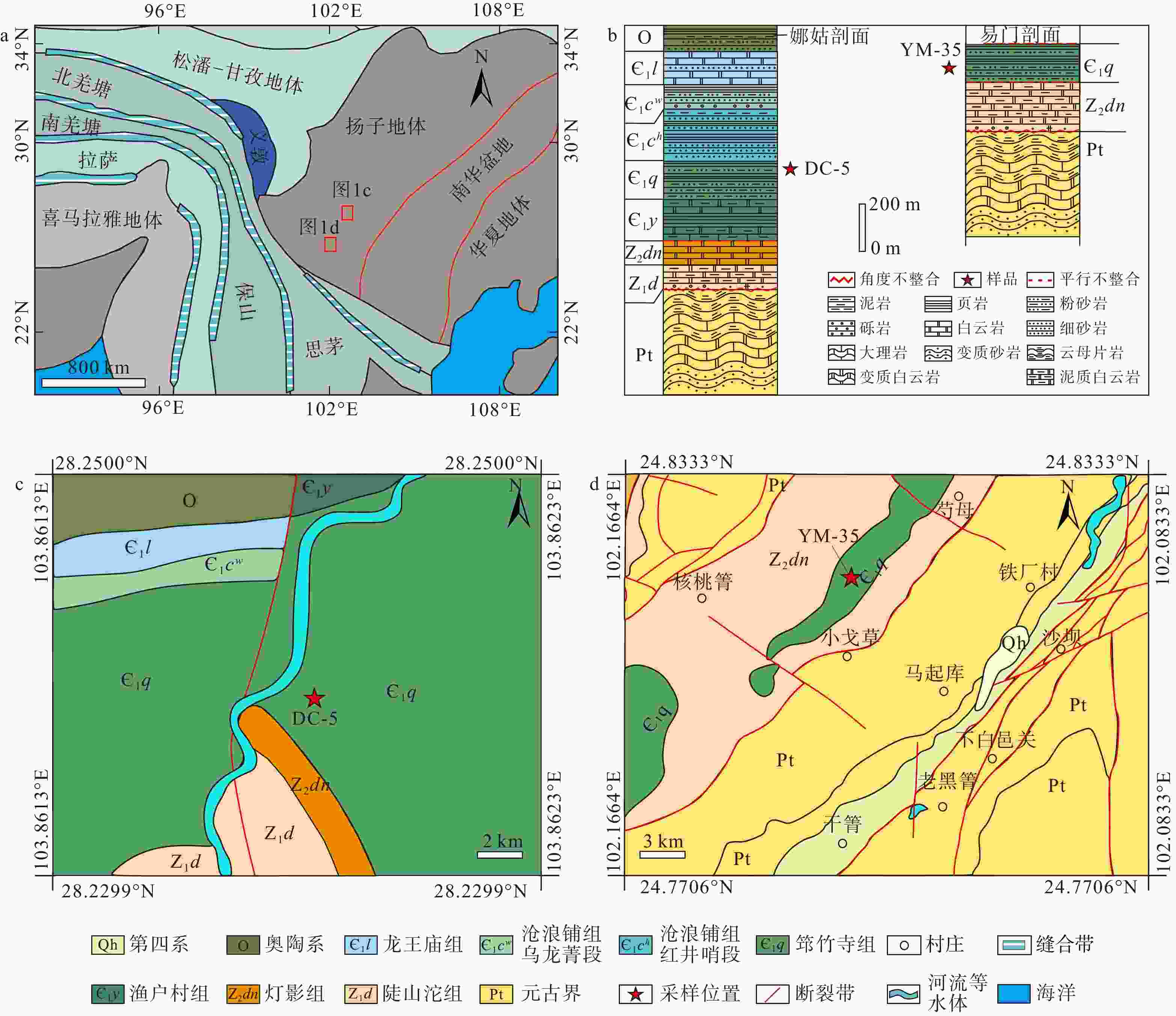
图 1 研究区区域地质和采样简图
a—华南板块及其邻区构造简图(据Liu et al.,2023;刘兵兵等,2025修改);b—东川区娜姑镇和易门县埃迪卡拉纪-奥陶纪地层柱状图(据熊家镛等,1980修改);c—东川区娜姑镇地质简图(据熊家镛等,1980修改);d—易门县地质简图 (据熊家镛等,1980修改)
Figure 1. Regional geotectonic framework and simplified geological maps of the study area
(a) geotectonic map of South China and adjacent regions (modified from Liu et al., 2023; Liu et al., 2025); (b) Ediacaran–Ordovician stratigraphic columns in the Nagu and Yimen areas (modified from Xiong et al., 1980); (c) Simplified geological map of the Nagu area, Dongchuan (modified from Xiong et al., 1980); (d) Simplified geological map of the Yimen area (modified from Xiong et al., 1980)
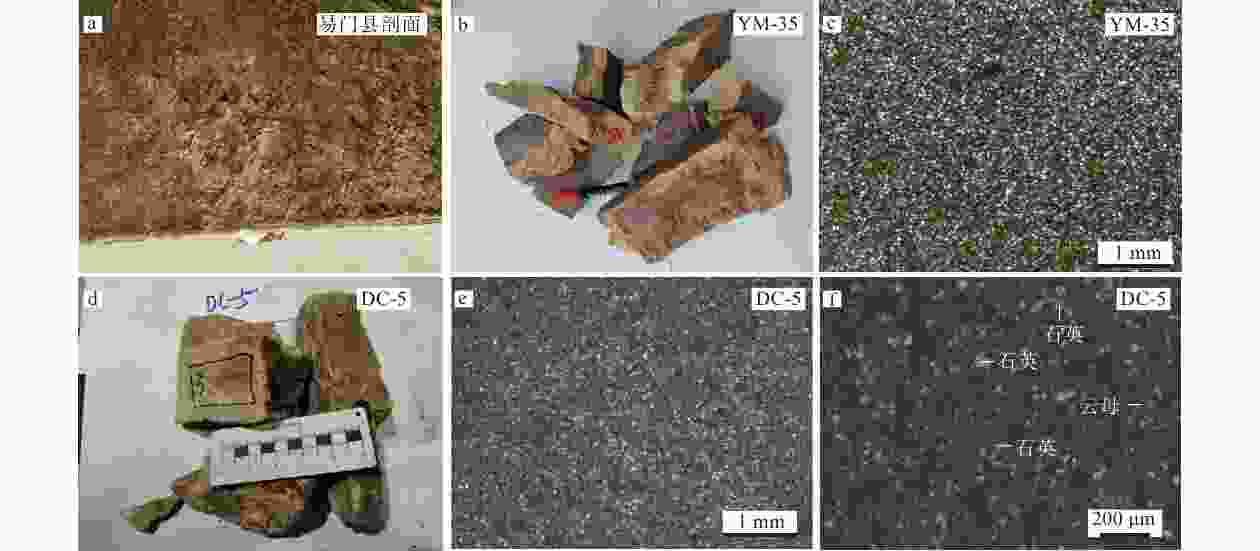
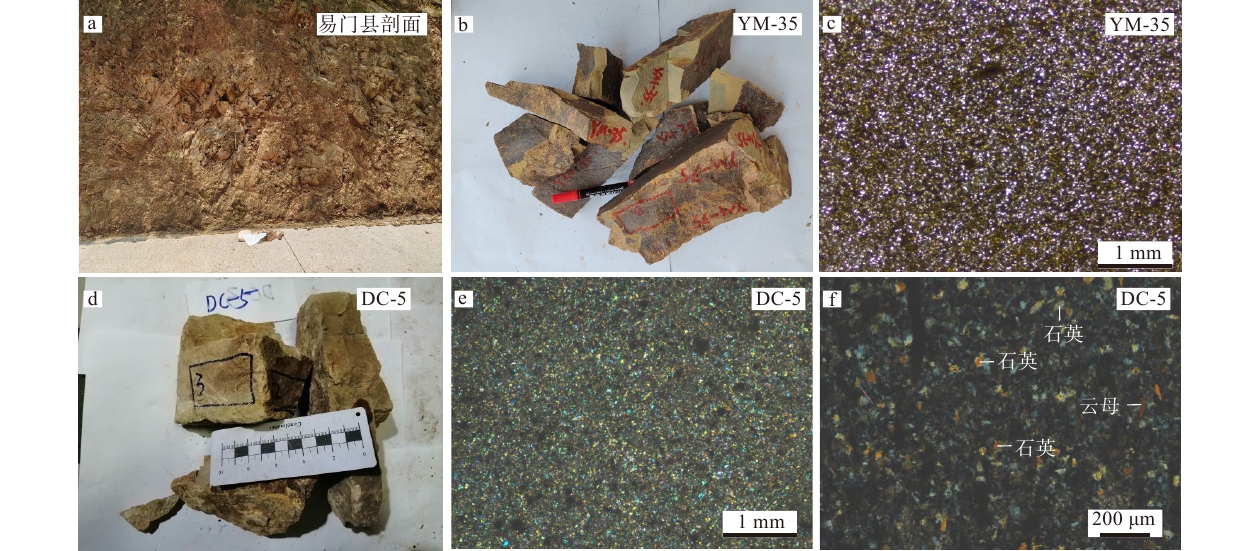
图 2 样品野外露头、手标本及镜下照片
a—样品YM-35野外露头;b—样品YM-35手标本;c—样品YM-35单偏光镜下照片;d—样品DC-5手标本;e—样品DC-5单偏光镜下照片;f—样品DC-5正交光镜下照片
Figure 2. Field outcrops, hand specimens and thin-section photomicrographs of representative samples
(a) Field outcrop photograph of sample YM-35; (b) Hand specimen of sample YM-35; (c) Plane-polarized light (PPL) photomicrograph of sample YM-35; (d) Hand specimen of sample DC-5; (e) PPL photomicrograph of sample DC-5; (f) Cross-polarized light (XPL) photomicrograph of sample DC-5
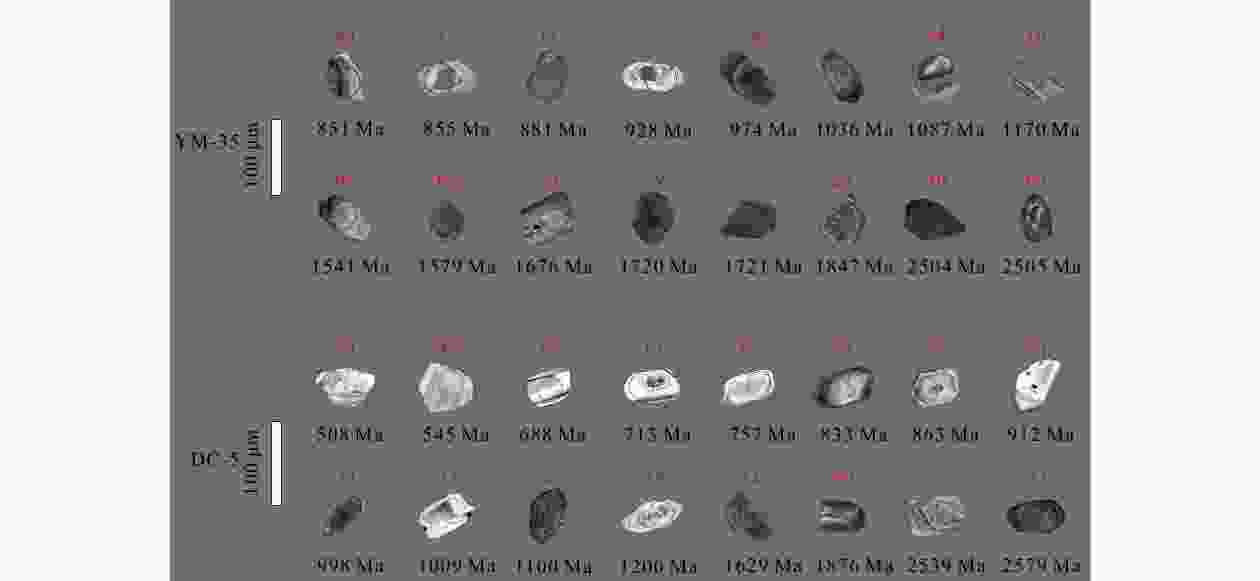
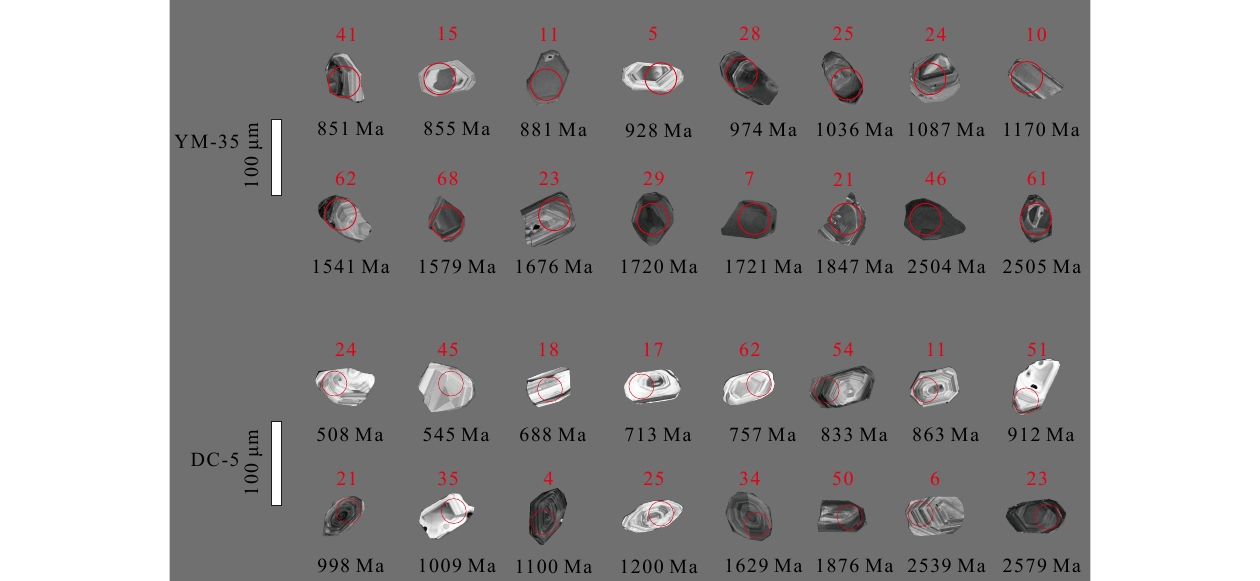
图 3 东川区娜姑镇和易门县下寒武统碎屑岩代表性锆石CL图像
红圈代表 U−Pb 分析测点位置,红色数字为测点编号;锆石下方数字为对应测点 U−Pb 年龄;束斑直径 44 μm
Figure 3. Representative cathodoluminescence (CL) images of detrital zircons from the Lower Cambrian clastic rocks in Nagu Town, Dongchuan District and Yimen County
Red circles indicate U-Pb analytical spots, red numbers are spot IDs. Values below zircons represent corresponding U-Pb ages; laser beam diameter is 44 μm.
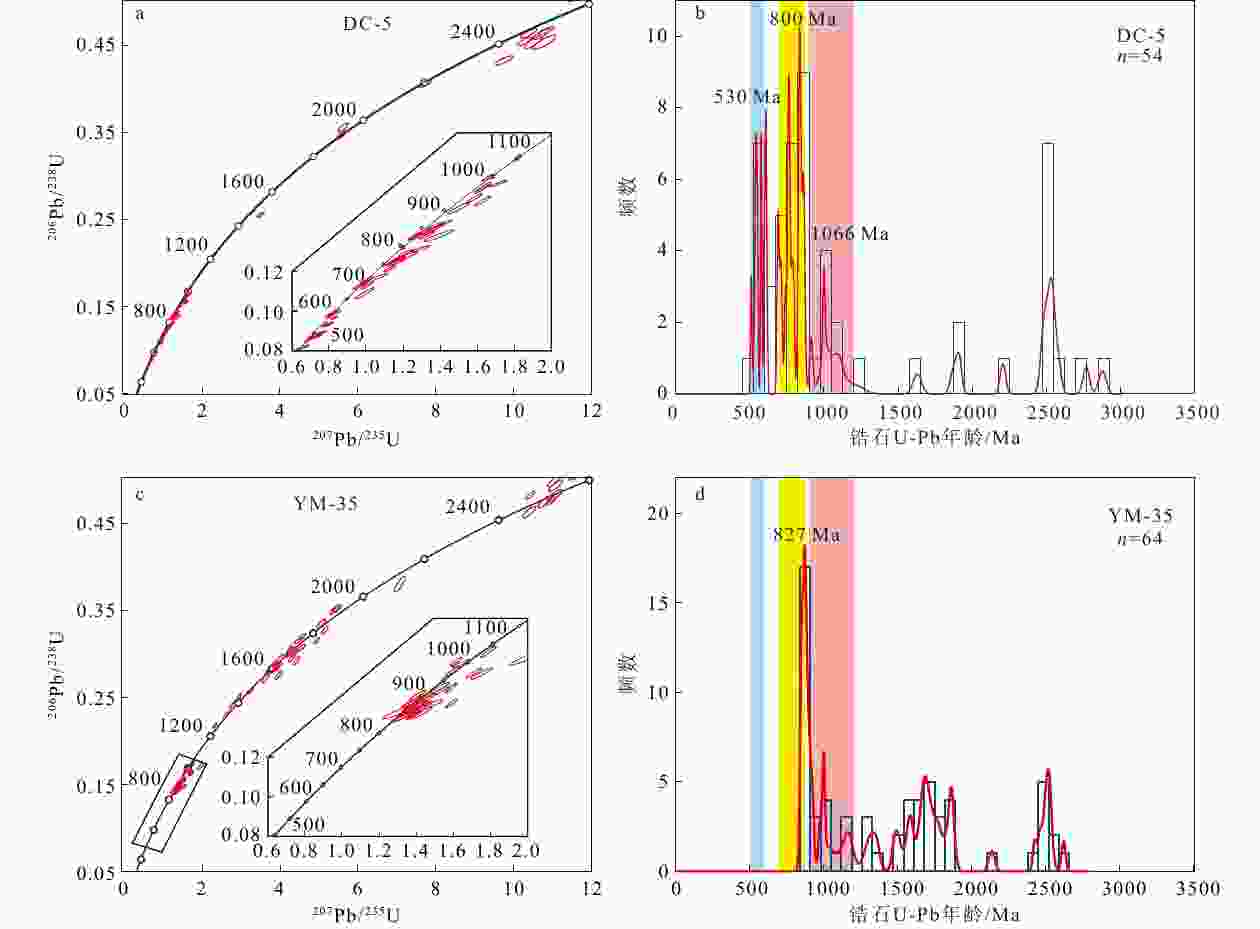
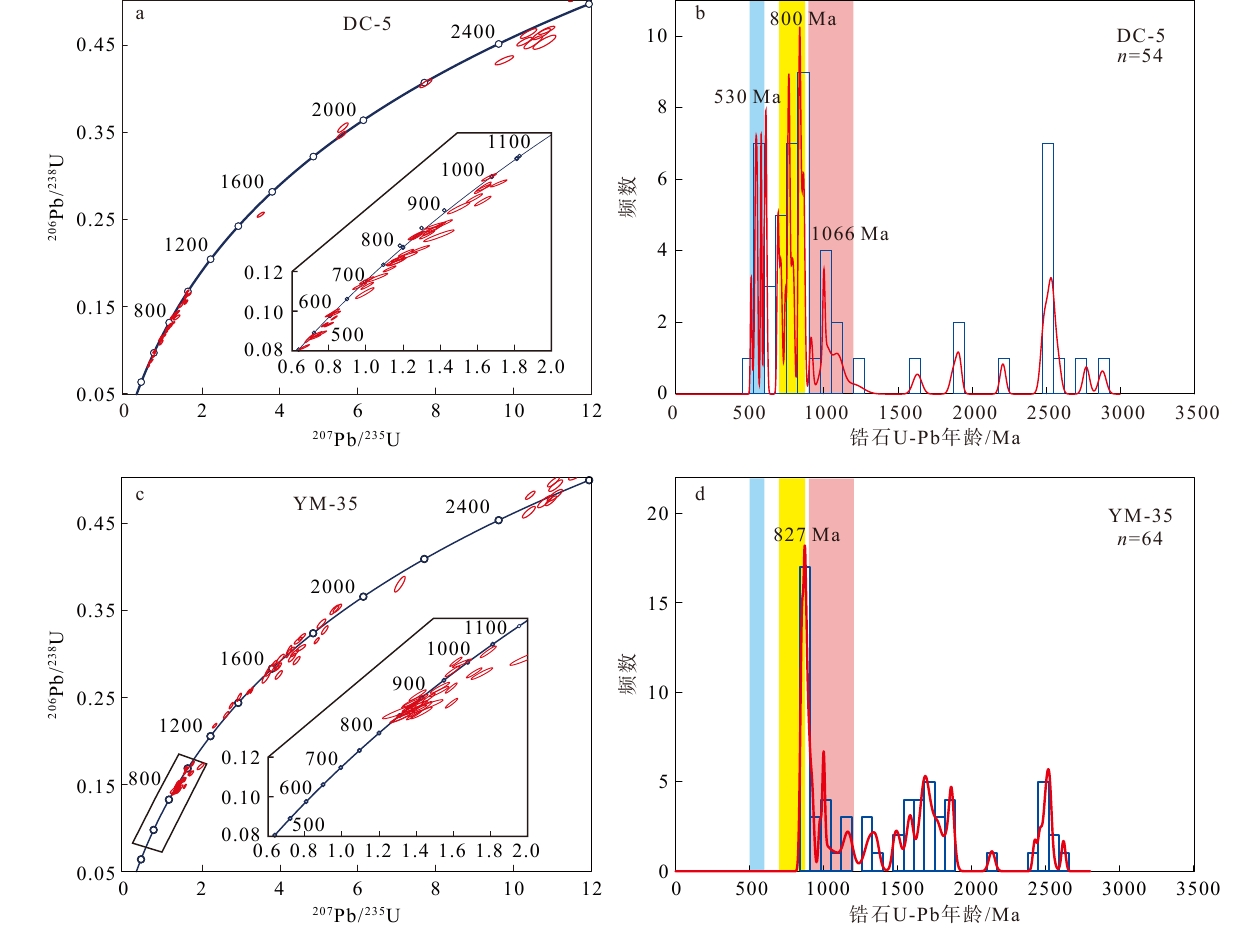
图 4 东川区娜姑镇和易门县筇竹寺组碎屑锆石U-Pb年龄谐和图和频谱图
蓝色曲线为U–Pb谐和曲线;曲线旁数字表示谐和年龄,Ma;红色椭圆表示分析数据点及其2σ误差范围;插图为数据点密集区域的局部放大图;n 代表有效锆石测点数量a—样品 DC-5 U-Pb 年龄谐和图;b—样品 DC-5锆石 U-Pb 年龄频谱图;c—样品 YM-35 U-Pb 年龄谐和图;d—样品 YM-35锆石 U-Pb 年龄频谱图
Figure 4. Detrital zircon U-Pb concordia diagrams and age probability density spectra for the Qiongzhusi Formation in Nagu Town, Dongchuan District and Yimen County
(a) Zircon U-Pb concordia diagram for sample DC-5; (b) Zircon U-Pb age probability density spectra for sample DC-5; (c) Zircon U-Pb concordia diagram for sample YM-35; (d) Zircon U-Pb age probability density spectra for sample YM-35The blue curves represents the U–Pb concordia curve, and numbers along the concordia curve indicate concordia ages (Ma). Red ellipses represent analytical data points with 2σ uncertainties. The inset shows an enlarged view of the data-rich portion of the diagram. n represents the number of valid zircon analytical spots.
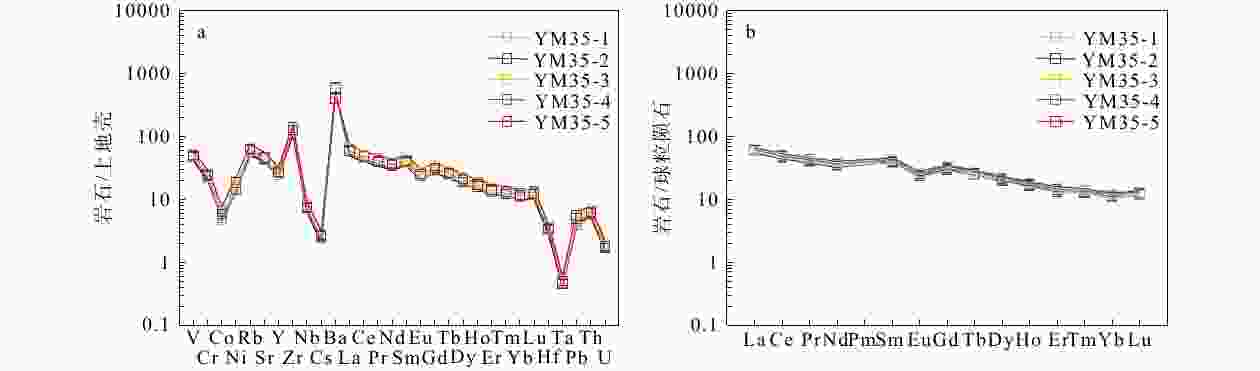
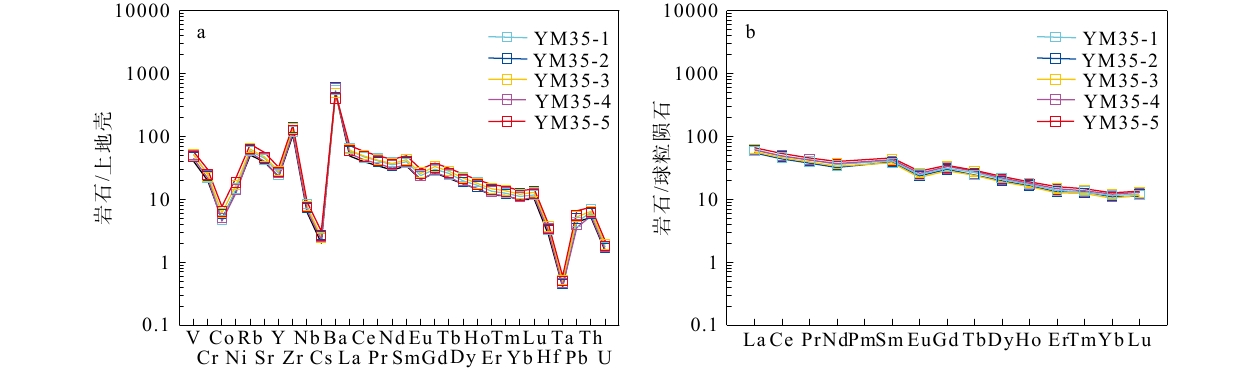
图 5 易门县筇竹寺组页岩微量元素上地壳标准化蛛网图和稀土元素球粒陨石标准化配分模式图(球粒陨石数据引自McDonough and Sun, 1995;上地壳数据引自Rudnick and Gao, 2014)
a—微量元素上地壳标准化蛛网图;b—稀土元素球粒陨石标准化配分模式图
Figure 5. Upper continental crust (UCC)-normalized trace element spider diagrams and chondrite-normalized rare earth element (REE) distribution patterns of shales from the Qiongzhusi Formation,Yimen County (Chondrite normalizing values are from McDonough and Sun, 1995; upper continental crust normalizing values are from Rudnick and Gao, 2014)
(a) UCC-normalized trace element spider diagram; (b) Chondrite-normalized REE pattern
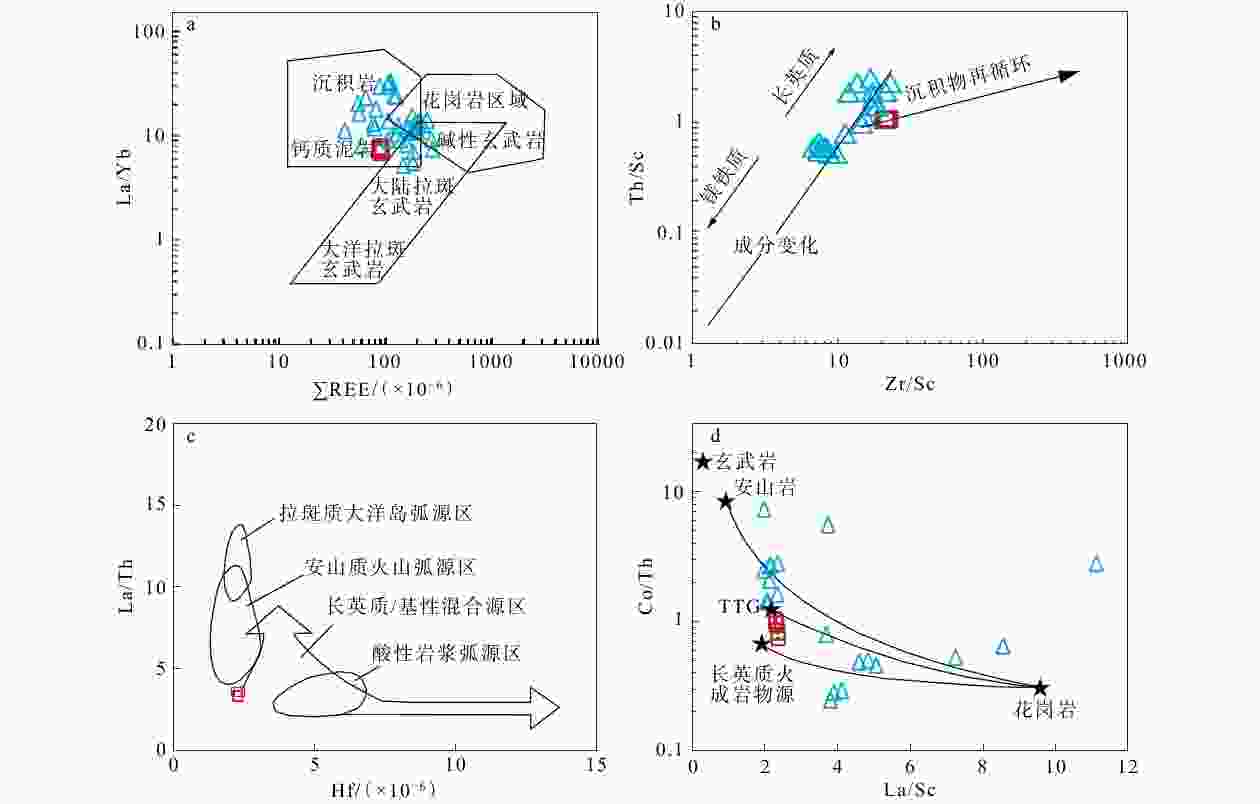
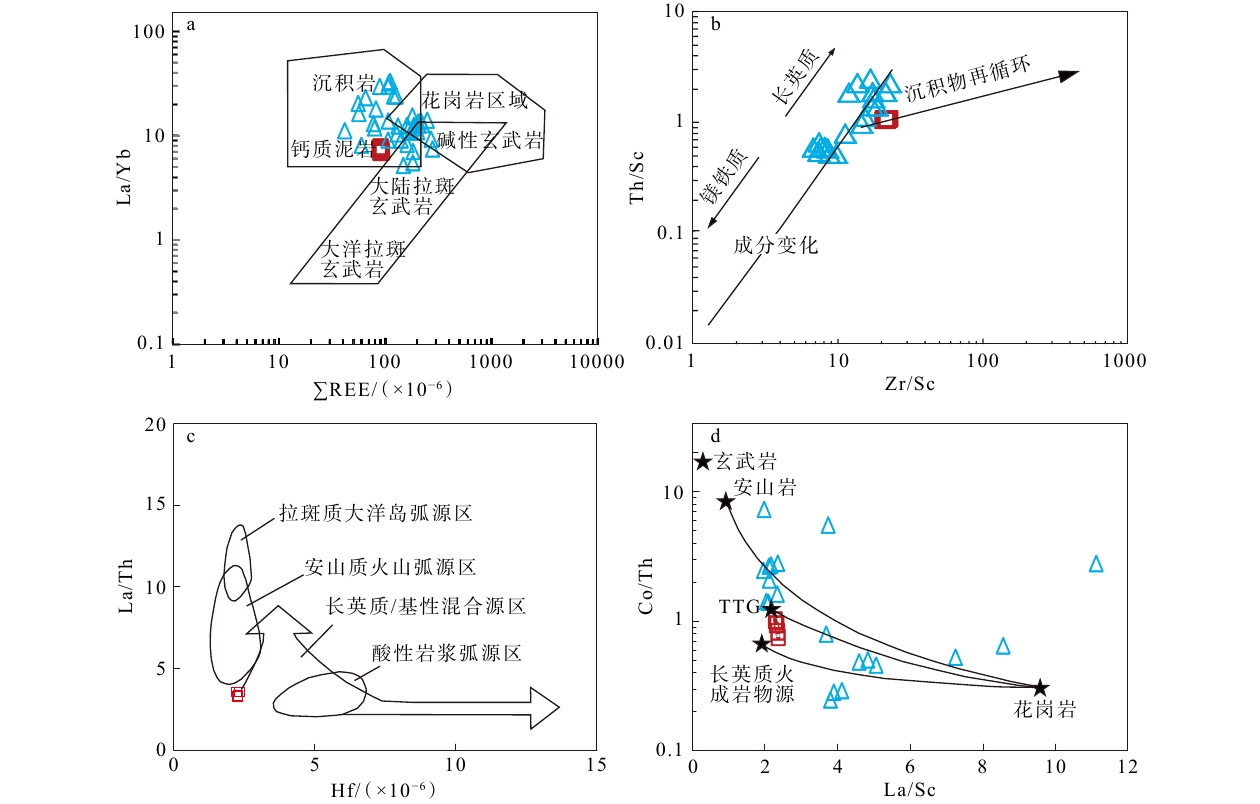
图 6 扬子西缘下寒武统碎屑沉积岩物源性质判别图解
红色方框代表文中数据,蓝色三角代表已发表数据(陈思达等,2023;杨永祯等,2024;刘慧萍等,2025)a—La/Yb vs. REE(底图引自Taylor and McLennan,1985);b—Th/Sc vs. Zr/Sc(底图引自McLennan et al.,1993);c—La/Th vs. Hf(底图引自Floyd and Leveridge,1987);d—Co/Th vs. La/Sc(底图引自Wronkiewicz and Condie,1987)
Figure 6. Geochemical provenance discriminant diagrams for Lower Cambrian clastic sedimentary rocks on the western margin of the Yangtze Block
(a) La/Yb vs. REE (basemap from McLennan et al., 1993); (b) Th/Sc vs. Zr/Sc (basemap from McLennan et al., 1993); (c) La/Th vs. Hf (basemap from Floyd and Leveridge, 1987); (d) Co/Th vs. La/Sc (basemap from Wronkiewicz and Condie, 1987) Red squares denote data from this study; blue triangles denote literature data from Chen et al., 2023; Yang et al., 2024; Liu et al., 2025.
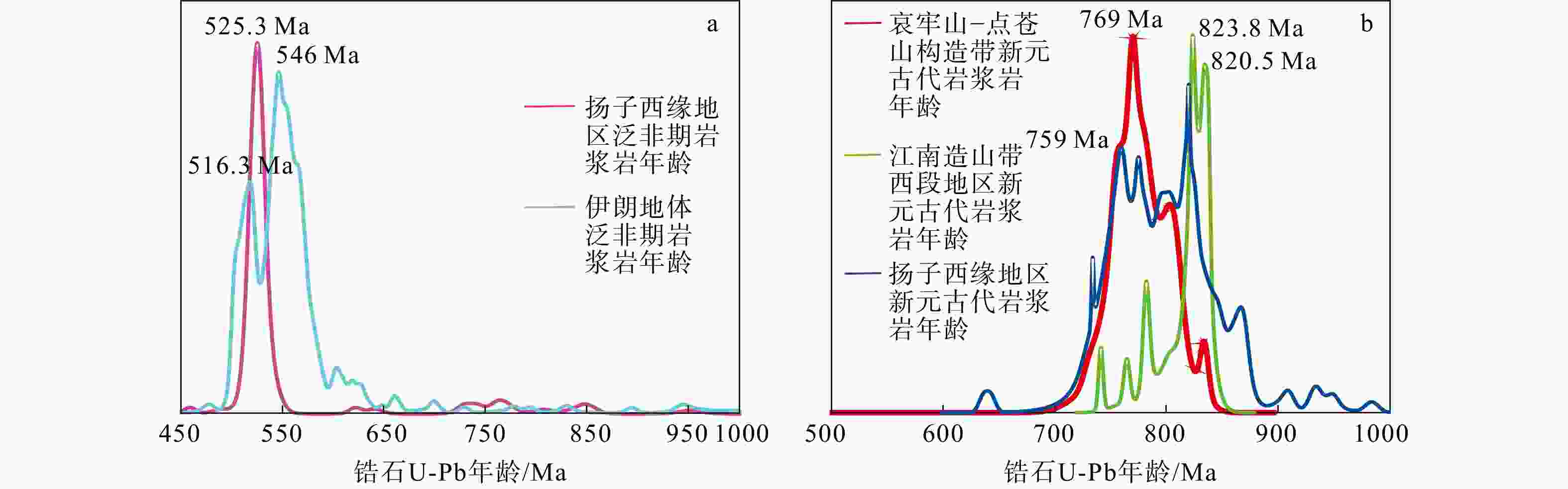
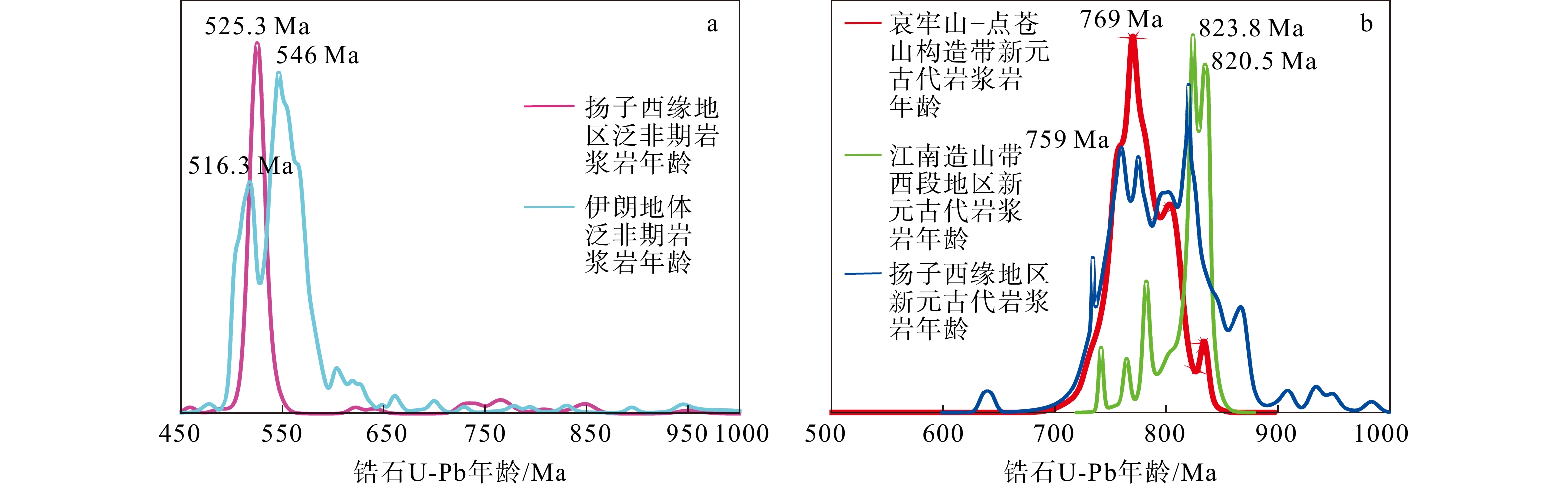
图 7 潜在物源区岩浆岩锆石U-Pb年龄频谱图(数据引自宋昊等,2015;Shafaii Moghadam et al.,2017;Shahzeidi et al.,2017;Moradi et al.,2022;刘兴源等,2023;占沈薇,2023;邓藤丽等,2025;Deng et al.,2025;李亚博等,2025)
a—泛非期潜在物源岩浆岩年龄频谱;b—新元古代潜在物源岩浆岩年龄频谱
Figure 7. Zircon U–Pb age probability density spectra for magmatic rocks from potential provenance areas (Data from Song et al., 2015; Shafaii Moghadam et al., 2017; Shahzeidi et al., 2017; Moradi et al., 2022; Liu et al., 2023; Zhan et al., 2023; Deng et al., 2025; Deng et al., 2025; Li et al., 2025)
(a) Pan-African magmatic rocks; (b) Neoproterozoic magmatic rocks
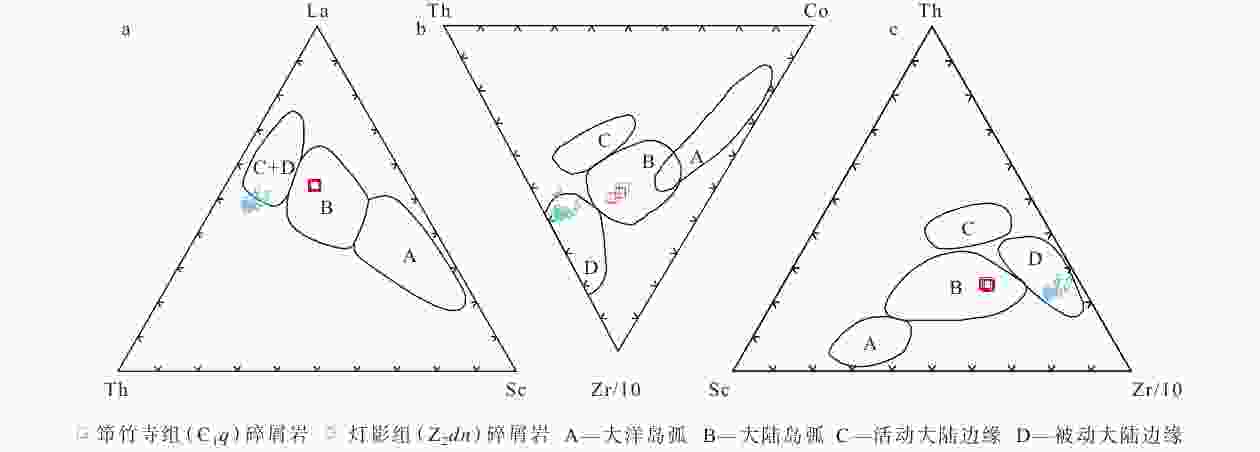
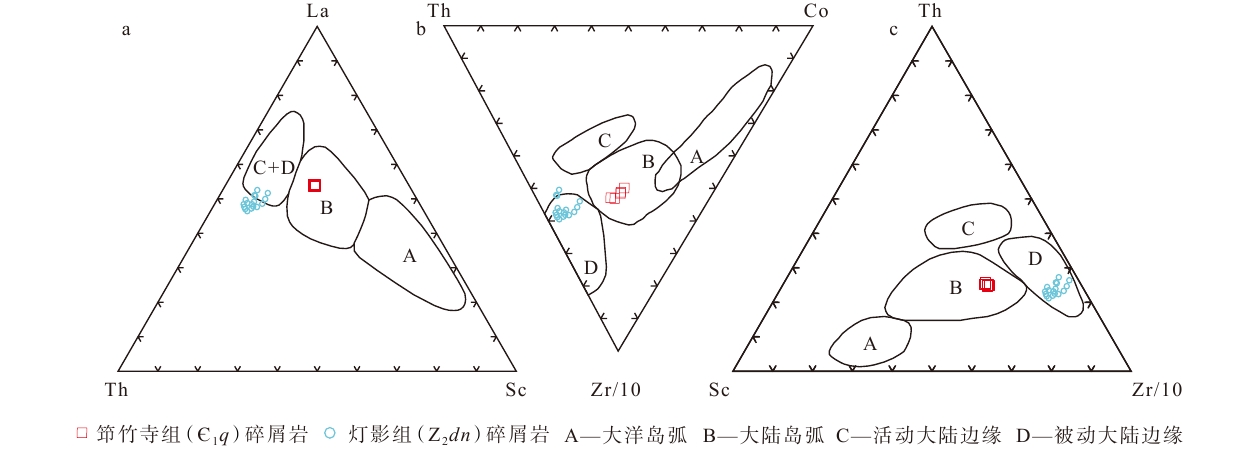
图 8 扬子西缘埃迪卡拉系—下寒武统碎屑沉积岩物源区构造背景微量元素判别图解
红色方框代表文中数据,绿色圆圈数据来自Gu et al.,2023;底图引自Bhatia,1983a—La−Th−Sc;b—Th−Co−Zr/10;c—Th−Sc−Zr/10
Figure 8. Trace element tectonic setting discrimination diagrams for Ediacaran–Lower Cambrian clastic sedimentary rocks on the western margin of the Yangtze Block
(a) La–Th–Sc; (b) Th–Co–Zr/10; (c) Th–Sc–Zr/10Red squares denote data from this study; green circles denote literature data from Gu et al., 2023; base maps are from Bhatia, 1983.
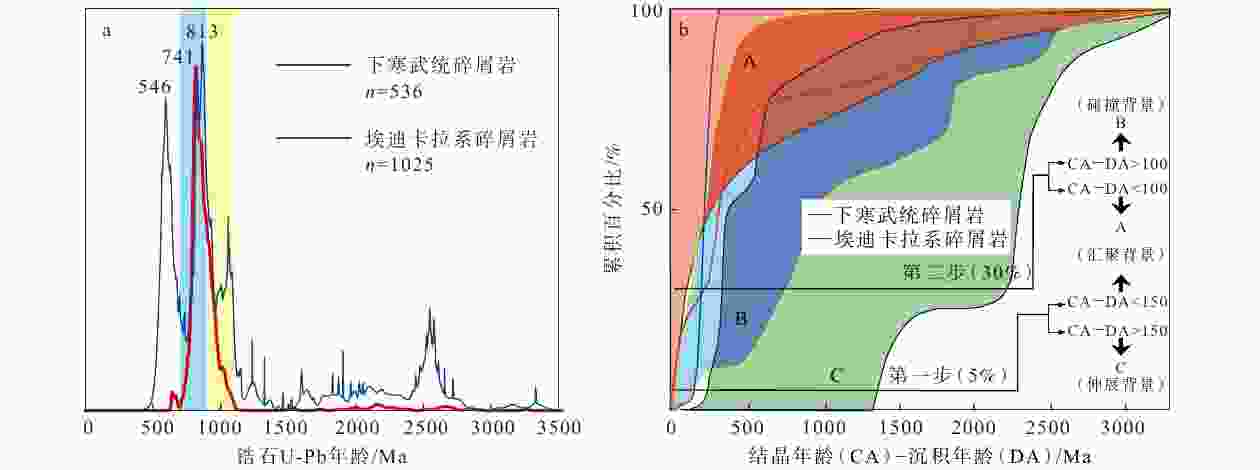
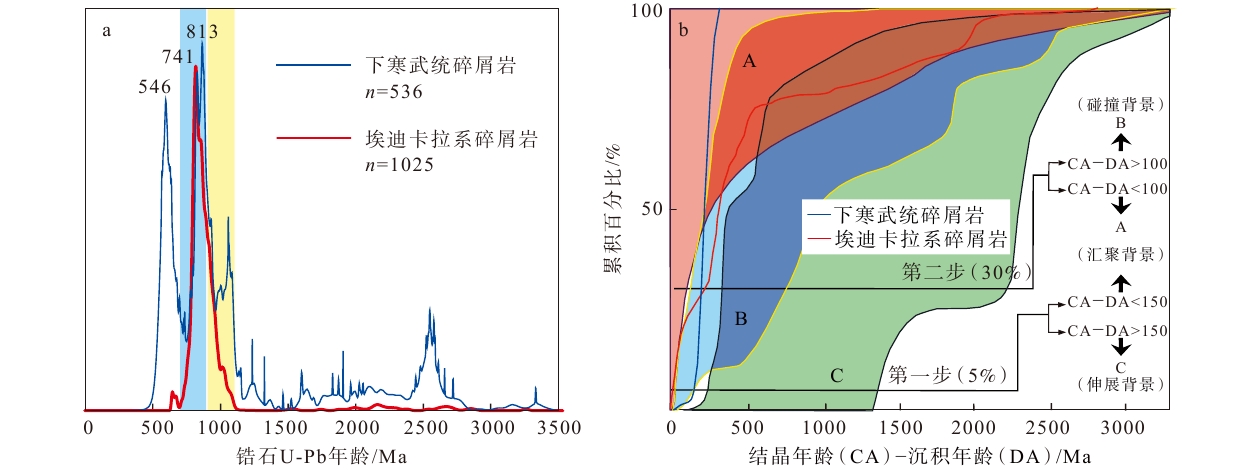
图 9 扬子西缘埃迪卡拉系-下寒武统碎屑锆石U-Pb年龄频谱图和累积分布曲线图(数据来源:Wang et al.,2012;Chen et al.,2016;Tian et al.,2020;Gu et al.,2023;刘兴源等,2023;底图引自Cawood et al.,2012)
n 代表有效锆石测点数量a—碎屑锆石U-Pb年龄频谱图;b—碎屑锆石结晶年龄(CA)-沉积年龄(DA)的累积分布曲线图
Figure 9. Detrital zircon U–Pb age probability density spectra and cumulative distribution plot for the Ediacaran–Lower Cambrian on the western margin of the Yangtze Block (Data from Wang et al., 2012; Chen et al.,2016; Tian et al., 2020; Gu et al., 2023; Liu et al., 2023; modified from Cawood et al., 2012)
(a) Detrital zircon U–Pb age probability density spectrum; (b) Cumulative probability distribution curves of detrital zircon crystallization age (CA) minus depositional age (DA) n represents the number of valid zircon analytical spots.
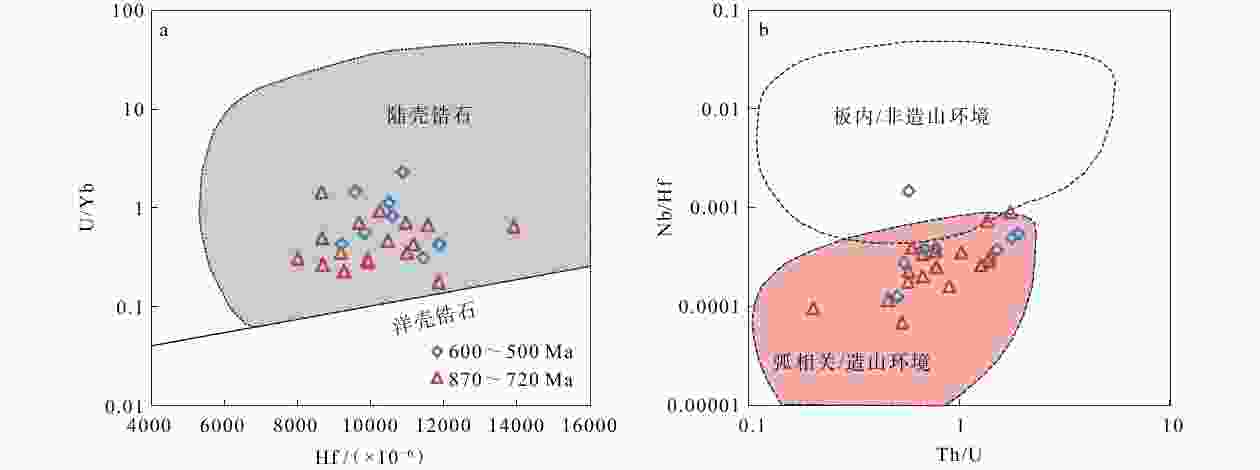
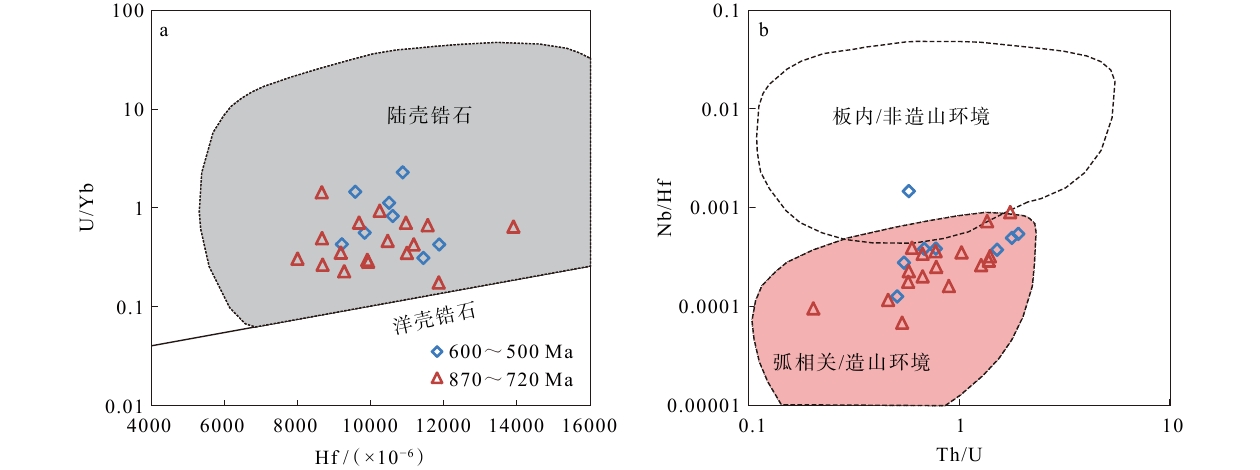
图 10 筇竹寺竹寺组样品碎屑锆石微量元素结晶与构造判别图解
a—锆石Hf−U/Yb结晶环境判别图解(底图引自Grimes et al.,2007);b—锆石Th/U−Nb/Hf构造环境判别图解(底图引自Yang et al.,2012)
Figure 10. Trace element tectonic discriminant diagrams of crystallization and tectonic setting for detrital zircons from the Qiongzhusi Formation
(a) Zircon Hf vs. U/Yb crystallization environment discrimination diagram (base map after Grimes et al., 2007); (b) Zircon Th/U vs. Nb/Hf tectonic setting discrimination diagram (base map after Yang et al., 2012)
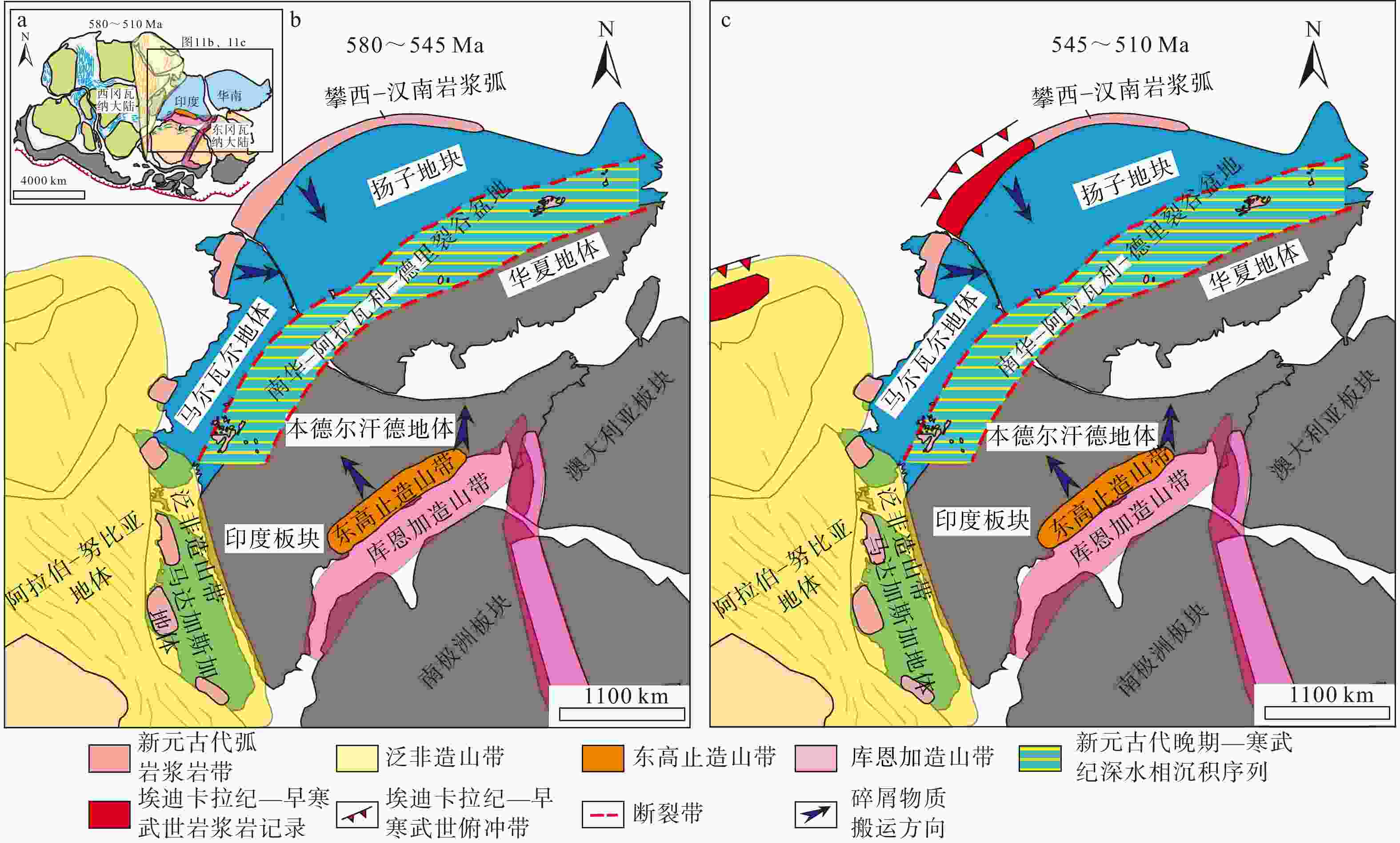
图 11 华南—印度联合地体埃迪卡拉纪—早寒武世构造格局演化图
a—冈瓦纳大陆埃迪卡拉纪—早寒武世构造格局图(据Zhao et al.,2018修改);b—华南−印度联合地体埃迪卡拉纪早—中期构造格局图(据刘兴源等,2023修改);c—华南−印度联合地体埃迪卡拉末期—早寒武世构造格局图(据刘兴源等,2023修改)
Figure 11. Tectonic evolution of the South China–India terrane during the Ediacaran-Early Cambrian
(a) Tectonic framework of Gondwana during the Ediacaran–Early Cambrian (modified after Zhao et al., 2018); (b) Tectonic framework of the united South China–India terrane during the early–middle Ediacaran (modified after Liu et al., 2023); (c) Tectonic framework of the united South China–India terrane during the latest Ediacaran–Early Cambrian (modified after Liu et al., 2023)
表 1 易门县筇竹寺组全岩样品主量和微量元素分析结果
Table 1. Whole-rock major and trace element compositions from the Qiongzhusi Formation,Yimen County
样品编号 Ag Al As Be Bi Ca Cd Co Cr Cs Cu Fe Ga Ge In K Li YM-35-1 0.09 3.72 3.7 1.01 0.07 6.73 0.04 5.9 24 2.43 39.3 3.18 8.87 <0.05 0.116 1.72 53.5 YM-35-2 0.08 3.82 3.0 1.03 0.05 6.37 0.74 4.7 25 2.41 84.0 2.98 8.84 <0.05 0.160 1.76 55.5 YM-35-3 0.09 3.81 3.5 1.03 0.08 6.78 0.08 6.1 25 2.54 49.1 3.22 8.92 <0.05 0.126 1.76 53.8 YM-35-4 0.06 3.90 2.8 1.05 0.06 6.56 0.05 5.2 25 2.61 38.7 3.01 9.22 <0.05 0.122 1.80 56.0 YM-35-5 0.09 3.83 4.1 1.05 0.07 6.84 0.04 6.4 25 2.61 39.6 3.32 9.23 <0.05 0.122 1.77 53.3 样品编号 Mg Mn Mo Na Ni P Pb Rb Re S Sb Sc Se Sn Ta Te Ti YM-35-1 4.08 1615 6.85 0.04 16.8 890 5.3 61.0 <0.002 0.44 0.60 5.8 1 1.3 0.49 <0.05 0.208 YM-35-2 3.86 1500 4.72 0.05 14.8 880 4.4 58.9 <0.002 0.27 0.49 5.8 <1 1.3 0.47 <0.05 0.214 YM-35-3 4.15 1615 8.98 0.05 17.0 880 5.3 63.2 <0.002 0.49 0.63 6.0 1 1.4 0.49 <0.05 0.214 YM-35-4 4.04 1575 5.75 0.05 14.7 890 4.1 63.4 <0.002 0.19 0.46 6.0 <1 1.4 0.48 <0.05 0.220 YM-35-5 4.14 1635 8.58 0.05 18.6 880 5.5 63.0 <0.002 0.54 0.70 6.0 <1 1.4 0.50 <0.05 0.212 样品编号 Tl W Zn Ba Ce Dy Er Eu Gd Hf Ho La Lu Nb Nd Pr Sm YM-35-1 0.33 1.0 38 604 29.4 5.40 2.35 1.45 6.54 3.3 1.00 14.0 0.31 7.5 16.5 3.91 6.29 YM-35-2 0.31 0.9 419 544 29.2 5.02 2.24 1.39 6.22 3.3 0.95 14.2 0.30 7.7 16.6 3.91 6.11 YM-35-3 0.35 1.0 79 490 30.1 5.56 2.45 1.51 6.86 3.6 1.02 14.4 0.33 7.7 17.4 4.00 6.56 YM-35-4 0.31 1.0 39 597 30.2 5.17 2.26 1.39 6.28 3.6 0.97 14.6 0.32 7.7 16.9 4.04 6.28 YM-35-5 0.35 1.0 36 403 29.6 5.31 2.38 1.47 6.46 3.4 0.97 14.2 0.31 7.6 16.9 3.91 6.30 样品编号 Sr Tb Th Tm U V Y Yb Zr Al2O3 As2O3 BaO CaO Cl CoO Cr2O3 CuO YM-35-1 47.5 0.97 6.22 0.35 1.81 49 27.6 2.02 127 7.12 <0.01 0.07 9.66 0.01 <0.01 <0.01 <0.01 YM-35-2 45.3 0.97 6.25 0.32 1.74 52 26.2 1.90 123 7.39 <0.01 0.06 9.09 0.01 <0.01 <0.01 <0.01 YM-35-3 47.5 1.05 6.47 0.35 1.92 52 28.0 2.06 134 7.33 <0.01 0.05 9.80 0.01 <0.01 <0.01 <0.01 YM-35-4 46.3 0.97 6.29 0.34 1.82 52 26.9 1.90 130 7.39 <0.01 0.07 9.20 0.01 <0.01 <0.01 <0.01 YM-35-5 46.6 0.98 6.27 0.34 1.82 48 27.0 1.95 126 7.41 <0.01 0.05 9.75 0.01 <0.01 <0.01 <0.01 样品编号 TFe2O3 K2O MgO MnO Na2O NiO P2O5 PbO SiO2 SnO2 SO3 SrO TiO2 V2O5 ZnO ZrO2 LOI1000 YM-35-1 4.67 2.10 6.97 0.22 0.05 <0.01 0.18 <0.01 52.54 <0.01 1.04 <0.01 0.35 <0.01 <0.01 0.01 15.72 YM-35-2 4.38 2.17 6.62 0.21 0.05 <0.01 0.19 <0.01 54.00 <0.01 0.64 <0.01 0.35 <0.01 0.04 0.01 15.05 YM-35-3 4.74 2.13 7.08 0.23 0.05 <0.01 0.18 <0.01 51.97 <0.01 1.15 <0.01 0.35 <0.01 <0.01 0.01 15.99 YM-35-4 4.31 2.16 6.75 0.21 0.04 <0.01 0.19 <0.01 53.68 <0.01 0.44 <0.01 0.36 <0.01 <0.01 0.01 15.55 YM-35-5 4.84 2.16 7.10 0.23 0.05 <0.01 0.19 <0.01 51.80 <0.01 1.28 <0.01 0.35 <0.01 <0.01 0.01 15.87  下载: 导出CSV
-
[1] ANDERSEN T, 2002. Correction of common lead in U-Pb analyses that do not report 204Pb. Chemical Geology, 192(1–2): 59–79. [2] BHATIA M R, 1983. Plate tectonics and geochemical composition of sandstones[J]. The Journal of Geology, 91(6): 611-627. doi: 10.1086/628815 [3] BHATIA M R, CROOK K A W, 1986. Trace element characteristics of graywackes and tectonic setting discrimination of sedimentary basins[J]. Contributions to Mineralogy and Petrology, 92(2): 181-193. doi: 10.1007/BF00375292 [4] Bureau of Geology and Mineral Resources of Yunnan Province. 1990. Regional Geology of Yunnan Province[M]. Beijing: Geological Publishing House. [5] CAI Y F, WANG Y J, CAWOOD P A, et al., 2014. Neoproterozoic subduction along the Ailaoshan zone, South China: geochronological and geochemical evidence from amphibolite[J]. Precambrian Research, 245: 13-28. doi: 10.1016/j.precamres.2014.01.009 [6] CAI Y F, WANG Y J, CAWOOD P A, et al., 2015. Neoproterozoic crustal growth of the Southern Yangtze Block: geochemical and zircon U-Pb geochronological and Lu-Hf isotopic evidence of Neoproterozoic diorite from the Ailaoshan zone[J]. Precambrian Research, 266: 137-149. doi: 10.1016/j.precamres.2015.05.008 [7] CAWOOD P A, HAWKESWORTH C J, DHUIME B, 2012. Detrital zircon record and tectonic setting[J]. Geology, 40(10): 875-878. doi: 10.1130/G32945.1 [8] CHEN Q, SUN M, LONG X P, et al., 2016. U-Pb ages and Hf isotopic record of zircons from the Late Neoproterozoic and Silurian-Devonian sedimentary rocks of the western Yangtze Block: implications for its tectonic evolution and continental affinity[J]. Gondwana Research, 31: 184-199. doi: 10.1016/j.gr.2015.01.009 [9] CHEN Q, ZHAO G C, SUN M, 2021. Protracted northward drifting of South China during the assembly of Gondwana: constraints from the spatial-temporal provenance comparison of Neoproterozoic-Cambrian strata[J]. GSA Bulletin, 133(9-10): 1947-1963. doi: 10.1130/B35791.1 [10] CHEN S D, XU Z Q, SONG H, et al., 2023. Geochemical characteristics and sedimentary environment of Qiongzhusi Formation in Daibuzhen, Huize Area, Yunnan Province[J]. Sichuan Metallurgy, 45(1): 12-21. (in Chinese with English abstract) [11] DENG Q, WANG Z J, LIU H, et al., 2025. Subduction-collision and rapid uplift of the NW Yangtze Block during the Ediacaran-Cambrian transition: new evidence from the shoshonite series[J]. International Geology Review, 67(3): 331-351. doi: 10.1080/00206814.2024.2446942 [12] DENG T L, PENG Y W, CHENG W B, et al., 2025. Geochronology, petrogenesis, and tin-tungsten metallogenic potential of the Neoproterozoic highly fractionated granites in the Mosuoying area, western margin of the Yangtze Block[J]. Journal of Chengdu University of Technology (Science & Technology Edition), 52(3): 456-479. (in Chinese with English abstract) [13] FENG Z Z, PENG Y M, JIN Z K, et al., 2001. Lithofacies palaeogeography of the Cambrian in South China[J]. Journal of Palaeogeography, 3(1): 1-14. (in Chinese with English abstract) [14] FENG Z Z, PENG Y M, JIN Z K, et al., 2002. Lithofacies palaeogeography of the Early Cambrian in China[J]. Journal of Palaeogeography, 4(1): 1-12. (in Chinese with English abstract) [15] FLOYD P A, LEVERIDGE B E, 1987. Tectonic environment of the Devonian Gramscatho basin, south Cornwall: framework mode and geochemical evidence from turbiditic sandstones[J]. Journal of the Geological Society, 144(4): 531-542. doi: 10.1144/gsjgs.144.4.0531 [16] GEHRELS G E, DECELLES P G, OJHA T P, et al., 2006. Geologic and U-Pb geochronologic evidence for Early Paleozoic tectonism in the Dadeldhura thrust sheet, far-west Nepal Himalaya[J]. Journal of Asian Earth Sciences, 28(4-6): 385-408. doi: 10.1016/j.jseaes.2005.09.012 [17] GRIMES C B, JOHN B E, KELEMEN P B, et al., 2007. Trace element chemistry of zircons from oceanic crust: a method for distinguishing detrital zircon provenance[J]. Geology, 35(7): 643-646. doi: 10.1130/G23603A.1 [18] GU Z D, LONERGAN L, ZHAI X F, et al., 2021. The formation of the Sichuan Basin, South China, during the Late Ediacaran to Early Cambrian[J]. Basin Research, 33(4): 2328-2357. doi: 10.1111/bre.12559 [19] GU Z D, JIAN X, WATTS A B, et al., 2023. Formation and evolution of an Early Cambrian foreland basin in the NW Yangtze Block, South China[J]. Journal of the Geological Society, 180(3): jgs2022-127. doi: 10.5194/egusphere-egu24-9027 [20] HE W H, TANG T T, YUE M L, et al., 2014. Sedimentary and tectonic evolution of Nanhuan-Permian in South China[J]. Earth Science—Journal of China University of Geosciences, 39(8): 929-953. (in Chinese with English abstract) [21] JIANG G Q, SOHL L E, CHRISTIE-BLICK N, 2003. Neoproterozoic stratigraphic comparison of the Lesser Himalaya (India) and Yangtze block (South China): paleogeographic implications[J]. Geology, 31(10): 917-920. doi: 10.1130/G19790.1 [22] JIANG G Q, SHI X Y, ZHANG S H, et al., 2011. Stratigraphy and paleogeography of the Ediacaran Doushantuo Formation (ca. 635-551 Ma) in South China[J]. Gondwana Research, 19(4): 831-849. doi: 10.1016/j.gr.2011.01.006 [23] LI L M, LIN S F, XING G F, et al., 2017. First direct evidence of Pan-African orogeny associated with Gondwana assembly in the Cathaysia block of southern China[J]. Scientific Reports, 7(1): 794. doi: 10.1038/s41598-017-00950-x [24] LI Y B, REN X, SAFONOVA I, et al., 2025. Early Neoproterozoic oceanic subduction along the western Yangtze Block: constraints from the genesis of Tianquan diorites in the western Sichuan[J]. Journal of Chengdu University of Technology (Science & Technology Edition), 52(3): 480-501. (in Chinese with English abstract) [25] LIN S F, WANG L J, XIAO W J, et al. , 2024. The Early Paleozoic Wuyi-Yunkai orogeny in South China: a collisional orogeny with a major lag in time between onset of collision and peak metamorphism in subducted continental crust[M]//NANCE R D, STRACHAN R A, QUESADA C, et al. Supercontinents, orogenesis and magmatism. London: Geological Society, London, Special Publications: 649-641. [26] LIU B B, PENG T P, FAN W M, et al., 2020. Tectonic evolution and paleoposition of the Baoshan and Lincang blocks of West Yunnan during the Paleozoic[J]. Tectonics, 39(10): e2019TC006028. doi: 10.1029/2019TC006028 [27] LIU B B, PENG T P, FAN W M, et al., 2023. Correlation between South China and India and development of double rift systems in the South China-India Duo during late Neoproterozoic time[J]. GSA Bulletin, 135(1-2): 351-366. doi: 10.1130/B36397.1 [28] LIU B B, YAN Q H, SHI Z Q, et al., 2025. Late Neoproterozoic-Middle Cambrian tectonic affinity and paleogeographic position of the South China Block and its geotectonic significance[J]. Geotectonica et Metallogenia, 49(4): 975-988. (in Chinese with English abstract) [29] LIU H P, RONG J, LIU Z L, et al., 2025. Element geochemical characteristics and geological significance of the Cambrian Qiongzhusi Formation in northern Guangyuan, Sichuan Basin[J]. Natural Gas Geoscience, 36(5): 936-952. (in Chinese with English abstract) [30] LIU X Y, CAO J, LI S S, et al., 2023. Geochemical characteristics and geological significance of Neoproterozoic Qingmingshan granite in northern Guangxi[J]. Journal of Guilin University of Technology, 43(3): 351-363. (in Chinese with English abstract) [31] LIU Y S, HU Z C, ZONG K Q, et al., 2010. Reappraisement and refinement of zircon U-Pb isotope and trace element analyses by LA-ICP-MS[J]. Chinese Science Bulletin, 55(15): 1535-1546. doi: 10.1007/s11434-010-3052-4 [32] LUDWIG K R, 2003. User's manual for Isoplot 3.00: a geochronological toolkit for Microsoft Excel[M]. Berkeley: Berkeley Geochronology Center. [33] MCDONOUGH W F, SUN S S, 1995. The composition of the Earth[J]. Chemical Geology, 120(3-4): 223-253. doi: 10.1016/0009-2541(94)00140-4 [34] MCLENNAN S M, 1989. Rare earth elements in sedimentary rocks: influence of provenance and sedimentary processes. Rev. Mineral. 21: 169–200. [35] MCLENNAN S M, HEMMING S, MCDANIEL D K, et al. , 1993. Geochemical approaches to sedimentation, provenance, and tectonics[M]//JOHNSSON M J, BASU A. Processes controlling the composition of clastic sediments. Geological Society of America: 21-40. [36] MORADI A, SHABANIAN N, DAVOUDIAN A R, et al., 2022. Zircon U-Pb and geochemistry of the north Shahrekord metamorphosed felsic rocks: implications for the Ediacaran-Cambrian tectonic setting of Iran[J]. International Journal of Earth Sciences, 111(7): 2239-2263. doi: 10.1007/s00531-022-02225-x [37] QI L, XU Y J, DU Y S, et al., 2023. Neoproterozoic sedimentary records in the Cathaysia Block and their implications for the supercontinent reconstruction[J]. Sedimentary Geology and Tethyan Geology, 43(1): 188-211. (in Chinese with English abstract) [38] RUDNICK R L, GAO S, 2014. Composition of the continental crust[M]//HOLLAND H D, TUREKIAN K K. Treatise on geochemistry. Oxford: Elsevier: 1-51. [39] SHAFAII MOGHADAM H, GRIFFIN W L, LI X H, et al., 2017. Crustal evolution of NW Iran: Cadomian arcs, Archean fragments and the Cenozoic magmatic flare-up[J]. Journal of Petrology, 58(11): 2143-2190. doi: 10.1093/petrology/egy005 [40] SHAHZEIDI M, MOAYYED M, MURATA M, et al., 2017. Late Ediacaran crustal thickening in Iran: geochemical and isotopic constraints from the ~550 Ma Mishu granitoids (northwest Iran)[J]. International Geology Review, 59(7): 793-811. doi: 10.1080/00206814.2016.1198728 [41] SONG H, XU Z Q, NI S J, et al., 2015. Response of the motianling granitic pluton in North Guangxi to the tectonic evolution in the southwestern section of the Jiangnan Orogenic Belt: constraints from neoproterozoic zircon geochronology[J]. Geotectonica et Metallogenia, 39(6): 1156-1175. (in Chinese with English abstract) [42] TAYLOR S R, MCLENNAN S M, 1985. The continental crust: its composition and evolution[M]. Oxford: Blackwell Scientific Publications. [43] TIAN Z D, LENG C B, and ZHANG, X C, 2020. Provenance and tectonic setting of the Neoproterozoic metasedimentary rocks at southeastern Tibetan Plateau: Implications for the tectonic affinity of Yidun terrane: Precambrian Research, 344: 1–19, [44] VERMEESCH P, 2012. On the visualisation of detrital age distributions[J]. Chemical Geology, 312-313: 190-194. [45] WANG J, LI Z X, 2003. History of Neoproterozoic rift basins in South China: implications for Rodinia break-up[J]. Precambrian Research, 122(1-4): 141-158. doi: 10.1016/s0301-9268(02)00209-7 [46] WANG L J, YU J H, GRIFFIN W L, et al. , 2012. Early crustal evolution in the western Yangtze Block: evidence from U-Pb and Lu-Hf isotopes on detrital zircons from sedimentary rocks[J]. Precambrian Research, 222-223: 368-385. [47] WANG L J, LIN S F, XIAO W J, 2023. Yangtze and Cathaysia blocks of South China: their separate positions in Gondwana until early Paleozoic juxtaposition[J]. Geology, 51(8): 723-727. doi: 10.1130/geol.s.23060891.v1 [48] WANG S D, DUAN X X, CAI X B, et al., 2023. Enrichment and fractionation of REY in the weathering crust of metamorphic rocks in the Shiguan Area of the Dabie Orogenic Belt[J]. Geology and Exploration, 59(4): 828-851. (in Chinese with English abstract) [49] WANG Y P, BAO Z D, ZHANG L J, et al., 2024. Diagenesis of microbial dolomite reservoirs in the second Member of Dengying Formation of Ediacaran in the Penglai area, Sichuan Basin: Insights into the formation and evolution of high-quality reservoirs[J]. Journal of Geomechanics, 30(4): 579-594. (in Chinese with English abstract) [50] WRONKIEWICZ D J, CONDIE K C, 1987. Geochemistry of Archean shales from the Witwatersrand Supergroup, South Africa: source-area weathering and provenance[J]. Geochimica et Cosmochimica Acta, 51(9): 2401-2416. doi: 10.1016/0016-7037(87)90293-6 [51] WU Y B, ZHENG Y F, 2004. Genesis of zircon and its constraints on interpretation of U-Pb age[J]. Chinese Science Bulletin, 49(15): 1554-1569. doi: 10.1007/BF03184122 [52] XIA X P, NIE X S, LAI C K, et al., 2016. Where was the Ailaoshan Ocean and when did it open: a perspective based on detrital zircon U-Pb age and Hf isotope evidence[J]. Gondwana Research, 36: 488-502. doi: 10.1016/j.gr.2015.08.006 [53] XIONG J Y, ZHANG Z B, LIU S R, 1980. The eighth team of Regional Geological Investigation Team, Geological Bureau of Yunnan Province. Regional Geological Survey Report of the People's Republic of China 1: 200000 Dongchuan G-48-XIV[R]. Yuxi: Geological Bureau of Yunnan Province (In Chinese). [54] XU Y F, 2018. The Definition of the Paleoproterozoic Stratum and the prospecting significance in the Yimen area, central Yunnan Province[D]. Kunming: Kunming University of Science and Technology. (in Chinese with English abstract) [55] YANG C, LI X H, LI Z X, et al., 2020. Provenance evolution of age-calibrated strata reveals when and how South China Block collided with Gondwana[J]. Geophysical Research Letters, 47(19): e2020GL090282. doi: 10.1029/2020GL090282 [56] YANG J H, CAWOOD P A, DU Y S, et al. , 2012. Large igneous province and magmatic arc sourced Permian-Triassic volcanogenic sediments in China[J]. Sedimentary Geology, 261-262: 120-131. [57] YANG Y Z, GUO L, FANG Z X, et al., 2024. Weathering characteristics of sedimentary source area of Qiongzhusi Formation, eastern margin of Ancient Kangding-Yunnan Land: case study of the Wulongcun section of Wuding district, Chuxiong City, Yunnan province, China[J]. Acta Sedimentologica Sinica, 42(1): 324-341. (in Chinese with English abstract) [58] YAO J L, CAWOOD P A, SHU L S, et al., 2019. Jiangnan Orogen, South China: a~970-820 Ma Rodinia margin accretionary belt[J]. Earth-Science Reviews, 196: 102872. doi: 10.1016/j.earscirev.2019.05.016 [59] ZHAN S W, 2023. Geochemical characteristics and geological significance of Lugu granite in the western margin of the Yangtze Block[D]. Chengdu: Chengdu University of Technology. (in Chinese with English abstract) [60] ZHANG D M, CHENG X, WEI B T, et al., 2023. Magnetic fabric study of the Cambrian Stage 3 sedimentary rocks in Eastern Yunnan and its implications for paleocurrent direction[J]. Journal of Northwest University (Natural Science Edition), 53(4): 655-670. (in Chinese with English abstract) [61] ZHANG K X, PAN G T, HE W H, et al., 2015. New division of tectonic-strata superregion in China[J]. Earth Science—Journal of China University of Geosciences, 40(2): 206-233. (in Chinese with English abstract) [62] ZHANG K X, HE W H, XU Y D, et al., 2023. The division of Qingbaikouan-Triassic tectono-stratigraphic regions and their characteristics in South China[J]. South China Geology, 39(1): 1-23. (in Chinese with English abstract) [63] ZHANG S, LUO B, WANG Z C, et al., 2025. Genesis of the Deyang-Anyue intracratonic rift in the Sichuan Basin and its connection with the Proto-Tethys Ocean[J]. Natural Gas Industry, 45(2): 37-50. (in Chinese with English abstract) [64] ZHANG Y L, JIA X T, WANG Z Q, et al., 2018. New insights into provenance of Early Cambrian Xiannüdong Formation in the Micangshan Area: evidence from sedimentology, heavy mineral and detrital zircon chronology[J]. Acta Geologica Sinica, 92(9): 1918-1935. (in Chinese with English abstract) [65] ZHAO G C, WANG Y J, HUANG B C, et al., 2018. Geological reconstructions of the East Asian blocks: from the breakup of Rodinia to the assembly of Pangea[J]. Earth-Science Reviews, 186: 262-286. doi: 10.1016/j.earscirev.2018.10.003 [66] ZHAO G C, HAN Y G, LI J H, et al., 2022. Environmental effects of assembly and breakup of supercontinents[J]. Acta Geologica Sinica, 96(9): 3120-3127. (in Chinese with English abstract) [67] ZHAO J H, ASIMOW P D, ZHOU M F, et al., 2017. An Andean-type arc system in Rodinia constrained by the Neoproterozoic Shimian ophiolite in South China[J]. Precambrian Research, 296: 93-111. doi: 10.1016/j.precamres.2017.04.017 [68] ZHAO J H, NEBEL O, JOHNSON T E, 2021. Formation and evolution of a Neoproterozoic continental magmatic arc[J]. Journal of Petrology, 62(8): egab029. doi: 10.1093/petrology/egab029 [69] ZHAO T Y, CAWOOD P A, ZI J W, et al., 2019. Early Paleoproterozoic magmatism in the Yangtze Block: evidence from zircon U-Pb ages, Sr-Nd-Hf isotopes and geochemistry of ca. 2.3 Ga and 2.1 Ga granitic rocks in the Phan Si Pan Complex, north Vietnam[J]. Precambrian Research, 324: 253-268. doi: 10.1016/j.precamres.2019.01.012 [70] ZHOU M Z, LUO T Y, HUANG Z L, et al., 2011. Early Cambrian volcanic records in Guizhou Province, China and their geological significances[J]. Acta Mineralogica Sinica, 31(3): 453-461. (in Chinese with English abstract) [71] ZHOU M Z, LUO T Y, HUFF W D, et al., 2018. Timing the termination of the Doushantuo negative carbon isotope excursion: evidence from U-Pb ages from the Dengying and Liuchapo formations, South China[J]. Science Bulletin, 63(21): 1431-1438. doi: 10.1016/j.scib.2018.10.002 [72] 陈思达, 徐争启, 宋昊, 等, 2023. 云南省会泽地区待补镇筇竹寺组岩石地球化学特征及沉积环境分析[J]. 四川冶金, 45(1): 12-21. doi: 10.3969/j.issn.1001-5108.2023.01.004 [73] 邓藤丽, 彭义伟, 程文斌, 等, 2025. 扬子西缘摩挲营新元古代高分异花岗岩年龄、成因和锡钨成矿潜力[J]. 成都理工大学学报(自然科学版), 52(3): 456-479. doi: 10.12474/cdlgzrkx.2024112601 [74] 冯增昭, 彭勇民, 金振奎, 等, 2001. 中国南方寒武纪岩相古地理[J]. 古地理学报, 3(1): 1-14. doi: 10.3969/j.issn.1671-1505.2001.01.001 [75] 冯增昭, 彭勇民, 金振奎, 等, 2002. 中国早寒武世岩相古地理[J]. 古地理学报, 4(1): 1-12. doi: 10.3969/j.issn.1671-1505.2002.01.001 [76] 何卫红, 唐婷婷, 乐明亮, 等, 2014. 华南南华纪-二叠纪沉积大地构造演化[J]. 地球科学—中国地质大学学报, 39(8): 929-953. doi: 10.3799/dqkx.2014.087 [77] 李亚博, 任祥, SAFONOVA I, 等, 2025. 扬子西缘新元古代早期大洋俯冲作用: 来自川西天全闪长岩成因的制约[J]. 成都理工大学学报(自然科学版), 52(3): 480-501. doi: 10.12474/cdlgzrkx.2025021002 [78] 刘兵兵, 闫庆贺, 史志强, 等, 2025. 华南板块新元古代晚期-中寒武世古地理格局及其大地构造意义[J]. 大地构造与成矿学, 49(4): 975-988. doi: 10.16539/j.ddgzyckx.2024.01.157 [79] 刘慧萍, 戎佳, 刘自亮, 等, 2025. 四川盆地广元北部寒武系筇竹寺组元素地球化学特征及地质意义[J]. 天然气地球科学, 36(5): 936-952. doi: 10.11764/j.issn.1672-1926.2024.10.008 [80] 刘兴源, 曹杰, 李赛赛, 等, 2023. 桂北新元古代清明山花岗岩地球化学特征及其地质意义[J]. 桂林理工大学学报, 43(3): 351-363. doi: 10.3969/j.issn.1674-9057.2023.03.001 [81] 齐靓, 徐亚军, 杜远生, 等, 2023. 华夏地块新元古代沉积记录与超大陆重建[J]. 沉积与特提斯地质, 43(1): 188-211. doi: 10.3969/j.issn.1009-3850.2023.01.015 [82] 宋昊, 徐争启, 倪师军, 等, 2015. 广西摩天岭岩体对江南造山带西南段构造演化的响应: 来自新元古代花岗岩锆石U-Pb年代学证据[J]. 大地构造与成矿学, 39(6): 1156-1175. doi: 10.16539/j.ddgzyckx.2015.06.015 [83] 王三达, 段晓侠, 蔡晓兵, 等, 2023. 大别造山带石关地区变质岩风化壳中REY富集和分异研究[J]. 地质与勘探, 59(4): 828-851. doi: 10.12134/j.dzykt.2023.04.011 [84] 王雅萍, 鲍志东, 张连进, 等, 2024. 四川盆地蓬莱地区埃迪卡拉系灯影组二段微生物岩储层成岩作用: 对优质储层形成与演化的启示[J]. 地质力学学报, 30(4): 579-594 [85] 吴元保, 郑永飞, 2004. 锆石成因矿物学研究及其对U-Pb年龄解释的制约[J]. 科学通报, 49(16): 1589-1604. doi: 10.3321/j.issn:0023-074X.2004.16.002 [86] 熊家镛, 张志斌, 刘世荣, 等, 1980. 中华人民共和国1: 20万区域地质调查报告(东川幅)[R]. 玉溪: 云南省地质局. [87] 徐云飞, 2018. 滇中易门地区古元古界的厘定及区域找矿意义[D]. 昆明: 昆明理工大学. [88] 杨永祯, 郭岭, 方泽鑫, 等, 2024. 康滇古陆东缘筇竹寺组沉积物源的风化特征: 以云南省楚雄市武定县乌龙村剖面为例[J]. 沉积学报, 42(1): 324-341. doi: 10.14027/j.issn.1000-0550.2022.073 [89] 云南省地质矿产局, 1990. 云南省区域地质志[M]. 北京: 地质出版社. [90] 占沈薇, 2023. 扬子板块西缘泸沽花岗岩的地球化学特征及地质意义[D]. 成都: 成都理工大学. [91] 张冬孟, 程鑫, 卫弼天, 等, 2023. 滇东地区寒武系第三阶沉积岩磁组构研究及其对古水流方向的启示[J]. 西北大学学报(自然科学版), 53(4): 655-670. doi: 10.16152/j.cnki.xdxbzr.2023-04-016 [92] 张克信, 潘桂棠, 何卫红, 等, 2015. 中国构造-地层大区划分新方案[J]. 地球科学—中国地质大学学报, 40(2): 206-233. [93] 张克信, 何卫红, 徐亚东, 等, 2023. 华南青白口纪–三叠纪构造–地层区划及特征[J]. 华南地质, 39(1): 1-23. [94] 张帅, 罗冰, 汪泽成, 等, 2025. 四川盆地德阳-安岳克拉通内裂陷成因及其与原特提斯洋的联系[J]. 天然气工业, 45(2): 37-50. doi: 10.3787/j.issn.1000-0976.2025.02.004 [95] 张英利, 贾晓彤, 王宗起, 等, 2018. 米仓山地区早寒武世仙女洞组沉积物源新认识: 沉积学、重矿物和碎屑锆石年代学的证据[J]. 地质学报, 92(9): 1918-1935. doi: 10.3969/j.issn.0001-5717.2018.09.011 [96] 赵国春, 韩以贵, 李建华, 等, 2022. 超大陆聚散的环境效应[J]. 地质学报, 96(9): 3120-3127. doi: 10.3969/j.issn.0001-5717.2022.09.010 [97] 周明忠, 罗泰义, 黄智龙, 等, 2011. 贵州早寒武世火山活动记录及其地质意义[J]. 矿物学报, 31(3): 453-461. -

 下载:
下载:


计量
- 文章访问数: 495
- HTML全文浏览量: 102
- PDF下载量: 290
- 被引次数: 0
